Cummins' Destination Zero and product-driven reductions
347k tCO2e Scope 1, 435k Scope 2, and a target of 55 million tonnes of cumulative product-enabled reductions by 2030.

Cummins’ Destination Zero strategy is an interesting signal for how heavy industry is approaching the next phase of decarbonization.
Most discussions around industrial climate strategy focus on new technologies, hydrogen engines, electrification, and alternative fuels.
But what stands out in Cummins’ latest sustainability reporting is how deeply decarbonization is being integrated into core business strategy.
The company reports 347k tCO₂e Scope 1 emissions and ~435k Scope 2 emissions, reflecting the scale of its global manufacturing footprint. At the same time, Cummins estimates its products have already enabled tens of millions of tonnes of emissions reductions in the field, with a target of 55 million tonnes of cumulative reductions by 2030.
That combination, operational decarbonization plus product-driven emissions reductions, highlights a broader shift happening across heavy industry.
For manufacturers, a large share of climate impact sits across the value chain: suppliers, fuels, logistics, and downstream equipment usage.
As regulations tighten and customers demand lower-carbon products, many industrial companies are exploring ways to collaborate with suppliers and customers to reduce emissions across these shared value chains.
Cummins’ Destination Zero roadmap shows how quickly this conversation is evolving.
Curious how others in heavy industry are approaching supply-chain decarbonization and Scope 3 collaboration today.
Cummins Inc. Brian Mormino
Originally published on LinkedIn, 9 March 2026.
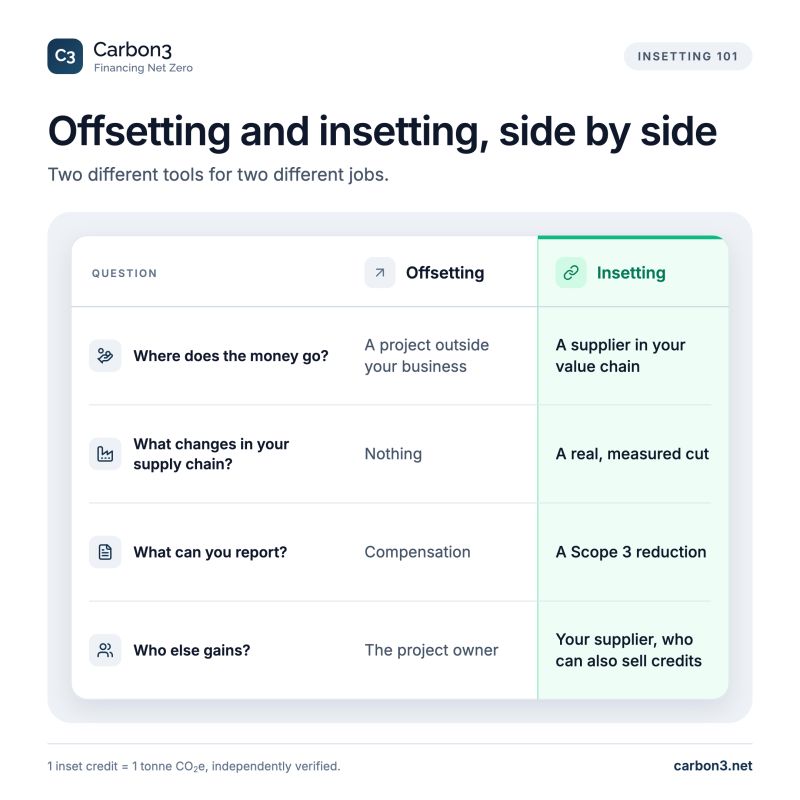
Insetting turns a sustainability expense into a supplier relationship
BASF and Boortmalt on barley emissions, Royal Canin and Soil Capital on 300,000 hectares of farmland, and ZEMBA on pooled buying power for low-emission shipping.
Read insight
DP World's Insetify: inset credits at commercial scale
Offering credits at no cost to customers is a deliberate market-building strategy. Create the buyer habit first; price discovery follows.
Read insight