Daiichi Sankyo and pharma's supply-chain footprint
4.16 million tCO2e in Scope 3 against roughly 114k in Scopes 1 and 2. The pattern repeats across the sector.

As Scope 3 disclosure expectations expand globally, pharmaceutical companies are increasingly confronting the scale of emissions embedded across their supply chains.
Recent sustainability disclosures from Daiichi Sankyo highlight how significant this challenge can be.
The company reports roughly 4.16 million tCO₂e in Scope 3 emissions for FY2024, compared with about 89k tCO₂e in Scope 1 and ~25k tCO₂e in Scope 2. In other words, the vast majority of the climate footprint sits across suppliers, materials, and product distribution rather than internal operations.
A similar pattern appears across the sector. For example, Chugai Pharmaceutical reports roughly 981k tCO₂e in Scope 3, again far exceeding operational emissions.
This structure reflects the reality of modern pharmaceutical production: complex global supply chains for active pharmaceutical ingredients (APIs), contract manufacturing, and specialized materials.
As disclosure frameworks expand, from TCFD-aligned reporting to evolving Scope 3 requirements in major markets, companies are under increasing pressure to demonstrate credible reductions across these value chains.
That raises an important strategic question for the industry: how suppliers, manufacturers, and partners collaborate to reduce emissions across shared production ecosystems.
How are pharmaceutical companies approaching supplier decarbonization across their global value chains today?
Daiichi Sankyo US Julie Gregory
Originally published on LinkedIn, 16 March 2026.
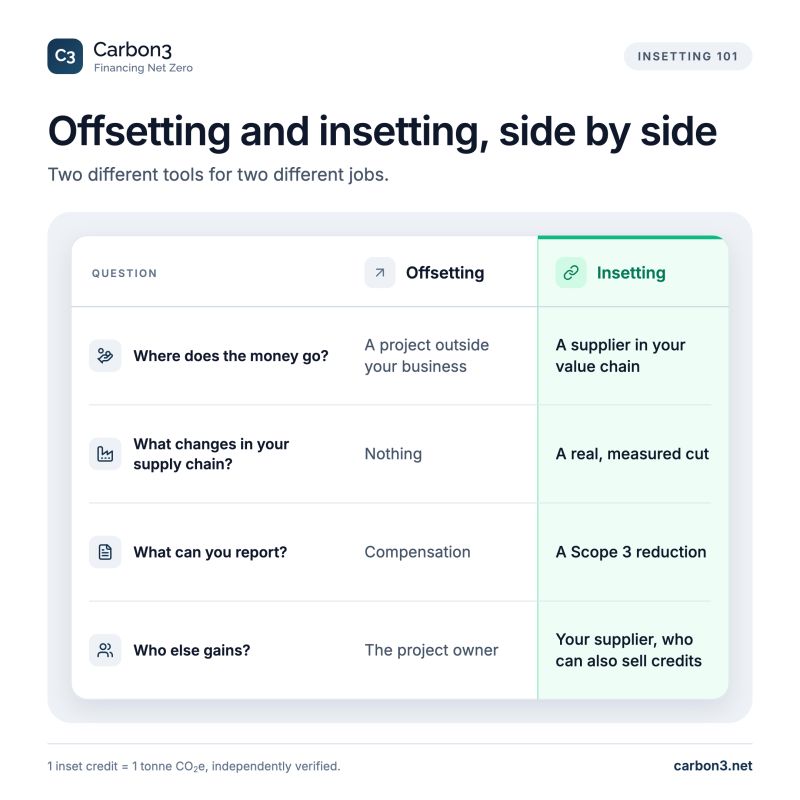
Insetting turns a sustainability expense into a supplier relationship
BASF and Boortmalt on barley emissions, Royal Canin and Soil Capital on 300,000 hectares of farmland, and ZEMBA on pooled buying power for low-emission shipping.
Read insight
DP World's Insetify: inset credits at commercial scale
Offering credits at no cost to customers is a deliberate market-building strategy. Create the buyer habit first; price discovery follows.
Read insight