Six opportunities for sustainable finance, and the gap beneath them
WRI's 2026 list is right about the institutional constraints. Underneath them sits a market-design problem: Scope 3 reductions remain an unpriced cost.
World Resources Institute set out six opportunities for sustainable finance in 2026. Commitments are still growing, but public climate finance is under pressure.
The goal is $1.3 trillion a year of international climate finance for emerging markets and developing countries by 2035. About half of those external flows is expected to come from private sources. That implies a large increase from current levels. Source (WRI): wri.org
WRI is right that the constraints are practical. Official development assistance has fallen, and blended finance is still too bespoke. Transition plans need credible instruments, but adaptation and nature remain underfunded. Cooperation is becoming more important. These are institutional problems, but there is also a market-design problem that sits underneath them.
Most corporate emissions sit in Scope 3. They are measurable, but also difficult to price, share, and fund. A supplier that invests in a cleaner process creates a reduction that buyers want to report. The cost usually stays with the supplier. The claim moves downstream. Offsets send capital outside the value chain. Bilateral insetting deals can work, but they are slow and rarely liquid.
Private finance will not scale sixteen-fold if the reduction created inside a real supply chain remains an unpriced cost. Public concessional capital cannot close that gap on its own. Buyers in steel, cement, aluminium, fertilisers, hydrogen, aviation, and shipping need a way to co-fund a supplier reduction and then evidence it without double counting. That is a custody and allocation problem as much as it is a capital problem.
Carbon3 builds market infrastructure for that step: verified Scope3 reductions issued as inset credits, allocated across supply-chain partners, traded with a full audit trail, and retired into reportable claims.
Originally published on LinkedIn, 27 August 2026.
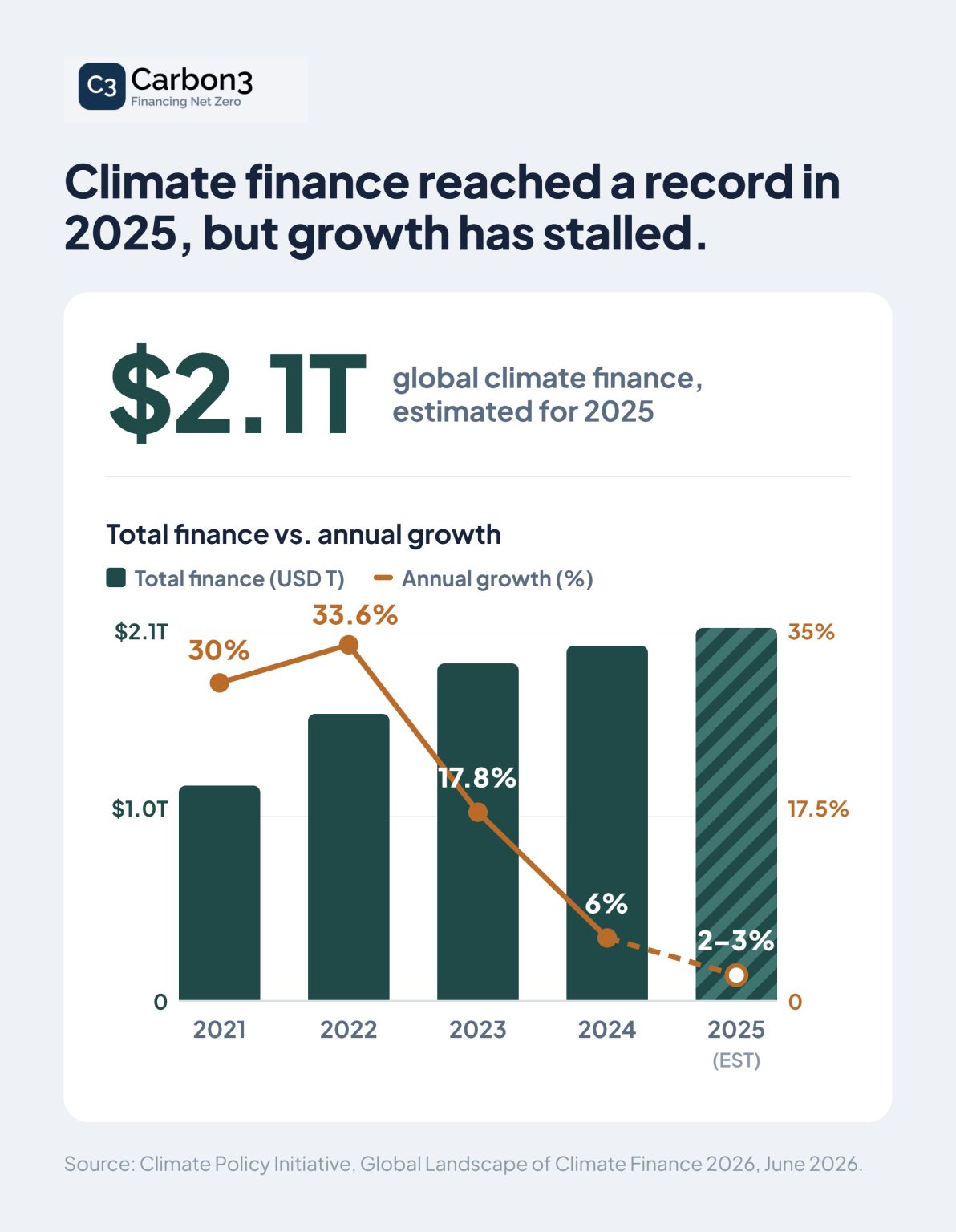
Global climate finance has crossed USD 2 trillion, but growth is slowing
Annual flows passed USD 2 trillion, while the growth rate fell from 30 percent in 2021 to an estimated 2 to 3 percent in 2025.
Read insight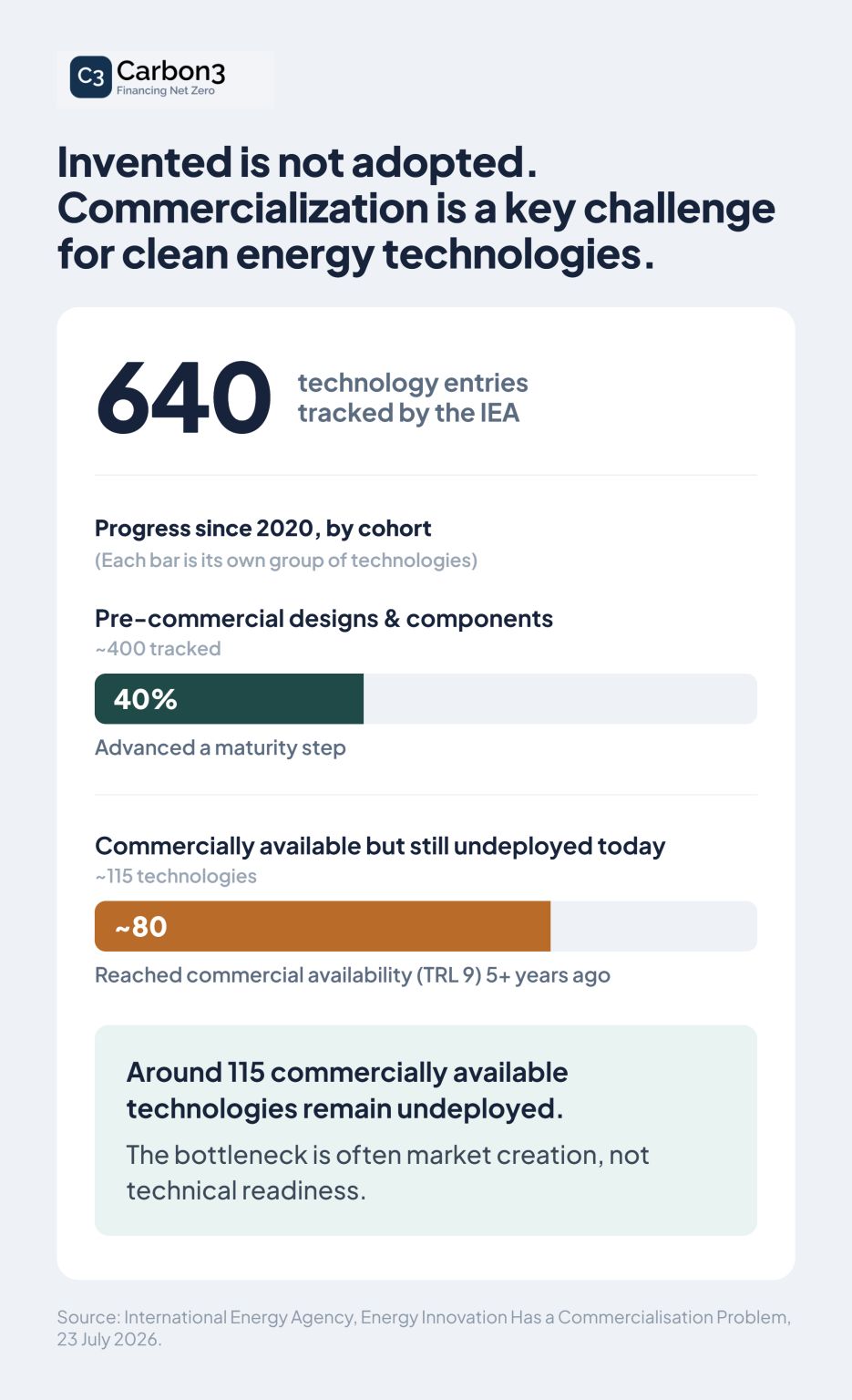
Around 115 clean-energy technologies are commercially ready and undeployed
The IEA counts nearly 80 that have been ready for more than five years. Closing the gap requires market creation, not better technology.
Read insight