The EU's Temporary Decarbonisation Fund has an inverted incentive
The Court of Auditors warns that retroactive, history-based payouts deliver weak steering power. The same flaw plagues most supplier programmes.
The EU’s Temporary Decarbonisation Fund aims to mitigate carbon leakage by recycling CBAM revenues into heavy industry. However, the European Court of Auditors (ECA) has cautioned that the fund’s conditions for support may not yield the intended climate impact.
To qualify for funding, companies must implement energy audits or climate neutrality plans. Yet, because the financial support is calculated against historical production and paid retroactively, the ECA warns that this poses a "risk to sound financial management." The incentive structure is inverted: companies are reimbursed long after operational decisions are made, drastically reducing the fund's steering power over new investments.
This structural critique is highly relevant to Scope 3 decarbonisation strategies. Reimbursing suppliers retroactively is an inefficient way to alter supply chain behavior. Instead, pricing the green premium at the point of transaction is required. Auditable insetting architectures address this by issuing verifiable units tied to strict additionality, ensuring that the financial incentive precedes the action and maps correctly to commercial flows.
Even with billions in recycled CBAM revenues flowing back to heavy industry, the fund’s retroactive, history-based payouts deliver weak steering power and limited real decarbonisation impact. The same inverted incentive plagues most corporate supply-chain programmes today: paying suppliers after the fact for past reductions rarely shifts future procurement behaviour or capex.
How C3 can help: by operating a verified insetting marketplace that prices the verifiable green premium at the point of transaction, issuing tradable, additionality-backed inset credits that suppliers can monetise upfront, buyers can embed in contracts, and both sides can allocate and report inside the Scope 3 boundary.
In short, C3 turns sustainability spend from an ex-post accounting exercise into a proactive, bankable commercial signal that actually drives new low-carbon investment while strengthening your CBAM resilience and ESG credibility. Early adoption here positions you ahead of both regulators and competitors who are still relying on blunt, backward-looking tools.
European Court of Auditors European Commission Publications Office of the European Union
ECA Opinion 13/2026 (Temporary Decarbonisation Fund): eca.europa.eu
EUR-Lex proposal PDF: eur-lex.europa.eu
Originally published on LinkedIn, 14 April 2026.
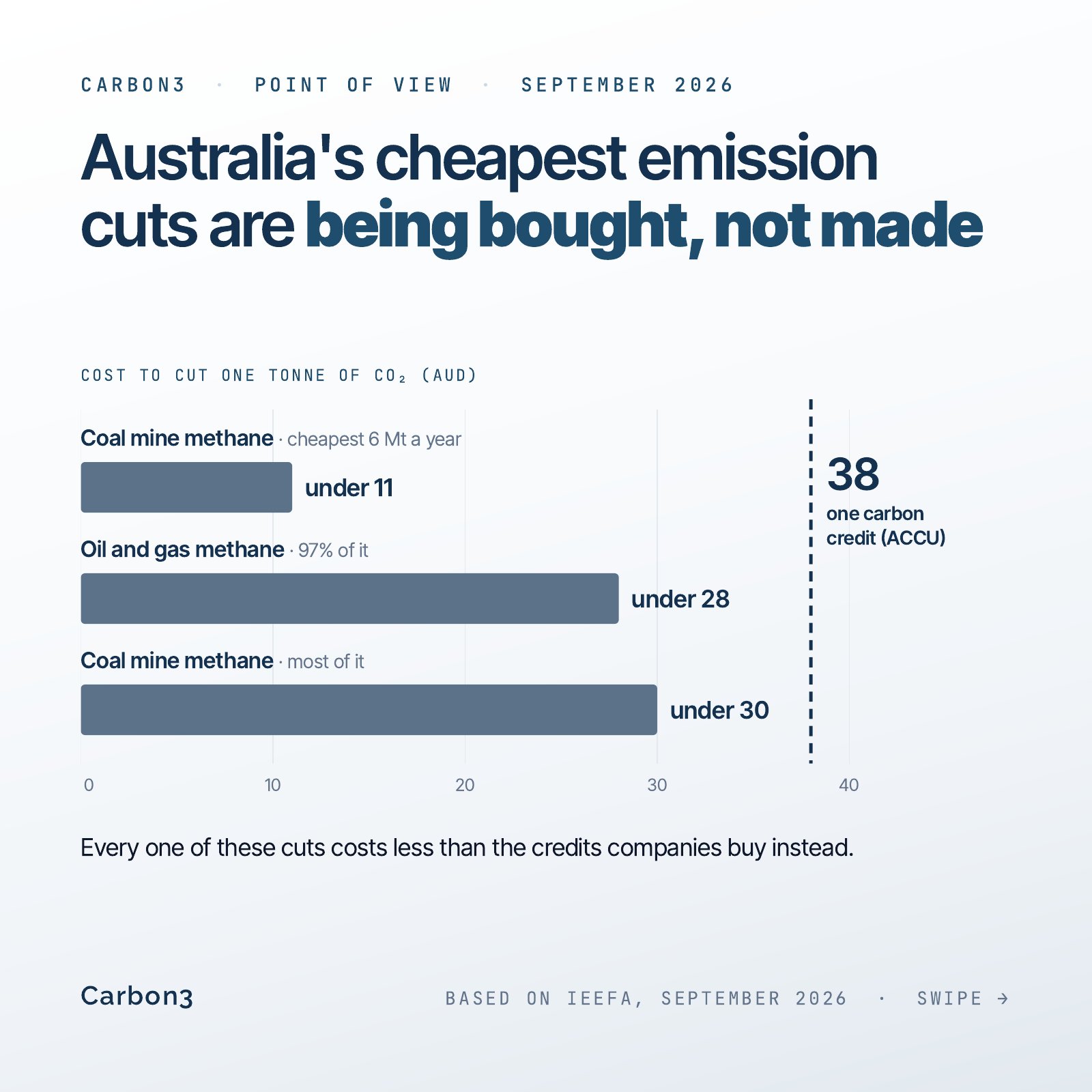
Australia's cheapest emission cuts are being bought, not made
IEEFA finds capturing methane from coal and gas would cost less than AUD 30 a tonne, well under the price of a carbon credit. Most facilities are not doing it.
Read insight
Three signals from the first week of September 2026
Amazon extends its inset marketplace to aviation fuel, a study brackets the carbon tax level that works, and Singapore signs a credit agreement with Laos.
Read insight