Woodside links sustainability to shareholder value
The competitive question is how credibly companies connect climate governance, operational delivery and capital allocation.

One of the more interesting signals from the energy sector this month is how explicitly some companies are now linking sustainability to business performance and shareholder value, rather than treating it as a parallel reporting exercise.
At Woodside Energy’s 2026 Sustainability Briefing, Acting CEO Liz Westcott said the company’s sustainability priorities “drive business performance and deliver value for shareholders,” and emphasized that performance is supported by governance and risk management at both Board and senior management levels. The briefing also framed responsible energy supply and sustainability as part of building a “resilient, profitable business” with long-term value creation at its core.
That framing matters. In a market shaped by policy volatility, capital discipline, and rising scrutiny from investors and customers, the competitive question is no longer whether sustainability sits inside strategy, it is how credibly companies can connect climate governance, operational delivery, and capital allocation.
For large energy producers, that increasingly extends beyond operational emissions into the wider value chain and customer-facing transition pathways.
How are energy companies integrating sustainability into core strategy while maintaining cost discipline and long-term resilience?
Woodside Energy Ines Melendez Ph.D.
Originally published on LinkedIn, 19 March 2026.
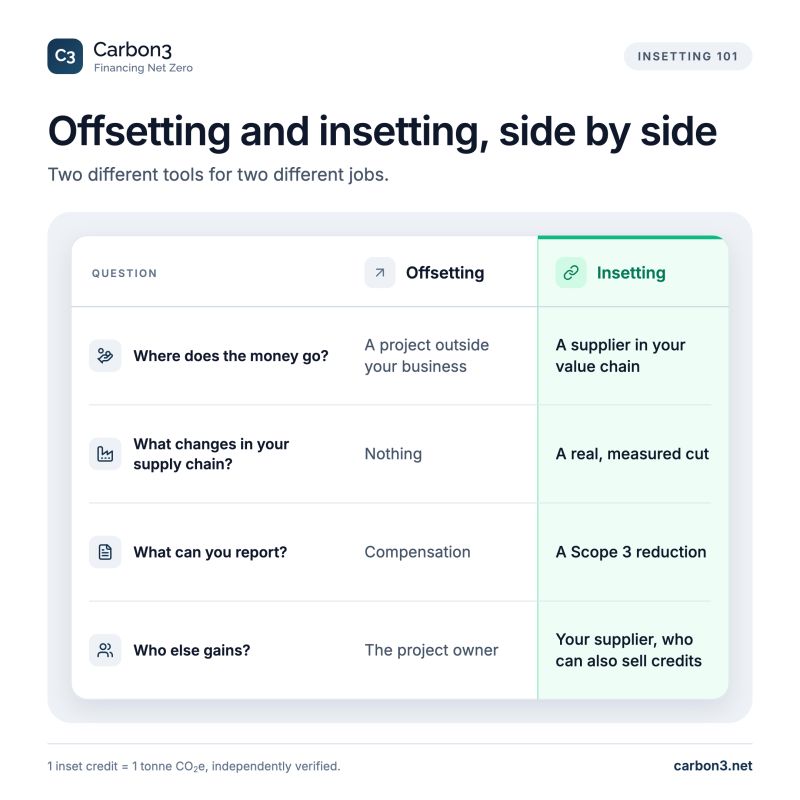
Insetting turns a sustainability expense into a supplier relationship
BASF and Boortmalt on barley emissions, Royal Canin and Soil Capital on 300,000 hectares of farmland, and ZEMBA on pooled buying power for low-emission shipping.
Read insight
DP World's Insetify: inset credits at commercial scale
Offering credits at no cost to customers is a deliberate market-building strategy. Create the buyer habit first; price discovery follows.
Read insight