Carbon markets 2026: flat on the surface, splitting underneath
Where the voluntary carbon market and corporate supply-chain climate action are heading, based on registry data, new standards and disclosed deals.
Where the voluntary carbon market and corporate supply-chain climate action are heading, based on registry data, new standards, and disclosed deals through July 2026.
In brief
The carbon market is neither booming nor dying. It has been flat for five years, and underneath that flat surface it is splitting in two: cheap, untraceable credits are losing value while high-quality, fully documented ones command rising prices. Companies have gone quiet about climate in public, yet more of them keep cutting supply-chain emissions, pushed now by their biggest customers rather than by regulators. The accounting rules landing between 2026 and 2028 favour instruments a company can trace and prove, and treat them as a supplement to real cuts, not a substitute. Value is moving to whoever can supply that proof.
Retirements have been flat for five years
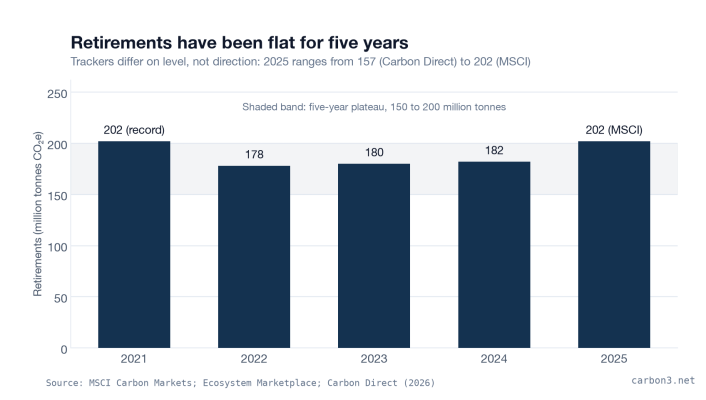
Retirements are the cleanest measure of real demand: the moment a company permanently uses a credit to back a climate claim. They have barely moved since 2021.
Retirements were 202 million tonnes in 2021 and 202 million tonnes in 2025 on MSCI’s count, with the years in between broadly stable. Other trackers put 2025 lower, at 157 to 174 million tonnes. Either way, the market has held roughly steady for five years. The value of that annual market has stuck near USD 1.4 billion for a fourth year running. The very large forecasts made early in the decade have now been wrong five years in a row.
Five years of flat retirements rule out both collapse and boom. A plan that assumes the overall market is about to expand is betting against the evidence. The safer assumption is reallocation inside a flat total, not broad growth across the market.
The average price no longer means anything
Underneath the flat total, prices have pulled apart. The gap between the cheapest and the most expensive credits is now enormous.
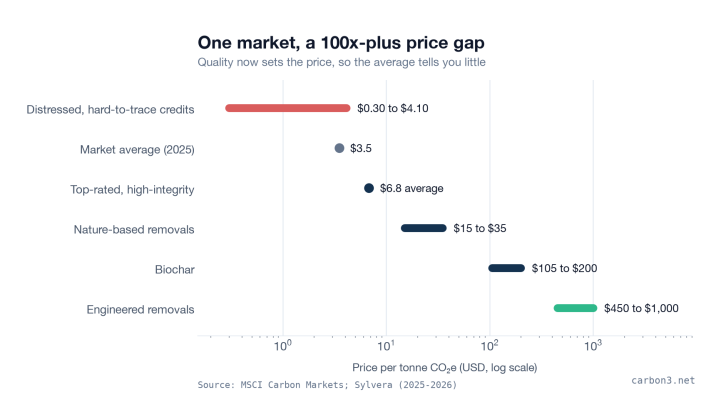
The MSCI price index fell to USD 3.5 per tonne in 2025, down from USD 4.3 the year before. The average conceals the real story. Cheap, hard-to-trace credits traded as low as USD 0.30 a tonne. Top-rated credits rose about 20 percent to average nearly USD 7. High-quality tree-and-soil (nature-based) removals sold for USD 15 to 35, biochar averaged USD 164, and machine-based (engineered) removals reached USD 450 to 1,000 at the top end. That is a gap of more than a hundredfold, and closer to a thousandfold at the extremes, inside what looks like a single market.
Buyers are not leaving. They are moving up to quality and paying for it. For a buyer, this means what you buy now matters more than when you buy it. For a seller, cheap and unproven credits are pricing toward scrap, and the only thing worth selling is quality a buyer can show an auditor.
Companies went quiet, but they did not stop
**Public climate talk has collapsed even as corporate action has climbed. **The retreat in talk is real. Mentions of sustainability on big-company earnings calls fell 76 percent in three years. The Net-Zero Banking Alliance shut down in October 2025 after most large US, Canadian, and Japanese banks walked out. The US securities regulator stopped defending its climate reporting rule in March 2025 and formally proposed rescinding it in May 2026. And Europe scaled back its own reporting law so far that roughly nine in ten previously covered companies no longer have to report, while large firms can no longer press their smaller suppliers for emissions data beyond a capped, simplified standard.
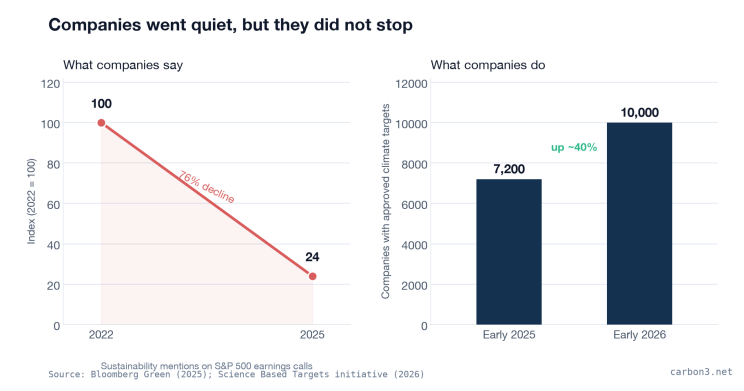
The action data moved the other way. The number of companies with approved science-based climate targets passed 10,000 in early 2026, up about 40 percent in a year, with a record 2,800 added in 2025 alone. More than 270 large buyers asked around 45,000 of their suppliers to report emissions. And companies are working with better data, leaning far less on rough spending-based estimates and more on figures collected from suppliers directly.
The two trends only look contradictory until you name the driver. **Companies now act on their supply-chain emissions less because a government tells them to, and more because their biggest customers require it. **When a Walmart or a Nestlé sets a supply-chain target, that target becomes a requirement for thousands of its suppliers, whatever any regulator does. It is a quieter pressure than a law, and a harder one to repeal, because no single government can lift it. So even as the rules ease off, the real pressure on suppliers keeps rising.
The new rules are picking a winner
The rules that decide what a climate claim is worth are being rewritten, in one direction.
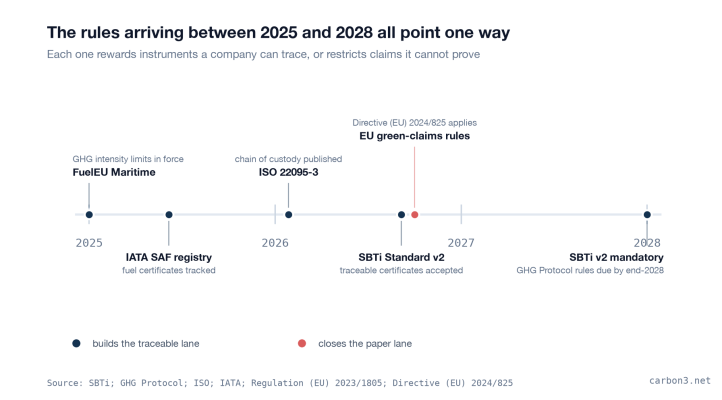
In June 2026 the Science Based Targets initiative, the body most large companies use to approve their goals, released a major new standard. It made two moves. First, it tightened supply-chain rules: any category above 5 percent of a company’s total supply-chain (Scope 3) emissions now needs its own reduction target. Second, for the first time, it allows documented, traceable certificates to be used for emissions a company cannot cut directly. But those certificates are a supplement to real reductions, never a replacement, and they are reported separately rather than subtracted from a company’s own emissions.
Originally published on LinkedIn, 25 July 2026.
Scope 3 isn't a reporting problem. It's a capital-allocation problem.
Why supply-chain decarbonisation stays unfunded, and what kind of fix it actually needs.
Read insight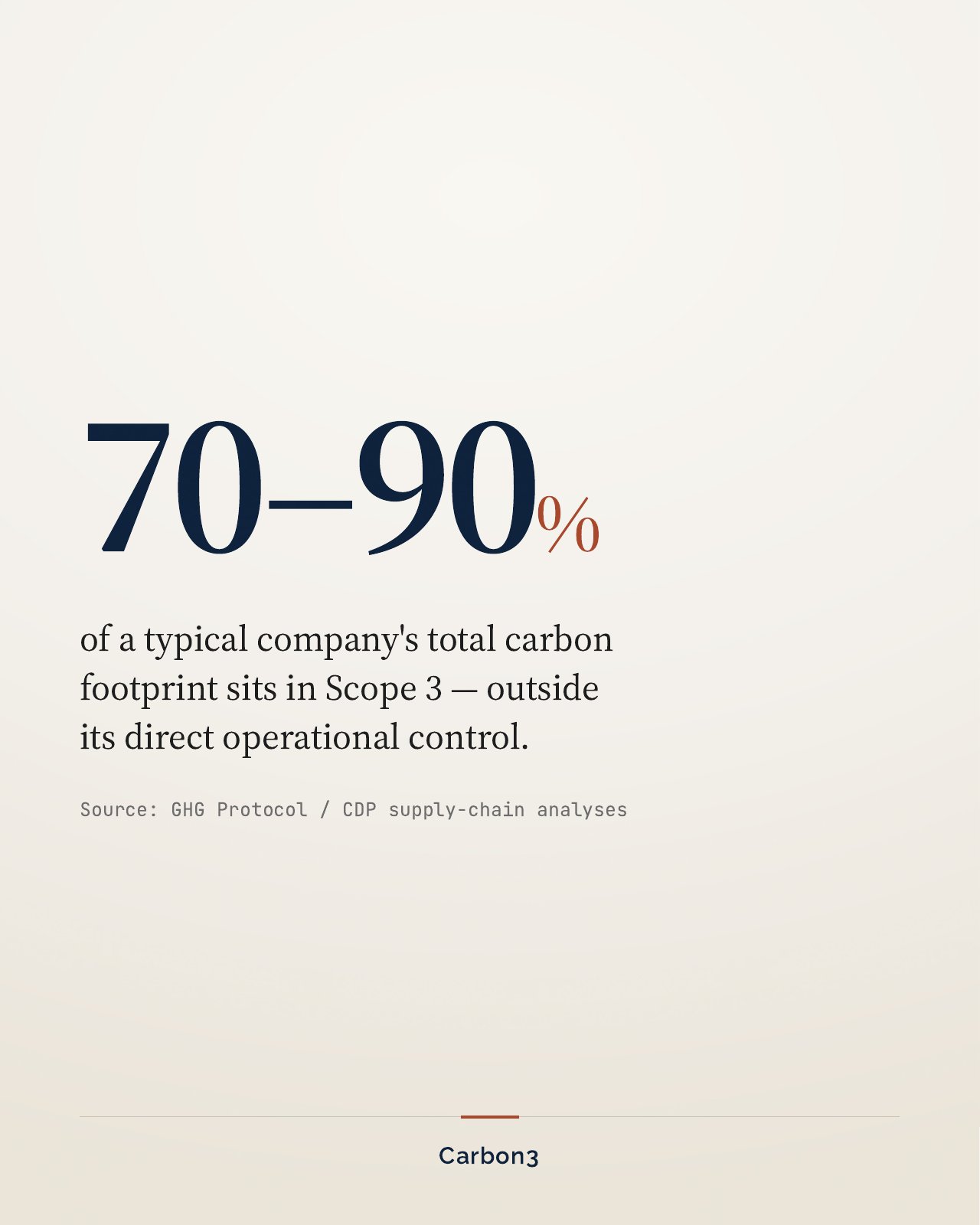
Three numbers behind the insetting paradox
Most emissions sit in Scope 3, funding a supplier's cut recovers nothing today, and one inset credit changes that.
Read insight