CBAM is an investment signal for Korean steel's customers
USD 7.7bn of Korean exports will sit under CBAM from 2028. The gap between directional demand and bankable contracts is what insetting closes.
CBAM is usually described as a cost for Korean steel. The more interesting reading is that it is an investment signal for Korean steel's customers.
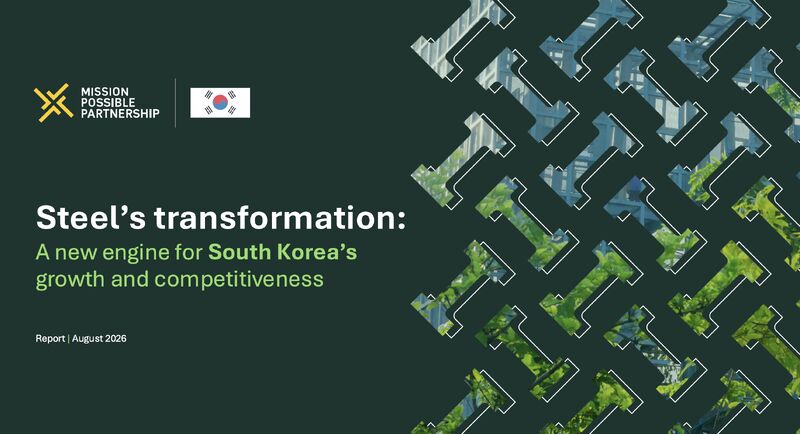
Mission impossible Possible Partnership's latest report on South Korea puts numbers on the pressure: around $7.7bn of Korean exports will sit under the EU CBAM once coverage extends to vehicles and machinery from 2028.
The report's core finding, though, is about demand. Korea can build any clean steel route, but appears just once in the global green steel offtake tracker, a 200-tonne trial delivery. Compare Stegra, the first commercial-scale green steel project to reach financial close, which had locked binding offtake for roughly 60% of capacity with buyers including Mercedes-Benz AG, BMW Group, Volvo Group and IKEA before financing was decided.
Every tonne of CO₂ removed from Korean steelmaking reduces the CBAM bill of the European company importing that steel, at a projected EUR 145/tCO₂ in 2030. The same tonne also reduces that importer's Scope 3 inventory. One physical reduction, two returns: a regulatory saving and a verified emissions claim. That gives importers a direct financial reason to co-fund decarbonization upstream in Korea, through long-term offtake, forward purchases, or capital participation in new production routes. German automakers are already doing exactly this with hydrogen-based steel projects in China. The same inbound capital could flow to Korea; what is missing is the market infrastructure to structure it.
The report counts 1.4 Mt of Korean clean steel demand tied to Scope 3 targets and calls it "directional, but not bankable." That gap between intent and contract is precisely what insetting is built to close. Carbon3 provides the infrastructure that lets a buyer co-fund verified emission reductions inside its own value chain and receive auditable inset credits in return, with attribution kept consistent from furnace to final declaration and no double counting. This is not offsetting: the investment lands in the buyer's own supply chain, and the physical low-carbon steel still has to flow.
Carbon-conditioned trade will keep expanding through the 2030s. The countries that convert that pressure into inbound investment, rather than treating it as a tax, will set the terms. Visit Carbon3 to learn more and pilot your projects with us https://carbon3.net/
Report and image source: missionpossiblepartnership.org
Originally published on LinkedIn, 16 August 2026.
The cost of delayed action in the steel sector
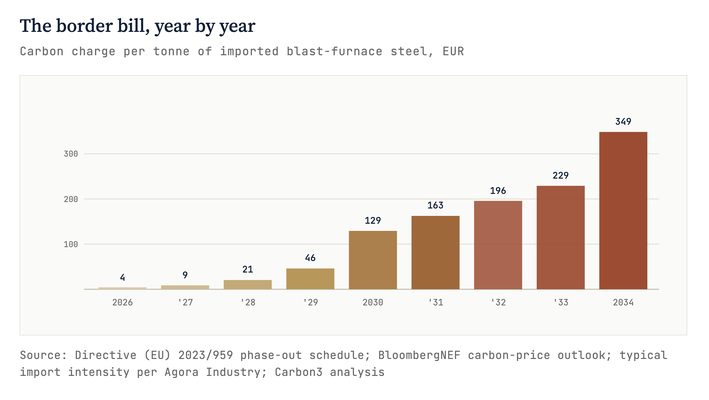
Europe's carbon border charge phases in slowly at first, then steeply. The next three years look cheap; the four after that are a cliff.
Read insight
The cost case against green steel is eroding
CBAM is pushing the carbon cost on conventional steel toward the green premium. Price convergence still does not build capacity.
Read insight