The cost of delayed action in the steel sector
Europe's carbon border charge phases in slowly at first, then steeply. The next three years look cheap; the four after that are a cliff.
Europe's carbon border charge phases in slowly at first, then steeply. The next three years look cheap, but the four after that are a cliff. Based on C3's 2026 steel research: what waiting costs a buyer, a mill, and the entire steel sector.
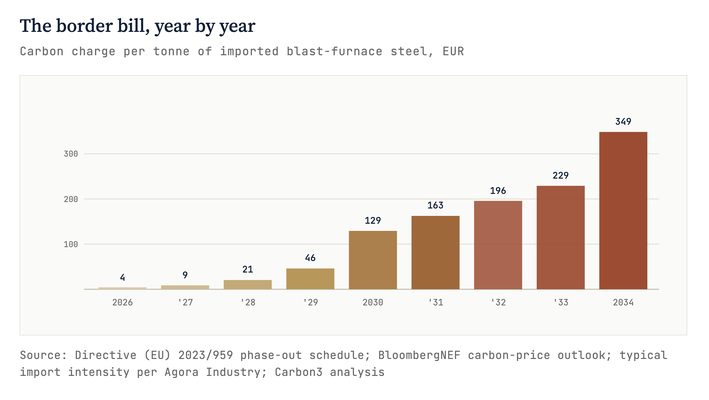
The charge starts small and rises steeply
Since January 2026, steel crossing into the EU pays a carbon border charge, and EU mills are losing their free emission allowances on the same schedule. The phase-in is not a straight line. It creeps for three years, then jumps: by 2030 nearly half of embedded carbon is charged, by 2034 all of it.
Priced out for a typical imported tonne of blast-furnace steel, under today's law and a rising carbon-price path, the bill grows about eighty-fold in eight years. That is a model output, not an invoice, and it moves with both assumptions. The early steps invite delay. The late steps punish it.
Two things could soften the top of the staircase. In July 2026 the Commission proposed slowing the phase-out: keeping 15% of free allocation through 2037 and reaching zero only in 2038. It is a proposal, not law, and it would flatten the late steps without removing them. And for many importers the more immediate bill is not carbon at all: since July 2026 a new steel trade regime caps duty-free imports at 18.3 million tonnes a year and charges a 50% duty above the quota, which dominates the border charge until about 2028.
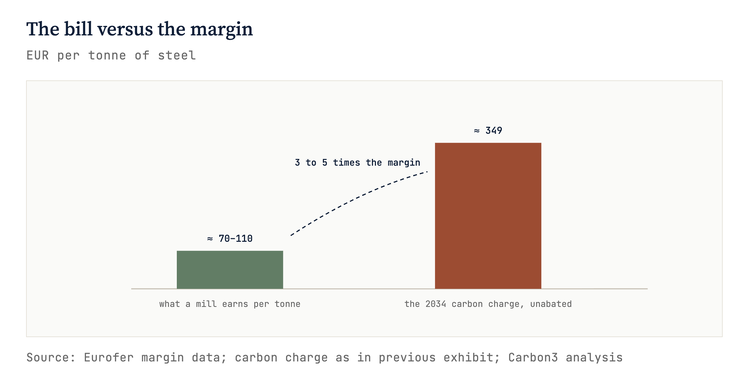
By the mid-thirties, the carbon bill on unabated steel is worth several times a mill's whole margin
Steelmaking margins are thin. A European mill earns somewhere around a hundred euros per tonne across the cycle. The carbon charge on unabated blast-furnace steel passes that level around 2030 and keeps climbing. A mill running on scrap or hydrogen never sees that bill: the comparison is the worst route against a typical margin. For that route, carbon stops being a line item and becomes the margin.
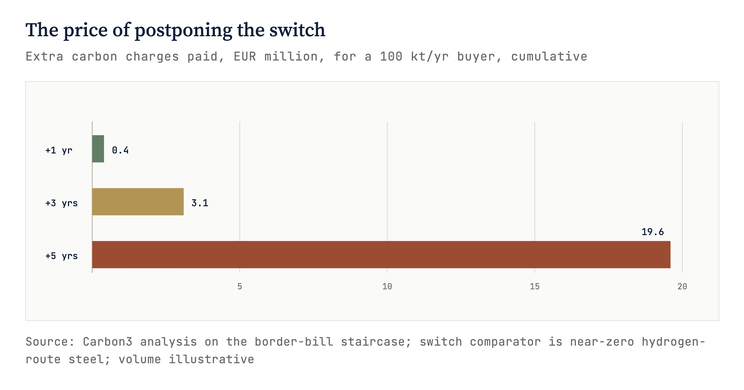
Waiting five years costs far more than five times waiting one
Picture a buyer importing a hundred thousand tonnes a year into the EU, deciding when to switch to near-zero steel. Green steel pays almost no border charge, so every year of staying on conventional supply adds that year's bill. Because of the staircase, the bills are not equal years. The fifth year of waiting crosses the big step.
Green steel carries a real premium today, and the delay figures above leave it out and apply no discounting. The border charge crosses into that premium's range in the early thirties. Carbon3's reference deal structure returns most of the premium to the buyer as a verified Scope 3 asset; that is a Carbon3 structure, not a market price. Waiting for the crossover only works if near-zero tonnes are still on the shelf.
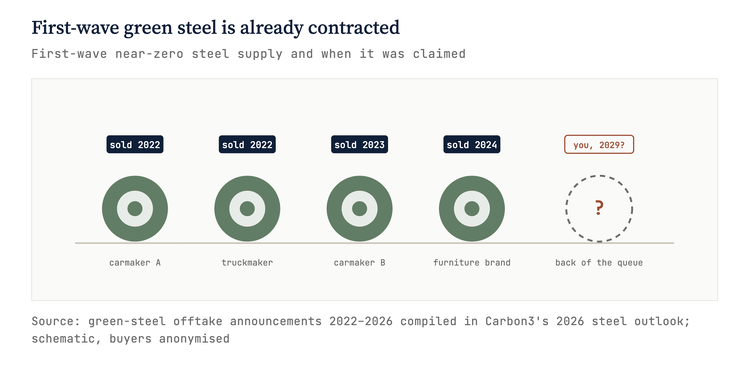
First-wave near-zero steel is sold out years ahead
The first wave of near-zero primary steel plants is small, and carmakers locked in most of it years before production started. Meanwhile part of the supply pipeline has slipped or been shelved. Fewer near-zero tonnes this decade, longer queues, and a stronger seller's market for that product. This is not the whole green-steel market: scrap-based electric steel is the lower-carbon tonne most buyers can actually get this decade. The scarce product is the near-zero primary steel the switch comparator assumes.
Furnace renewals lock in emissions for decades
The deepest cost of waiting is not a bill. It is lock-in. A large share of the world's blast furnaces reach their once-in-decades renewal point before 2030, and a relined furnace typically runs another fifteen to twenty-five years. Each renewal is a fork: rebuild conventional and run high-carbon into the 2040s or 2050s, or convert to a near-zero route. Miss the fork, and the next chance is a generation away.
Every year the industry defaults down the conventional path, it risks locking in up to roughly two billion tonnes of future CO₂: close to a full year of the entire global steel industry's emissions. That is an upper bound. It assumes a full campaign with no later retrofit, and renewals are rarely a clean either-or. Even a fraction of it is a decade of avoidable emissions.
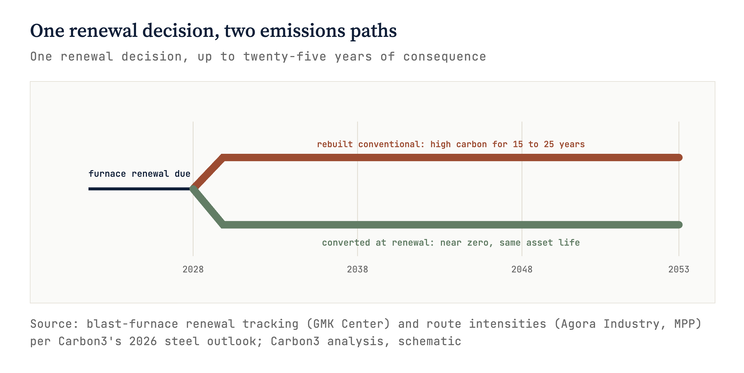
Ember showed that delaying shared power grids compounds through infrastructure lock-in. Steel is the same physics with a narrower window: the furnace renewal wave passes once this decade.
What early action looks like
For steel buyers: Contract green offtake and inset positions now, while the premium is recoverable as a verified Scope 3 asset. Waiting for the border charge to cross the premium means paying the staircase and then queuing behind the first movers.
For steelmakers at the renewal fork: Every furnace renewal this decade is a carbon commitment of fifteen to twenty-five years. Inset pre-financing turns conversion from sunk capital into a credit-issuing asset: the financing bridge the shelved projects said was missing.
**For importers into the EU: **Verified real emissions beat default values at the border, and one verified dataset can serve the border filing and the inset claim at once, cutting duplicated reporting cost.
Carbon3's role: price the abatement, retire it against named buyers, and reuse the same verified data at the border. One measurement, three uses. The staircase climbs either way. Insetting decides whether the money lands as cost or as asset. C3 is a marketplace for value-chain carbon insetting & converting verified Scope 3 reductions into financial assets.
Methodology & sources
Border bill per tonne = embedded emissions (typical blast-furnace import, ~2.05 tCO₂/t, Agora Industry) × EU carbon price (BloombergNEF base case, held flat between published years, conservative) × the legislated phase-in share (Directive (EU) 2023/959: 2.5% in 2026 rising to 100% in 2034).
*Margin comparison: Eurofer through-cycle EU mill EBITDA of about EUR 70–110/t. *
*Delay costs: cumulative difference between conventional (~2.05) and near-zero hydrogen-route steel (~0.13 tCO₂/t, Stegra-class) for an illustrative 100 kt/yr buyer; excludes the green premium, which insetting partly returns (the 2026 Outlook's reference deal recovers most of it at USD 145 per tonne of CO₂). *
*Furnace lock-in: ~240 Mt/yr of capacity reaching renewal 2026–2030 (GMK Center), spread evenly, × the intensity gap × a 25-year campaign life; campaigns more often run 15–20 years, so the 2.2 Gt is an upper bound. *
*Policy sensitivity: the Commission's 17 July 2026 ETS review proposal (COM(2026) 616) would keep 59% free allocation in 2030 and 15% through 2037, reaching zero in 2038; it is under legislative procedure and the Directive (EU) 2023/959 schedule remains law. *
*On the Reuters July 2026 analyst poll path (EUR 80/89/95/100/109 for 2026–2030) the five-year-versus-one-year ratio is roughly 46×, not 48×. *
*The new steel trade regime is Regulation (EU) 2026/1384 (18.3 Mt duty-free quota, 50% out-of-quota duty, in force 1 July 2026). *
*Caveats: the border charge here is stylised (intensity × price × phase-in share); an actual CBAM filing nets off the EU benchmark, marks up unverified default values and deducts carbon prices paid at origin, so verified low-intensity mills pay less and default filers can pay more. *
*No discounting is applied to cumulative delay costs. The margin chart compares the unabated blast-furnace route with a typical mill margin; scrap and hydrogen routes do not face that charge. *
Full citations in the companion research note "The Cost of Waiting: Steel" and Carbon3's Decarbonizing Steel with C3, 2026 Outlook.
Originally published on LinkedIn, 6 September 2026.
CBAM is an investment signal for Korean steel's customers
USD 7.7bn of Korean exports will sit under CBAM from 2028. The gap between directional demand and bankable contracts is what insetting closes.
Read insight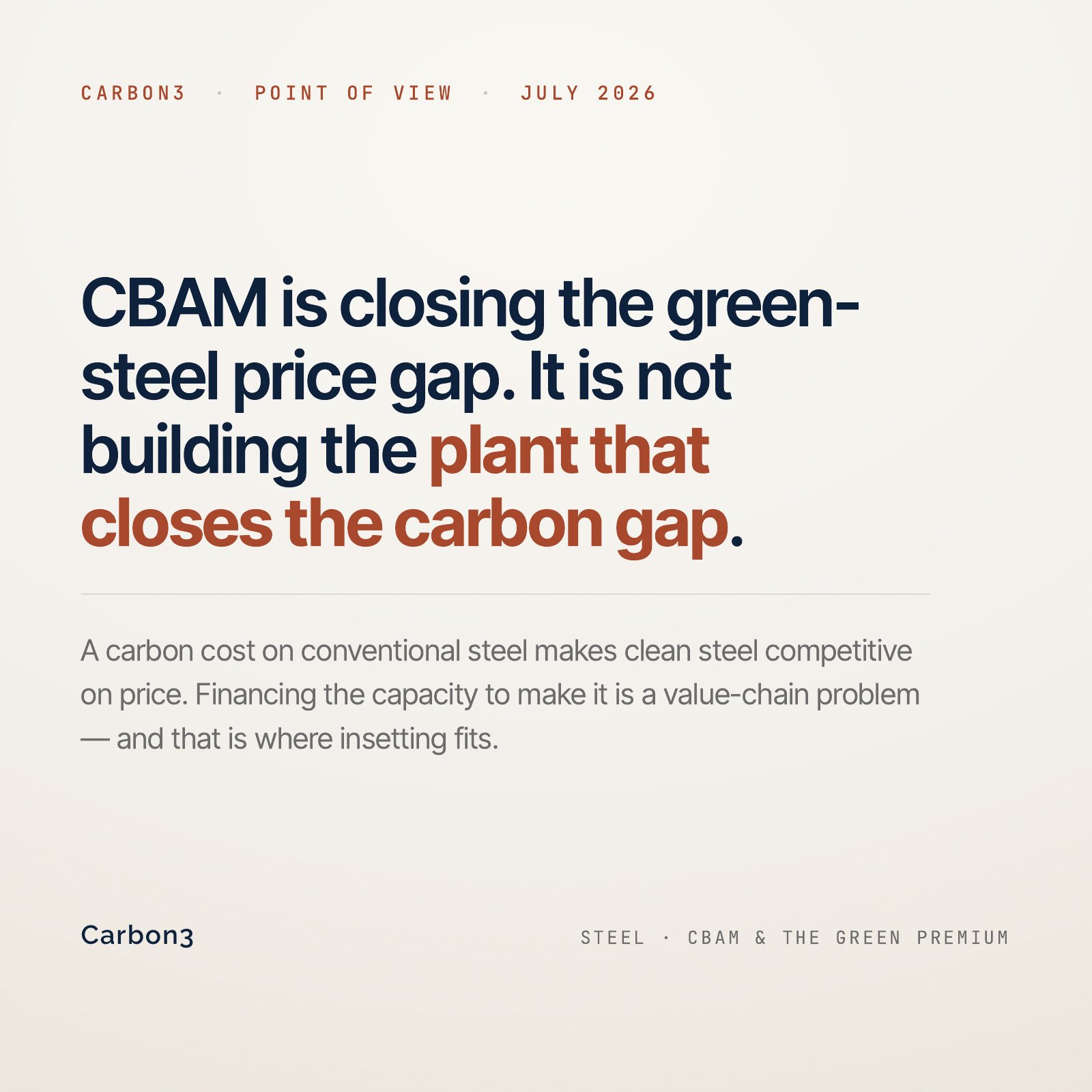
The cost case against green steel is eroding
CBAM is pushing the carbon cost on conventional steel toward the green premium. Price convergence still does not build capacity.
Read insight