The carbon insetting paradox
Decoupled versus coupled finance, Scope 3 accountability, and the shift from sunk cost to recoverable value.
Why the next decade of corporate climate action belongs to the value chain
A C-suite briefing on three paradoxes reshaping how companies finance decarbonisation, decoupled vs. coupled finance, Scope 3 accountability, and the shift from sunk cost to recoverable value.
Executive summary
Corporate climate action has spent a decade leaning on carbon offsets, a mechanism that, by design, sends money out of the value chain to projects somewhere else. That architecture is now under strain. Regulators, auditors, customers and investors are asking the same uncomfortable question: if you are financing emissions reductions you cannot attribute, influence, or verify, what exactly are you buying?
Insetting answers that question by inverting the geography of finance. Instead of paying an unrelated third party to reduce emissions, a company finances verified reductions within its own supply chain, receives credit for those reductions on its Scope 3 footprint, and, when structured as a market instrument, can price, allocate, and trade them as an asset rather than an expense.
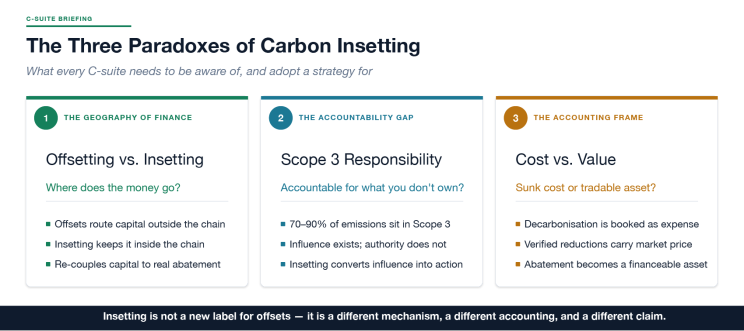
This briefing frames three paradoxes that every C-suite will have to resolve in the next planning cycle:
-
Offsetting vs. Insetting: a paradox about where the money goes.
-
Scope 3 accountability: a paradox about responsibility without direct control.
-
Cost vs. Value: a paradox about how decarbonisation is booked on the balance sheet.
The argument is simple: the old model treated climate action as a spend category. The next model treats it as market infrastructure.
The Three Paradoxes
1. Offsetting vs. Insetting: the geography of finance
If the emissions are in your supply chain, why is the money leaving it?
For twenty years, the default corporate response to a residual footprint has been to buy offsets, verified tonnes from afforestation, cookstove, or renewable energy projects in jurisdictions and sectors unrelated to the buyer. The mechanism was practical when verification infrastructure didn’t exist inside value chains. Today it produces a structural contradiction:
-
Finance leaves the value chain that generates the emissions.
-
Suppliers who could actually abate receive nothing.
-
Claims rest on market trust that has repeatedly been challenged.
Insetting re-couples capital to abatement. The same dollar that would have purchased an external offset is instead deployed to a direct supplier, a farmer, a fuel producer, a logistics operator, a manufacturer, who delivers a verified reduction measured against a clear baseline. The corporate buyer receives an inset credit representing that reduction and applies it to its own Scope 3 disclosure.
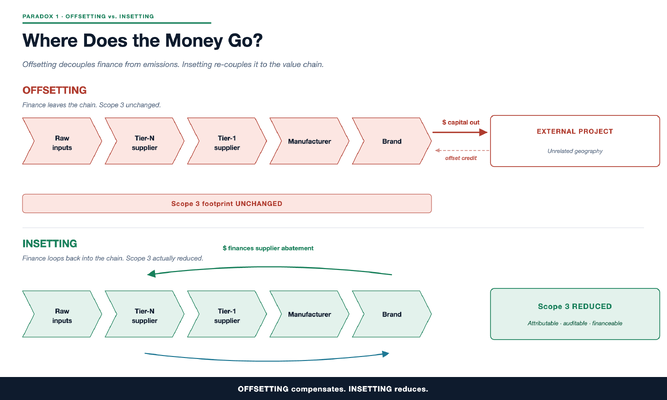
Insetting is not a rebrand of offsetting. It is a different mechanism, a different accounting frame, and a different claim. The integrity of the claim is anchored in attribution, the reduction happened in your supply chain, financed by your capital, measured against your baseline.
2. The Scope 3 accountability paradox: responsibility without control
Companies are increasingly held responsible for emissions they do not directly own, and given few tools to act on them.
The GHG Protocol separates emissions into three buckets. Scope 1 covers direct combustion. Scope 2 covers purchased electricity. Scope 3 covers the rest, upstream suppliers, downstream use, transport, packaging, capital goods, and so on. For most industries Scope 3 accounts for between 70% and 90% of total emissions, and for some (consumer goods, finance, software) it is effectively the whole footprint.
Under the Science Based Targets initiative’s Corporate Net-Zero Standard, Scope 3 is in scope of validated targets. Under the EU Corporate Sustainability Reporting Directive (CSRD), under the ISSB IFRS S2 standard, and under emerging disclosure rules in the US, UK, Singapore and Japan, Scope 3 is increasingly in scope of mandatory, audited disclosure.
The paradox is structural. A consumer goods company is asked to report, and reduce, emissions from farms it does not own, freight carriers it does not operate, and retailers it does not control. Influence exists; direct authority does not.
Insetting is the mechanism that converts influence into action. By financing verified abatement inside the value chain, a corporate buyer:
-
Transfers capital to the actor who can actually change the emissions profile.
-
Obtains a defensible, attributable reduction it can disclose against Scope 3.
-
Builds a commercial relationship with suppliers tied to measurable climate performance, rather than a compliance questionnaire.
What was an accountability gap becomes a procurement lever.
3. The Cost vs. Value paradox: decarbonisation as asset, not expense
If emissions reductions are permanent improvements, why do we book the spend as permanent cost?
Ask most CFOs how carbon sits on their books today and the honest answer is: expense, gone, unrecoverable. The company spends on an offset portfolio or a supplier capex programme; the money leaves; the reduction is reported; the line item is closed. There is no counter-asset, no market price, no recoverable value, and therefore no structural incentive to spend more.
Insetting, when combined with a market mechanism, changes the accounting frame. A verified reduction is a standardised unit, one tonne of CO₂e, with a defined baseline, an independent verification, and an audit trail. That unit can be:
-
Priced. Market-discovered, not negotiated bilaterally in the dark.
-
Allocated. Matched to specific buyers in the value chain who can claim it.
-
Traded. Between value-chain counterparties, creating liquidity.
-
Reported. Aligned to GHG Protocol and SBTi accounting requirements.
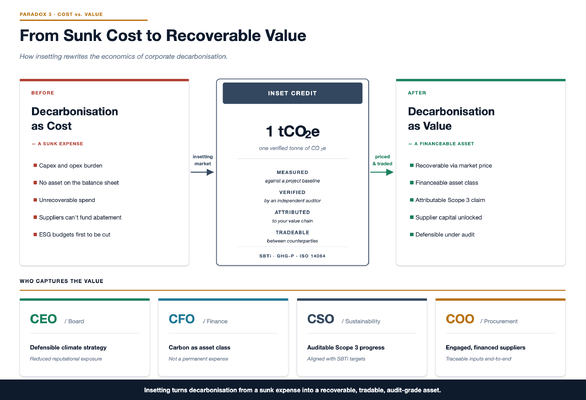
The economic consequence matters. When decarbonisation spend is recoverable, through credit revenue, through premium pricing, through green-financing terms, supplier capital for abatement becomes fundable, and the pace of Scope 3 reduction moves from “what the sustainability budget allows” to “what the market will bear”.
What this means for the C-suite
Insetting is not a sustainability sub-topic. It reshapes decisions that sit on four different desks at once.
For the CEO and Board
The strategic question is no longer “do we have a net-zero target?”, almost every large company does. The question is “is the path to that target defensible under disclosure, assurance, and stakeholder scrutiny?” Offsetting-heavy pathways are demonstrably less defensible than they were five years ago. Insetting positions the company’s climate narrative where it is hardest to attack: inside its own operations and supplier relationships. It also re-anchors climate in procurement and supplier strategy, which is a board-level topic anyway.
For the CFO and Finance
Three implications matter. First, the cost of capital is increasingly sensitive to disclosure quality; defensible Scope 3 progress lowers green-finance and transition-finance risk premia. Second, insetting converts climate spend from pure expense toward asset-like treatment, a verified credit has price, tradeability, and audit trail. Third, the emerging regulatory landscape (CSRD, IFRS S2, SEC climate rule where it lands, SGX-style disclosure) makes unattributable offset reliance a latent restatement and litigation risk. The CFO’s job is to make sure the company is on the right side of that shift before auditors price it in.
For the Chief Sustainability Officer
Insetting is the mechanism that makes SBTi Scope 3 targets actually achievable rather than aspirational. It aligns with the GHG Protocol Scope 3 Standard and the SBTi Corporate Net-Zero Standard (including FLAG guidance for land-sector value chains). It fits inside existing MRV discipline rather than replacing it. And it provides something the CSO has rarely had: a mechanism to move capital into the parts of the value chain where the emissions actually live, on terms the finance team will respect.
For the COO and Chief Procurement Officer
Insetting turns decarbonisation into a procurement instrument. Suppliers who can demonstrate verified abatement earn credit revenue; suppliers who cannot do not. That changes the supplier scorecard. It also funds supplier capex for transition projects, fuel switching, electrification, regenerative practices, low-carbon materials, that the supplier could not finance alone. The result is a more engaged, more differentiated, more traceable supplier base, with climate performance embedded in commercial terms rather than sustainability questionnaires.
Closing
Every energy transition, every industrial transformation, every financial reform has faced the same question: does the money flow to the place where the change actually has to happen, or somewhere more convenient?
For corporate decarbonisation, the honest answer for the last decade has often been “somewhere more convenient.” Insetting is the architecture that routes capital to where the emissions actually live, inside the value chain, with the supplier who can abate, on terms the finance function can defend. The next decade of corporate climate action will be judged less by the height of the target and more by the direction of the capital.
Smart climate strategy is less about buying reductions, and more about financing the ones that are yours to make.
Authored by Carbon3 Global Pte. Ltd. (C3), Singapore-based market infrastructure for supply-chain decarbonisation. Carbon3 enables companies to issue, price, allocate, and trade verified Scope 3 inset credits aligned to SBTi, GHG Protocol, and ISO 14064. Web: carbon3.net · LinkedIn: linkedin.com/company/c3org · Contact: carbon3.net/contact. This article is for information and discussion only; it is not investment, legal, accounting, or regulatory advice.
Originally published on LinkedIn, 19 April 2026.
Six opportunities for sustainable finance, and the gap beneath them
WRI's 2026 list is right about the institutional constraints. Underneath them sits a market-design problem: Scope 3 reductions remain an unpriced cost.
Read insight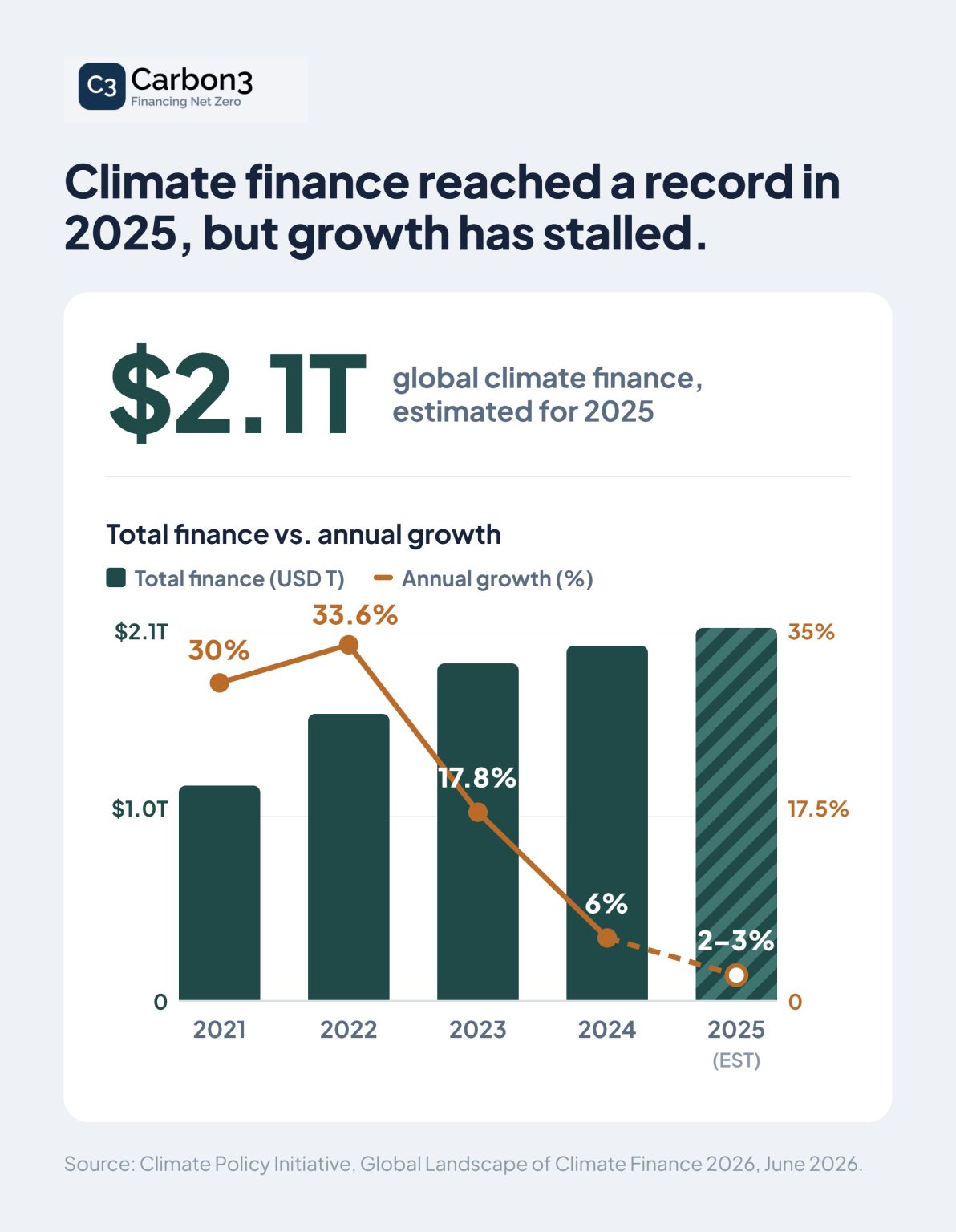
Global climate finance has crossed USD 2 trillion, but growth is slowing
Annual flows passed USD 2 trillion, while the growth rate fell from 30 percent in 2021 to an estimated 2 to 3 percent in 2025.
Read insight