Published · Carbon3
What CBAM does
The Carbon Border Adjustment Mechanism puts a carbon price on certain goods imported into the EU, equal to the price EU producers pay under the EU Emissions Trading System (EU ETS). It covers cement, iron and steel, aluminum, fertilizers, hydrogen and electricity, and some of their precursors and downstream products.
- Authorized CBAM declarants report the embedded emissions of the goods they imported in the previous year and surrender one CBAM certificate per tonne of CO₂e.
- Importers below 50 tonnes of covered goods a year are exempt. The threshold does not apply to hydrogen or electricity.
- Embedded emissions should be based on actual data from the producing installation, checked by an accredited verifier. Where actual data is missing, default values apply.
- A carbon price effectively paid in the country of production can be deducted.
- Certificates for 2026 imports are priced at the quarterly average of EU ETS auction prices, and from 2027 at the weekly average.
| Year | Share of embedded emissions priced through CBAM |
|---|---|
| 2026 | 2.5% |
| 2027 | 5% |
| 2028 | 10% |
| 2029 | 22.5% |
| 2030 | 48.5% |
| 2031 | 61% |
| 2032 | 73.5% |
| 2033 | 86% |
| 2034 | 100% |
Why CBAM matters for Scope 3
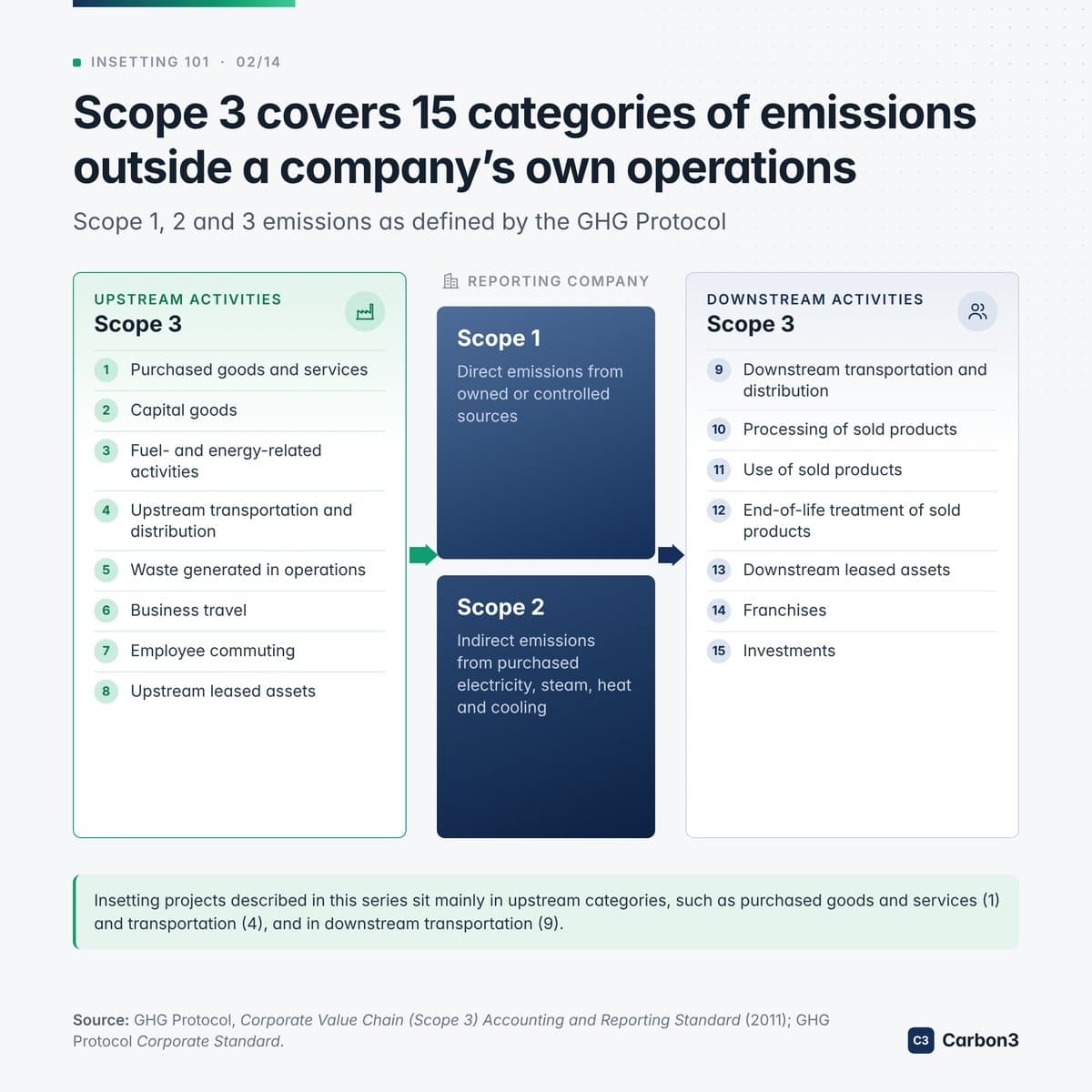
For the company that buys imported steel, aluminum or cement, the embedded emissions of those goods are Scope 3 emissions, under Category 1, purchased goods and services, or Category 2, capital goods. CBAM obliges importers to collect independently verified, installation-level emissions data for those same goods.
That makes CBAM a source of primary supplier data. A buyer that has relied on industry-average emission factors for purchased metals can ask for the embedded-emissions figures its suppliers already report, and use them to calculate and track its Scope 3 emissions.
Key dates
| Date | Step |
|---|---|
| 1 January 2026 | Definitive period starts; imports above the threshold require authorized declarant status |
| 1 February 2027 | Sale of CBAM certificates begins, including certificates for 2026 imports |
| 30 September 2027 | First annual CBAM declaration and surrender of certificates for 2026 imports |
| From 2027 | Declarants hold certificates covering at least 50% of embedded emissions at the end of each quarter |
How this connects to insetting on Carbon3
Inset credits do not reduce a CBAM obligation, and CBAM certificates are not carbon credits. What links them is the physical change: a steel, cement or aluminum producer that lowers the emissions of its process lowers the embedded emissions its customers import and report.
Insetting gives downstream buyers a way to co-fund that change. On Carbon3, a producer can register the project, an independent verifier confirms the emissions reductions, and inset credits are issued to the producer, as project developer, and allocated to the buyers who funded it. See steel and cement, chemicals and Insetting 101.
Questions
Can carbon credits be used to reduce CBAM payments?
No. CBAM is settled with CBAM certificates priced on the EU ETS, after deducting any carbon price effectively paid where the goods were made. Voluntary carbon credits and inset credits play no part.
Which Scope 3 categories are affected by CBAM goods?
Mostly Category 1, purchased goods and services, and Category 2, capital goods, for the company that buys the imported materials or products made from them.
Sources
- Regulation (EU) 2023/956 establishing a carbon border adjustment mechanism. Scope, declarations, certificates, phase-in
- Regulation (EU) 2025/2083 amending Regulation (EU) 2023/956 (simplification). 50-tonne threshold, certificate sales from February 2027, quarterly holding
- European Commission, Carbon Border Adjustment Mechanism
- GHG Protocol, Corporate Value Chain (Scope 3) Accounting and Reporting Standard. Categories 1 and 2
Read next
The Carbon3 Newsletter
Weekly analysis of industrial decarbonization and insetting across Scope 1 to 3, from the Carbon3 team.