Published · Carbon3
What insetting is
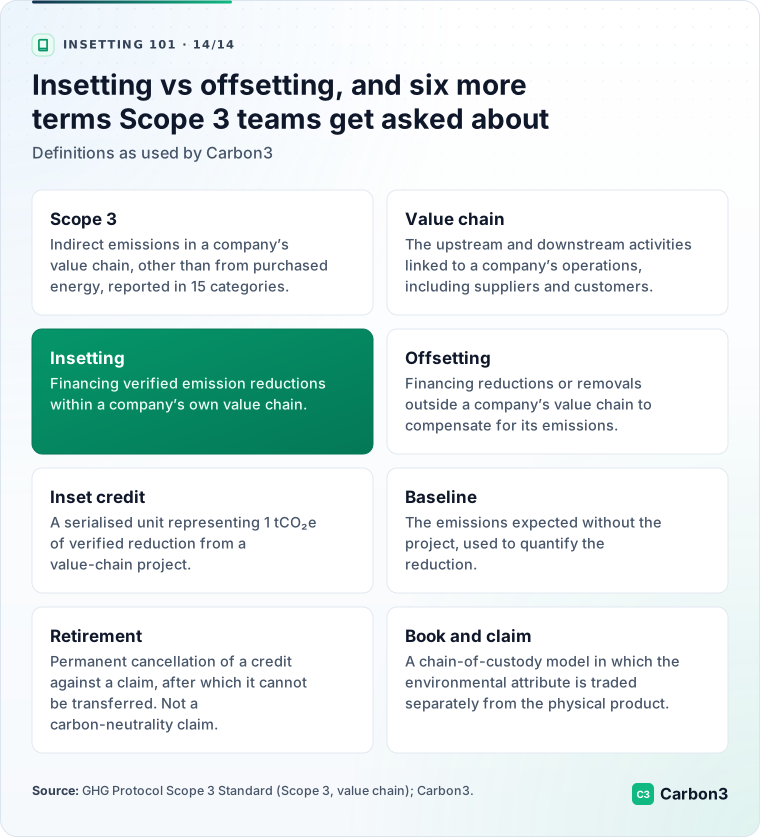
Insetting means financing emissions reductions within a company’s own value chain. Each reduction is quantified against a baseline, checked by a verifier and recorded so that each tonne is claimed once. The reduction happens at a supplier, carrier, farm or other partner the company buys from, so it lowers the emissions in that company’s Scope 3 inventory.
Three conditions separate an inset from other climate spending:
- Inside the value chain. The reduction occurs at a supplier, customer or other partner in the reporting company’s value chain.
- Measured and verified. The reduction is quantified against a baseline using a recognized methodology and checked by a verifier.
- Claimed once. Each verified tonne becomes one credit on the registry, allocated by rule and retired permanently, so no two parties claim the same tonne.
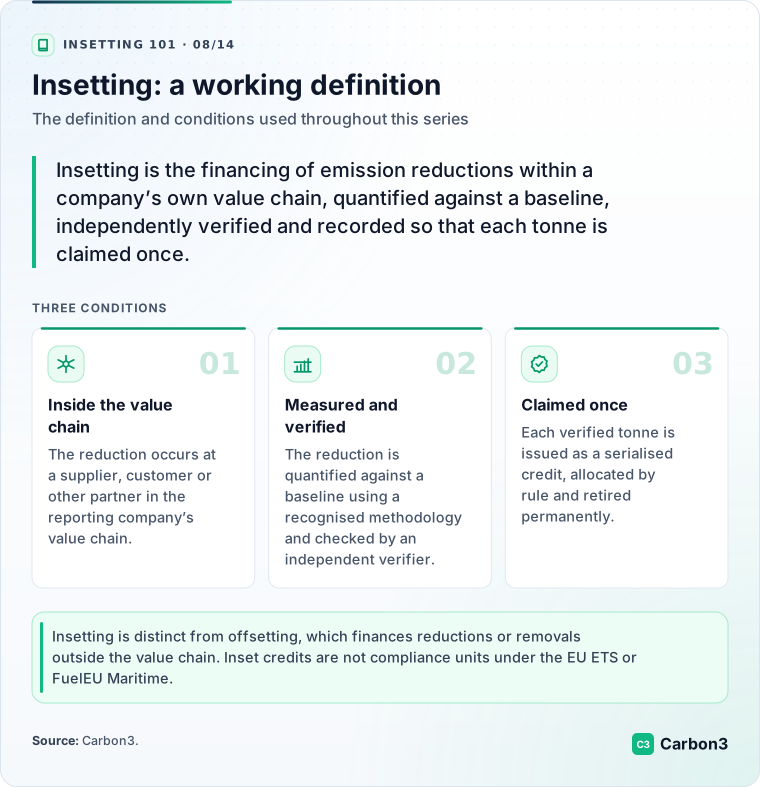
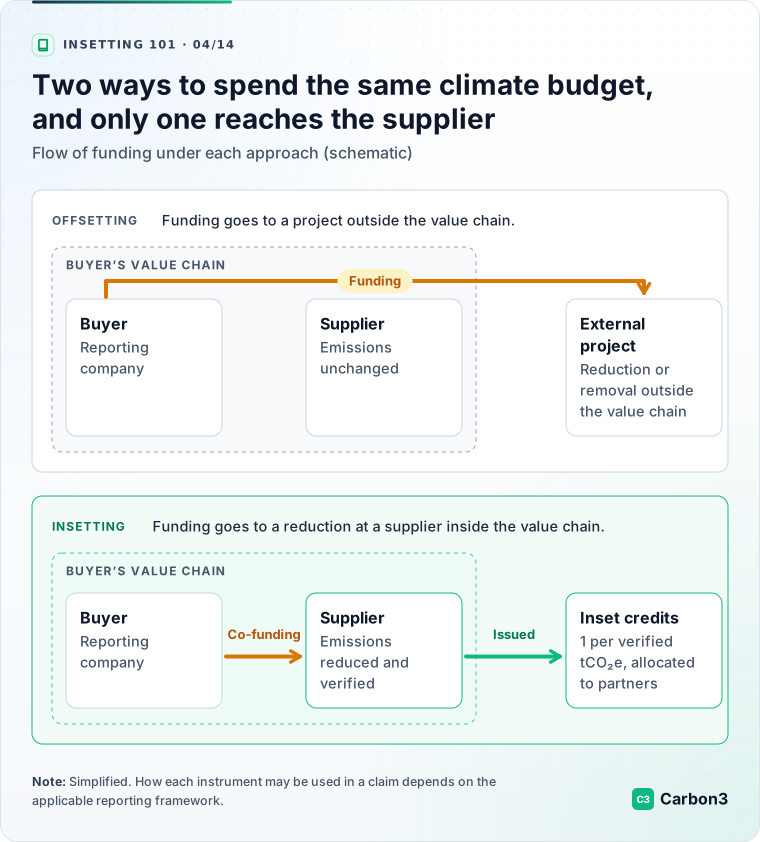
Offsetting is different: it finances reductions or removals outside the value chain to compensate for a company’s own emissions. The comparison of insetting and offsetting sets the two side by side. Insetting adds to a company’s own emissions reductions and does not replace them.
Why Scope 3 is where the emissions sit
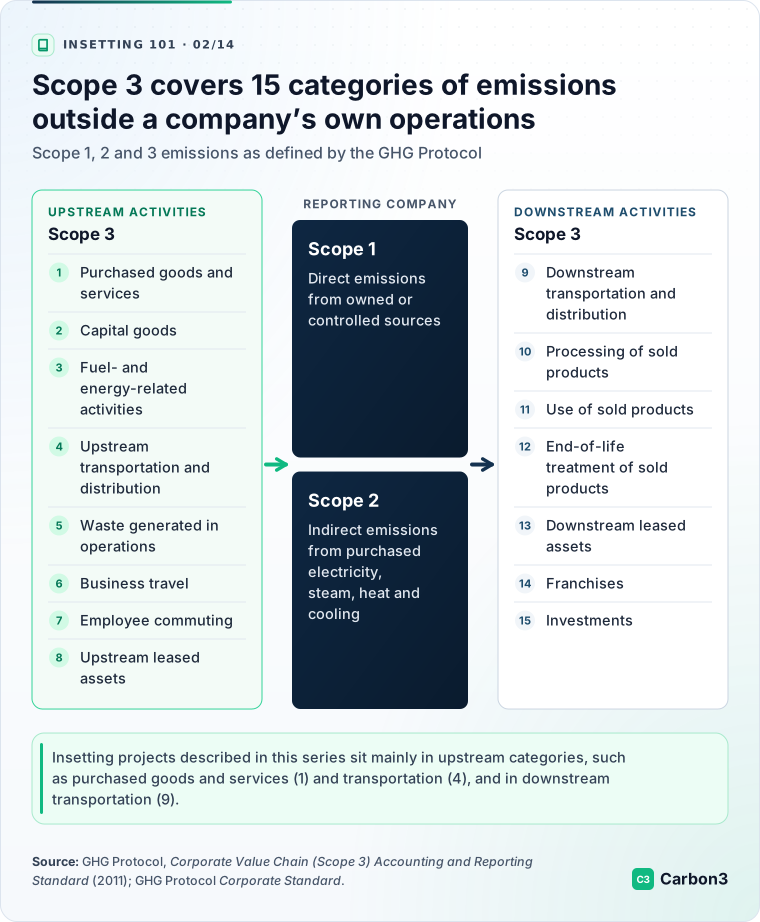
The GHG Protocol splits a company’s emissions into three scopes. Scope 1 covers direct emissions from sources the company owns or controls, and Scope 2 covers the emissions from the energy it buys. Scope 3 covers every other emission in its value chain, reported in 15 categories: eight upstream and seven downstream. Upstream examples are purchased goods and services (Category 1) and upstream transportation and distribution (Category 4).
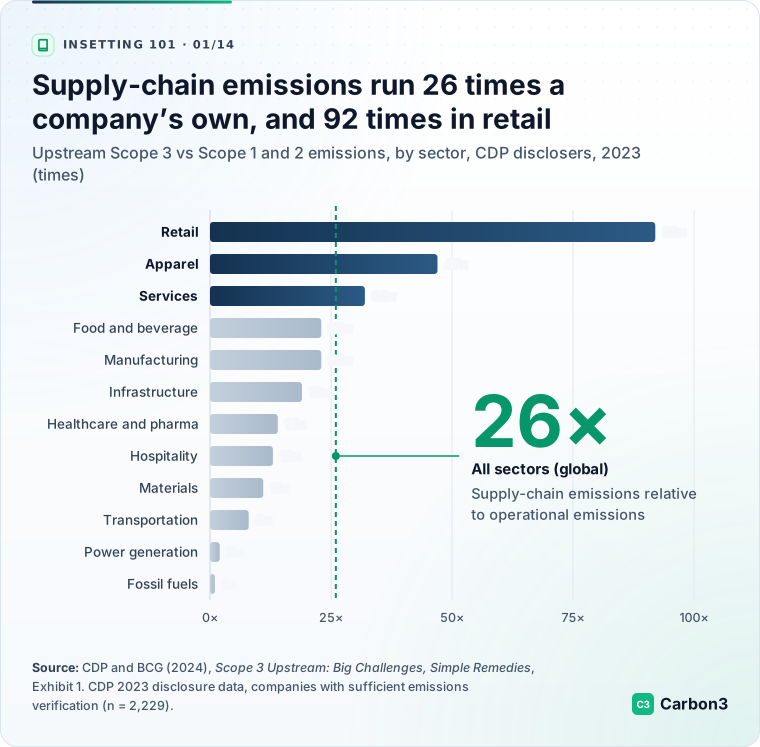
For most companies, Scope 3 is the largest part of the footprint. Across 2,229 companies disclosing to CDP in 2023, reported upstream Scope 3 emissions averaged 26 times their Scope 1 and 2 emissions, from about one times in fossil fuels to 92 times in retail (CDP and BCG, 2024).
Those same emissions are the supplier’s own Scope 1. When a supplier switches fuel, changes a process or adopts new farming practice, it pays for the change, yet the emissions reduction also appears in each of its customers’ Scope 3. Insetting lets those customers share the cost and hold an evidenced record of the reduction they helped pay for.
Where companies stand on Scope 3
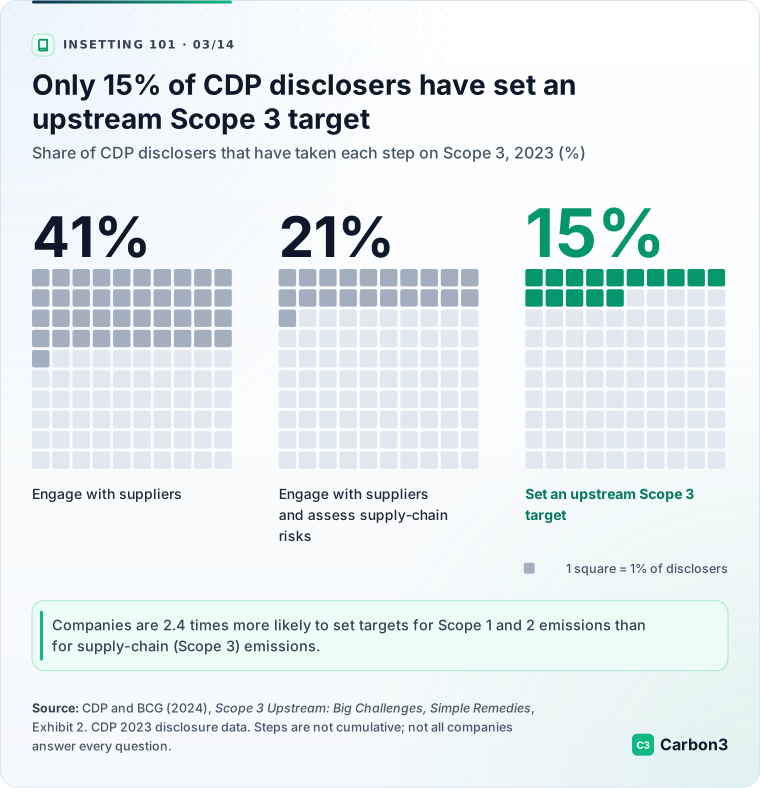
Many companies engage with their suppliers on climate, but few set targets for supply-chain emissions. Of companies disclosing to CDP in 2023, 41% engaged with their suppliers on climate, 21% engaged and assessed supply-chain risks, and 15% had set an upstream Scope 3 target. Companies were 2.4 times as likely to set targets for Scope 1 and 2 emissions as for Scope 3.
Rules are pushing Scope 3 forward. Under version 2.0 of the SBTi Corporate Net-Zero Standard, published on 11 June 2026, validations open on 1 February 2027 and the standard becomes mandatory for new target submissions from 1 February 2028. In the EU, the climate standard of the European Sustainability Reporting Standards, ESRS E1, includes Scope 3 emissions in what in-scope companies disclose. Disclosure creates the demand; insetting is one way to act on the emissions disclosed.
Two ways to spend the same climate budget
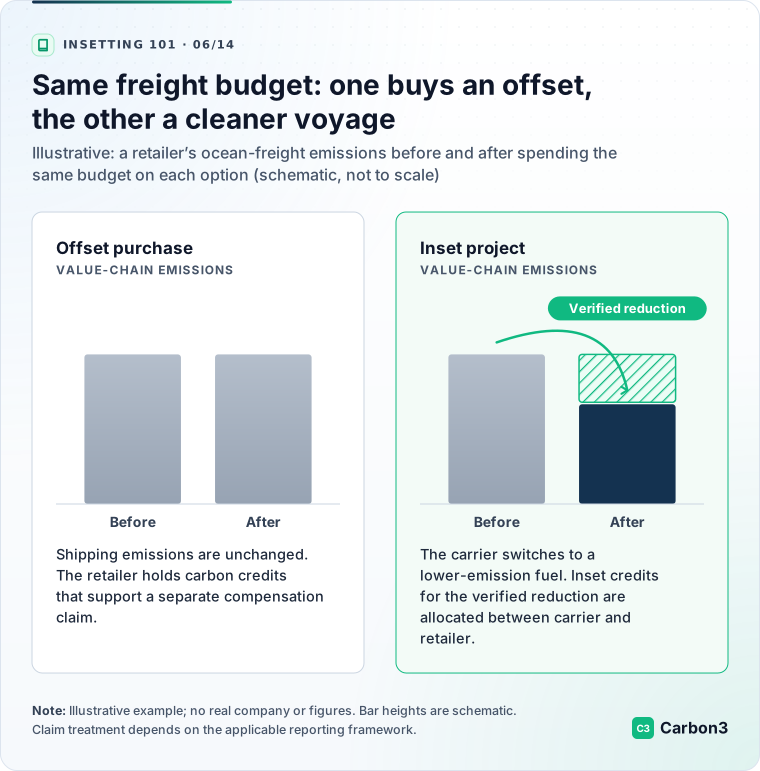
An offset pays for a project outside the buyer’s value chain and leaves its suppliers’ emissions where they were. An inset pays for a verified emissions reduction at a supplier inside the value chain, and the credits for that reduction are allocated to the partners that co-funded it.
How an inset project works, from scoping to retirement
Every inset project on Carbon3 follows the same seven steps in the same order. Carbon3 is the registry: project developers issue credits on it, and it records every change to them. It does not validate or verify.
| Step | What happens | Who | Record |
|---|---|---|---|
| 1. Scoping | The supplier and its co-funders define the emissions source, the boundary, the baseline, the method and who pays what. | Supplier and co-funders | Project scope |
| 2. Validation report | A validator checks the scope, baseline and method before work starts. From here the project developer can issue future credits. | Third-party validator | Validation report |
| 3. Implementation | The supplier makes the change and monitors emissions against the baseline for the agreed period. | Supplier | Monitoring data |
| 4. Verification report | A verifier checks the monitoring data and confirms how many tonnes of CO₂e were reduced. | Verifier | Verification report |
| 5. Issuance | The project developer issues one realized credit per verified tonne on the Carbon3 registry, linked to the verification report. | Project developer | Issuance record |
| 6. Allocation | The credits are split between the co-funders in line with what each paid. Each credit has one holder at a time. | Project developer and co-funders | Allocation record |
| 7. Sale or retirement | Holders keep, sell or retire their credits. A retired credit is claimed once and can never move again. | Credit holder | Retirement certificate |
| Party | What it puts in | What it gets |
|---|---|---|
| Supplier (project developer) | Makes the change and issues the inset credits: future credits once the project is validated, realized credits per verified tonne | Co-funding, credit payments or project finance that recover part of the abatement cost |
| Buyer (Scope 3 reporting company) | Co-funding or payment for credits | Credits and retirement records for its Scope 3 reporting |
| Investor (capital provider) | Project finance, often by buying future credits early | Credits backed by the project: future credits carry delivery risk, realized credits rest on reductions checked against a verification report |
| Carbon3 registry | Records each issuance, allocation, transfer and retirement against the credit's record ID | Does not validate, verify or hold funds |
| Step | What happens | Record produced |
|---|---|---|
| 1. Fuel switch | The carrier uses a lower-emission fuel on a voyage co-funded by a cargo owner. | Bunker delivery note and fuel certificate |
| 2. Quantification | Well-to-wake emissions are compared with a conventional-fuel baseline. | Voyage emissions calculation |
| 3. Verification | A verifier reviews the calculation and supporting evidence. | Verification report |
| 4. Issuance | The carrier, as project developer, issues one realized inset credit per verified tonne of CO₂e on the Carbon3 registry. | Issuance record with its own ID |
| 5. Allocation | The credit is transferred to the co-funding cargo owner. | Transfer record |
| 6. Retirement | The cargo owner retires the credit against a Scope 3 claim for transport emissions. | Retirement certificate |
What an inset credit records
One inset credit represents one tonne of CO₂e reduced inside a value chain. To hold up in an audit, the credit has to carry its own evidence: who it belongs to, where it came from, who checked it and what has happened to it since.
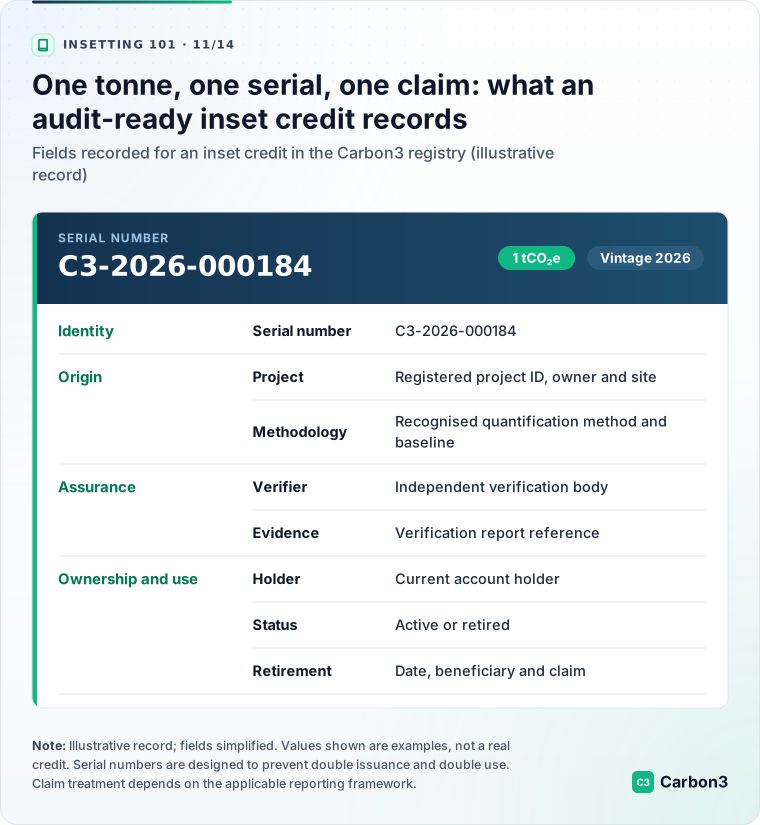
Because every allocation, transfer and retirement is written against the credit's record, a buyer, auditor or advisor can follow a Scope 3 claim back to the project and the verification report behind it, which is what “claimed once” means in practice.
Where insetting applies
Insetting fits wherever one company’s emissions reduction shows up in another company’s Scope 3. The table shows typical project types; real projects are scoped one by one.
| Sector | Intervention | Who reduces emissions | Who co-funds | Buyer’s Scope 3 category |
|---|---|---|---|---|
| Maritime | Lower-emission marine fuel | Carrier | Cargo owner | 4 or 9: transportation and distribution |
| Aviation | Sustainable aviation fuel | Airline | Corporate travel buyer | 6: business travel |
| Steel and cement | Low-carbon inputs and processes | Producer | Manufacturer | 1 or 2: purchased or capital goods |
| Agriculture and food | Regenerative farming practices | Farms | Food company | 1: purchased goods and services |
| Industrial heat | Electrified process heat | Manufacturer | Value-chain buyer | 1: purchased goods and services |
| Battery materials | Recycled content | Recycler | Electric vehicle manufacturer | 1: purchased goods and services |
Where the physical product cannot be traced to a buyer, as with fuel in a shared bunkering or pipeline system, the environmental attribute can be traded apart from the product under a book and claim model.
What buyers can claim today
The accounting rules for counting a supplier’s emissions reduction bought this way are still being written. The GHG Protocol is revising its Corporate and Scope 3 standards and developing a standard on actions and market instruments. A consolidated draft for public consultation is estimated for 2027, and the revised standard for the fourth quarter of 2028. Until then, Carbon3 builds to the strictest reading, so the evidence is ready whichever way the rules settle.
- When a supplier in the buyer’s own chain reduces emissions, the buyer’s Scope 3 goes down through lower supplier emissions data. The inset credit is the proof of that emissions reduction and who funded it, and it is not counted a second time. An emissions reduction outside the buyer’s own chain is reported separately, not as a lower Scope 3 figure.
- SBTi’s Corporate Net-Zero Standard V2.0 keeps the physical inventory as the basis for targets. Projects and certificates that meet its integrity criteria can support target implementation, reported separately; carbon credits are treated under its Ongoing Emissions Responsibility framework.
- In the EU, Directive (EU) 2024/825 applies from 27 September 2026 and bans product claims of climate neutrality based on offsetting. Inset credits support Scope 3 reporting, not “carbon neutral” product claims.
Claim treatment always depends on the applicable reporting framework.
Getting started
Four kinds of participant work from the same record. Project developers register a decarbonization project and issue credits for verified reductions. Supply-chain partners co-fund a project at a supplier and receive credits to retire. Credit buyers buy credits from verified projects. ESG consultants bring a client program to the platform.
| Participant | First step | Result |
|---|---|---|
| Project developer: supplier, producer, carrier or farm | Register a decarbonization project | Receives credits on the registry: future credits once the project is validated, realized credits for verified reductions, to allocate or sell |
| Supply-chain partner: brand, manufacturer or cargo owner | Co-fund a project at a supplier | Credits allocated for retirement, with retirement records |
| Credit buyer: corporate or institutional | Buy credits from registered projects | Credits with a recorded transfer history |
| ESG consultant: adviser to buyers or suppliers | Bring a client program to the platform | Credit records for client reporting |
The solutions for suppliers, for buyers and for investors describe each route, and the free Data Hub shows the public emissions, targets and projects behind any company.
Key terms
Insetting through Carbon3
Carbon3 is a registry and marketplace for inset credits. Project developers issue credits on the Carbon3 registry once a verification report on the tonnes is on file, or future credits once the project is validated. Carbon3 records each credit through allocation, transfer, sale and retirement, so every claim can be traced to its project.
To discuss a supply chain, contact us or list a project.
Questions
What is carbon insetting?
Carbon insetting means financing emissions reductions inside a company’s own value chain, at suppliers, carriers or farms it buys from. Each reduction is measured against a baseline, checked by a verifier and recorded so that each tonne is claimed once.
How is insetting different from offsetting?
An offset pays for a project outside the buyer’s value chain to compensate for its emissions. An inset pays for an emissions reduction inside it, so the reduction appears in the buyer’s own Scope 3. The comparison page covers the differences in detail.
Who issues inset credits?
The project developer issues them on the Carbon3 registry. Realized credits are issued against the verification report, one per verified tonne; future credits can be issued earlier, once the project is validated. The registry records, tracks and retires them.
Can a company count inset credits toward its Scope 3 target?
When a supplier in the buyer’s own chain reduces emissions, the buyer’s Scope 3 goes down through lower supplier emissions data. The inset credit is the proof of that emissions reduction and who funded it, and it is not counted a second time. An emissions reduction outside the buyer’s own chain is reported separately, not as a lower Scope 3 figure. The GHG Protocol’s work on actions and market instruments is still in consultation; its revised standard is estimated for the fourth quarter of 2028.
Are inset credits compliance units?
No. Inset credits are not EU ETS allowances or FuelEU Maritime compliance units, and they do not support product claims of carbon neutrality.
Sources
- CDP and BCG, Scope 3 Upstream: Big Challenges, Simple Remedies (2024), press release. 26 times average, sector multiples, 41%, 21%, 15% and 2.4 times
- GHG Protocol, Corporate Value Chain (Scope 3) Accounting and Reporting Standard. Scopes and the 15 categories
- GHG Protocol, Consolidated Corporate Standard: Standard Development Plan (29 July 2026). Consultation draft estimated Q2 2027; revised standard estimated Q4 2028
- SBTi, Corporate Net-Zero Standard Version 2.0 (June 2026). Published 11 June 2026; validations from 1 February 2027; mandatory from 1 February 2028
- Directive (EU) 2024/825 on empowering consumers for the green transition. Applies from 27 September 2026
- Carbon3 methodology. Credit lifecycle, record trail and future credits