Climate rules and reporting standards shape what value chain emissions cost and how companies report them.
Each page explains one rule or standard in plain words, with who is in scope, the key dates and the data it asks for, and lists its primary sources. Every page is dated and updated when the rules change.
Climate rule pages checked
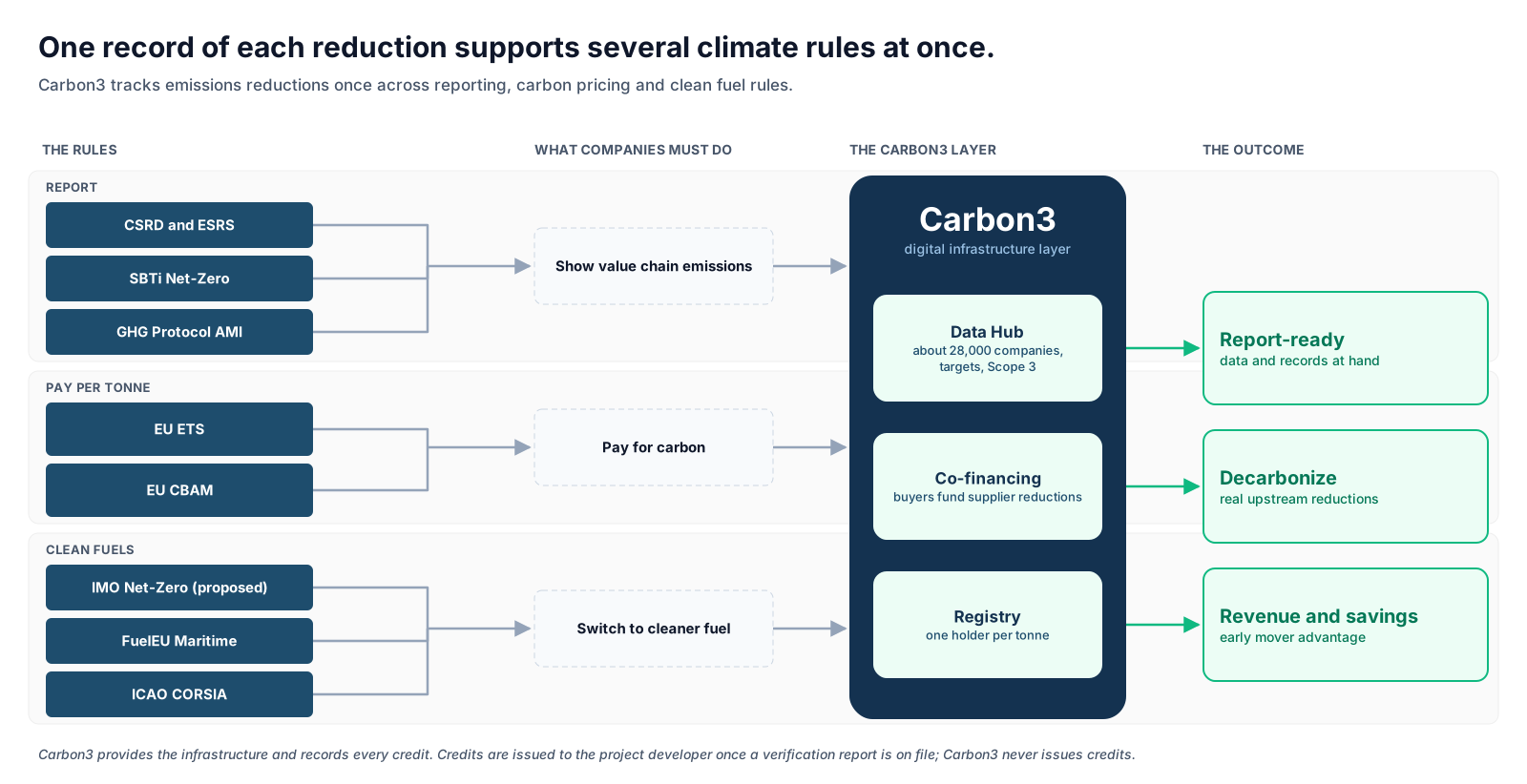
Carbon3 provides the financial infrastructure that helps these rules succeed.
Reporting, carbon pricing and clean-fuel rules all need real buyer demand, shared capital and a record of each emissions reduction claimed only once. The Data Hub surfaces about 28,000 companies with value chain (Scope 3) emissions and climate targets, as of November 2026, so operators and suppliers can see that demand without waiting for voluntary interest.
Buyers can then co-finance the green premium, the extra cost of the cleaner option, with shipowners, industrial plants, airlines and fuel producers. Sharing that cost de-risks the investment and unlocks spending on cleaner plants, ships and fuel. Carbon3 records each emissions reduction once in its registry, checked against a verification report on file, and keeps those records distinct from statutory compliance balances.
Climate rules
Laws and schemes that put a price, a limit or a disclosure duty on emissions.
- In forceEU CBAMThe Carbon Border Adjustment Mechanism makes importers of steel, aluminum, cement, fertilizers, hydrogen and electricity pay for embedded emissions from 2026.Read the summary
- In forceEU Emissions Trading SystemPower, industry, flights and large ships need one allowance per tonne, at about €86 to €91 in November 2026.Read the summary
- In forceFuelEU MaritimeShips calling at EU ports must cut the greenhouse gas intensity of their fuel 2% from 2025 and 80% by 2050.Read the summary
- ProposedIMO Net-Zero FrameworkA draft global fuel standard from the International Maritime Organization would charge ships $100 or $380 per tonne above two targets, if adopted.Read the summary
- In forceICAO CORSIAUnder the UN aviation agency's CORSIA scheme, international airlines cover emissions growth above 85% of 2019 levels with eligible units or cleaner fuel.Read the summary
- In force, narrowedCSRD and ESRSFrom financial year 2027, the EU's Corporate Sustainability Reporting Directive covers companies with over 1,000 staff and €450 million turnover.Read the summary
- DraftGHG Protocol AMIA draft GHG Protocol standard on Actions and Market Instruments would report market instruments and value chain actions in separate statements.Read the summary
Reporting standards
The standards and disclosure rules that set how companies count, target and report value chain emissions.
- Updated GHG ProtocolWhere the GHG Protocol stands on actions and market instruments, the Scope 3 revision and the consolidated standard, with the dates published so far.Read the guide
- Validations from Feb 2027SBTi Corporate Net-Zero Standard V2.0Larger companies that get targets validated by the Science Based Targets initiative must set Scope 3 targets for every major category.Read the summary
- Updated ESRS E1What ESRS E1 asks companies to disclose on climate, including gross Scope 3 emissions and carbon credits, and who reports after the Omnibus simplification.Read the guide
- Updated California SB 253Who must report emissions under California SB 253, what is due on 10 November 2026, when Scope 3 reporting starts and what CARB is still deciding.Read the guide
- Updated Book and claimHow book and claim separates a low-carbon attribute from the physical fuel or steel, how shipping, aviation and steel use it, and where the rules stand.Read the guide
The Carbon3 team can show how co-financing would work in a specific value chain.
Tell us which rules apply, and which buyers, operators or suppliers sit in the chain. A person on the Carbon3 team reads every message and replies by email.
Carbon3 provides the infrastructure and records every credit. Credits are issued to the project developer once a verification report is on file; Carbon3 never issues credits.
This page explains the rules in short. It is not legal advice.