On this page
Why it matters
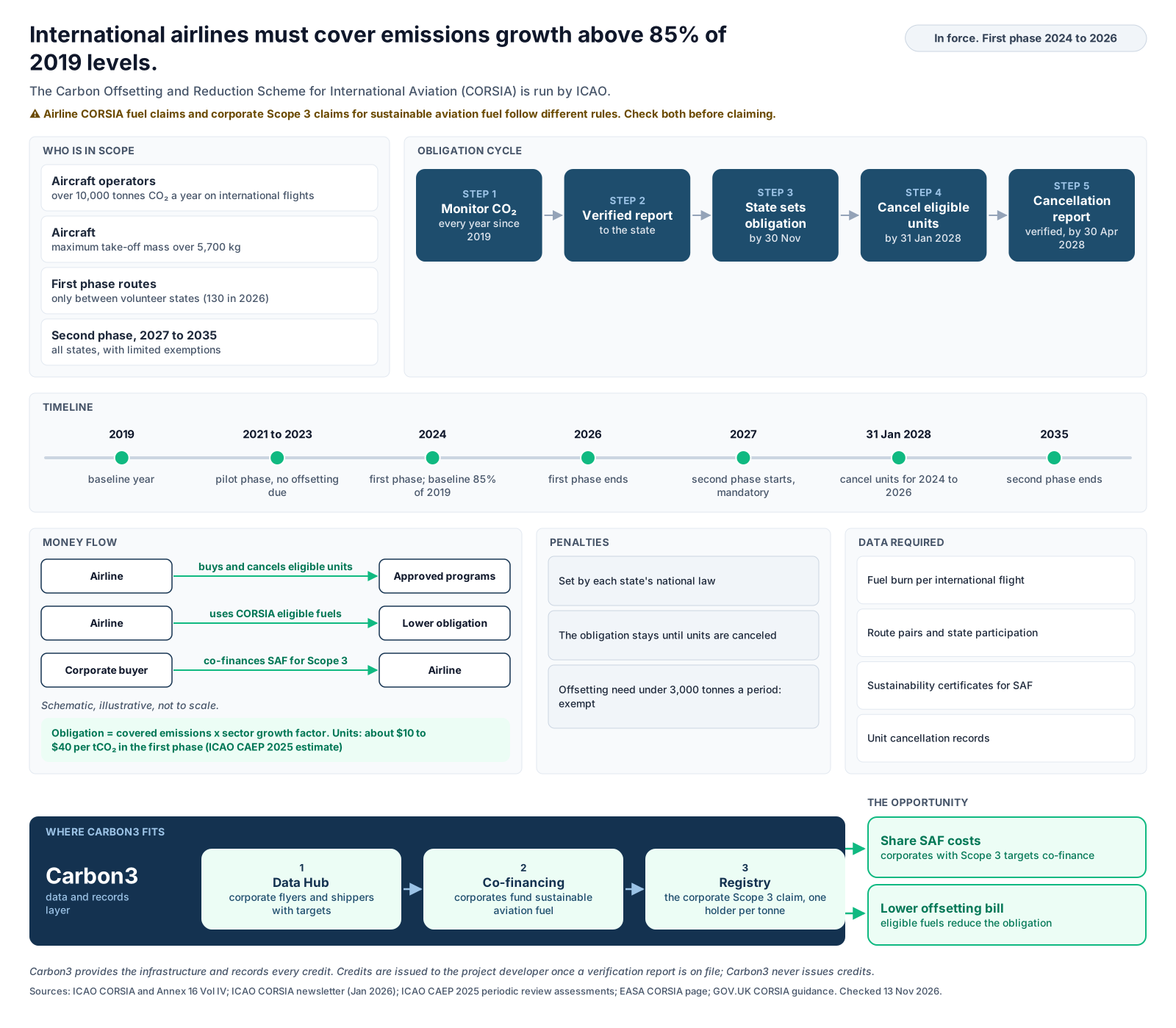
Airlines can meet part of their obligation with CORSIA eligible fuels, mainly sustainable aviation fuel (SAF), which lowers the number of units they must buy. Corporate customers with Scope 3 targets for business travel and air freight can co-finance that fuel.
Participation is growing. In 2026, 130 States volunteer for the first phase, up from 88 in 2021, and the second phase from 2027 applies to all States, with limited exemptions.
Airlines offset only the growth above 85% of their 2019 emissions.
ICAO sets each operator's obligation by applying the sector's growth factor to its covered emissions. Only flights between two participating States count in the first phase, and an operator whose offsetting need is under 3,000 tonnes in a period is exempt.
An airline covers only the emissions above 85% of its 2019 level, shown for an illustrative operator.
| Year | Index | Above 85% of 2019 |
|---|---|---|
| 2019 | 100 | None due |
| 2020 | 48 | None due |
| 2021 | 62 | None due |
| 2022 | 80 | None due |
| 2023 | 91 | None due |
| 2024 | 97 | 12 |
| 2025 | 102 | 17 |
| 2026 | 106 | 21 |
The first phase ends in 2026, and the units are due by January 2028.
Operators have monitored CO₂ on international flights every year since 2019 and send a verified report to their State. The State sets the obligation by 30 November, the operator cancels eligible units by 31 Jan 2028, and a verified cancellation report follows by 30 Apr 2028.
2019
baseline year
2021 to 2023
pilot phase, no offsetting due
2024
first phase, baseline 85% of 2019
2026
first phase ends
2027
second phase starts, mandatory
31 Jan 2028
cancel units for 2024 to 2026
2035
second phase ends
What it costs to fall short
Penalties are set by each State's national law, and the obligation stays in place until the units are canceled.
Where Carbon3 fits
Carbon3 provides the financial infrastructure for co-financing sustainable aviation fuel on routes companies use.
The Data Hub shows which companies have Scope 3 targets for business travel and air freight, among about 28,000 companies as of November 2026. That demand can co-finance the green premium, meaning the extra cost of cleaner fuel, so airlines and fuel producers do not carry it alone. Shared offtake de-risks new fuel supply and unlocks more eligible fuel.
CORSIA units are offsets bought by airlines and are not inset credits. Inset credits record emissions reductions inside a company's own value chain and cannot be canceled to meet an airline's CORSIA obligation. Carbon3 records each inset credit once, checked against a verification report on file, with one holder per tonne.
Airline CORSIA fuel claims and corporate Scope 3 SAF claims follow different rules, so both need checking before a claim is made.
Claim treatment depends on the applicable reporting framework.