On this page
Why it matters
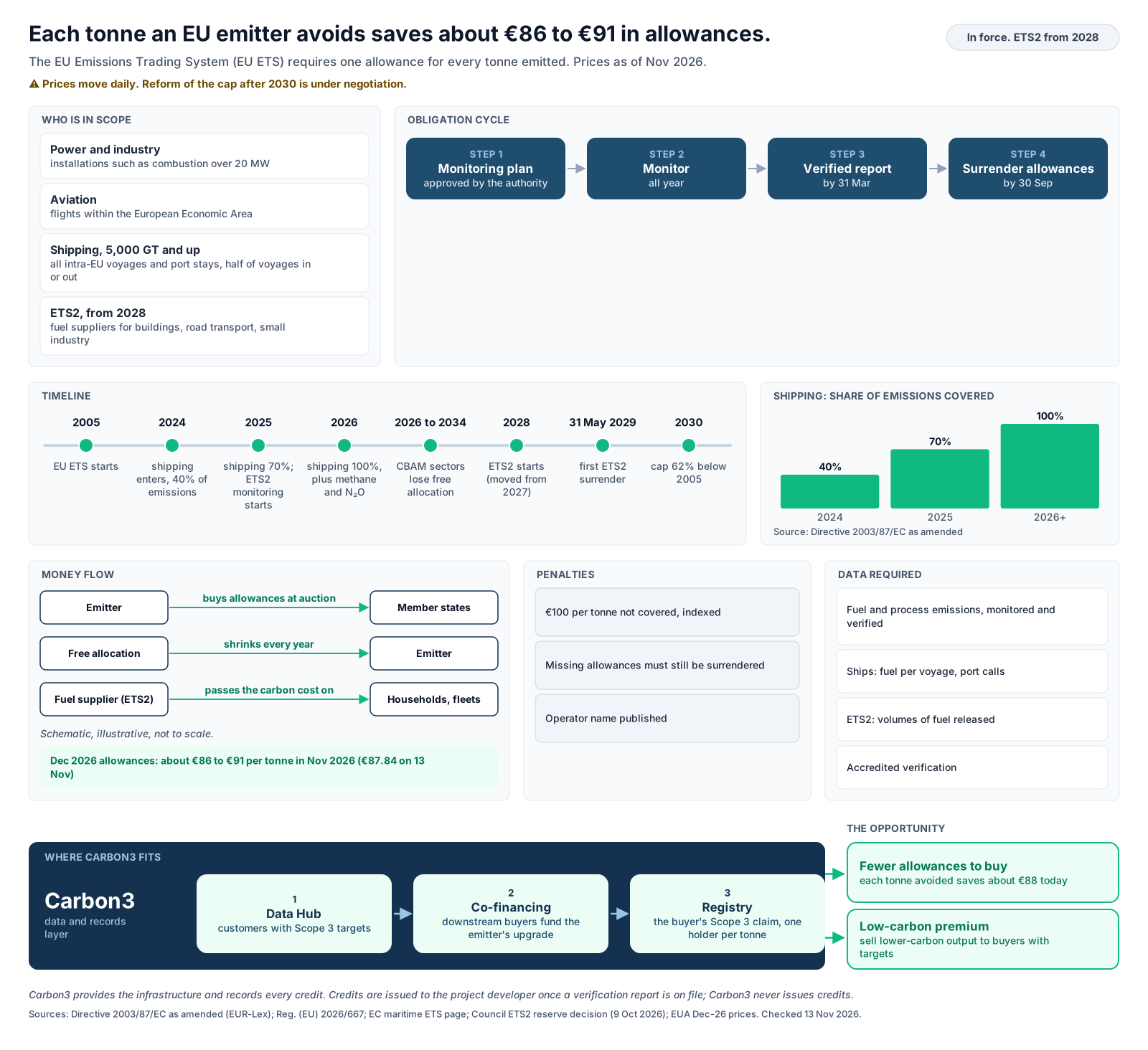
The EU cuts the number of allowances every year, aiming for emissions 62% below 2005 levels by 2030, so each avoided tonne is worth the market price of one allowance. Free allowances for the sectors covered by the Carbon Border Adjustment Mechanism (CBAM) are phased out between 2026 and 2034, which raises the cost for steel, cement, aluminum and fertilizer producers.
Prices move daily. The December 2026 allowance contract traded between about €86 and €91 per tonne in the first two weeks of November 2026.
A container line now pays for every tonne on voyages between EU ports.
Take a container ship of 5,000 gross tonnage or more that calls at Rotterdam and then Hamburg. From 2026 its operator surrenders allowances for 100% of emissions on that leg and at berth. Voyages into or out of the EU count at 50%, and methane and nitrous oxide are now included. In 2024 the operator paid for only 40% of those emissions, and in 2025 for 70%.
As a worked example, every 1,000 tonnes of CO₂e on covered voyages costs about €86,000 to €91,000 in allowances at November 2026 prices. Schematic, illustrative, not to scale.
Shipping pays for all covered emissions from 2026, at about €86 to €91 per allowance.
| Year | Share covered |
|---|---|
| 2024 | 40% |
| 2025 | 70% |
| 2026 onward | 100% |
| Allowance price, Nov 2026 | about €86 to €91 per tonne |
ETS2 brings a separate carbon price to building and road fuels from 2028.
ETS2 applies to the fuel suppliers for buildings, road transport and small industry, who pass the carbon cost on to households and fleets. ETS2 was moved from 2027 to 2028, and the first surrender is due by 31 May 2029. A reserve releases 40 million extra allowances if the price rises above €45 per tonne in 2020 prices. On 12 Nov 2026, the Court of Justice of the European Union dismissed Poland's challenge to the Fit for 55 EU ETS and ETS2 directive in Case C-505/23.
2005
EU ETS starts
2024
shipping enters at 40% of emissions
2025
shipping 70%, ETS2 monitoring starts
2026
shipping 100%, plus methane and nitrous oxide; aviation fully auctioned
2026 to 2034
CBAM sectors lose free allocation
2028
ETS2 starts
31 May 2029
first ETS2 surrender
2030
cap 62% below 2005
Emitters monitor all year and surrender allowances by 30 September.
Each installation or ship operator follows a monitoring plan approved by its authority and reports verified emissions by 31 March. It then surrenders one allowance per tonne by 30 September. Reform of the cap after 2030 is under negotiation, and the Council aims for a position on 11 Dec 2026.
What it costs to fall short
A missing allowance costs €100 per tonne, indexed to inflation, and the allowance must still be surrendered. The authority also publishes the operator's name.
Where Carbon3 fits
Carbon3 provides the financial infrastructure that helps customers co-finance emissions reductions at EU emitters.
The Data Hub surfaces buyers of steel, cement, power, flights and shipping with Scope 3 targets, among about 28,000 companies as of November 2026, so EU emitters see real downstream demand. Those buyers can co-finance the green premium, meaning the extra cost of the cleaner option, sharing the capital burden so operators do not absorb rising allowance costs alone. That co-financing de-risks and unlocks industrial decarbonization investments, while lowering the allowances an emitter needs.
Carbon3 records the inset credit for the buyer's Scope 3 claim, checked against a verification report on file, with one holder per tonne. Inset credits are not EU allowances and cannot be surrendered under the EU ETS, so the allowance saving and the Scope 3 claim stay distinct.
Claim treatment depends on the applicable reporting framework.