On this page
Why it matters
The penalty is set high on purpose, at about €58.5 per gigajoule of missing reduction, and it rises 10% for each consecutive year in deficit. A fleet that stays in deficit year after year pays more each time.
The rule also creates a market. Ships that beat the target can sell their surplus into a pool or bank it for the same ship the following year, with no cap and no discount.
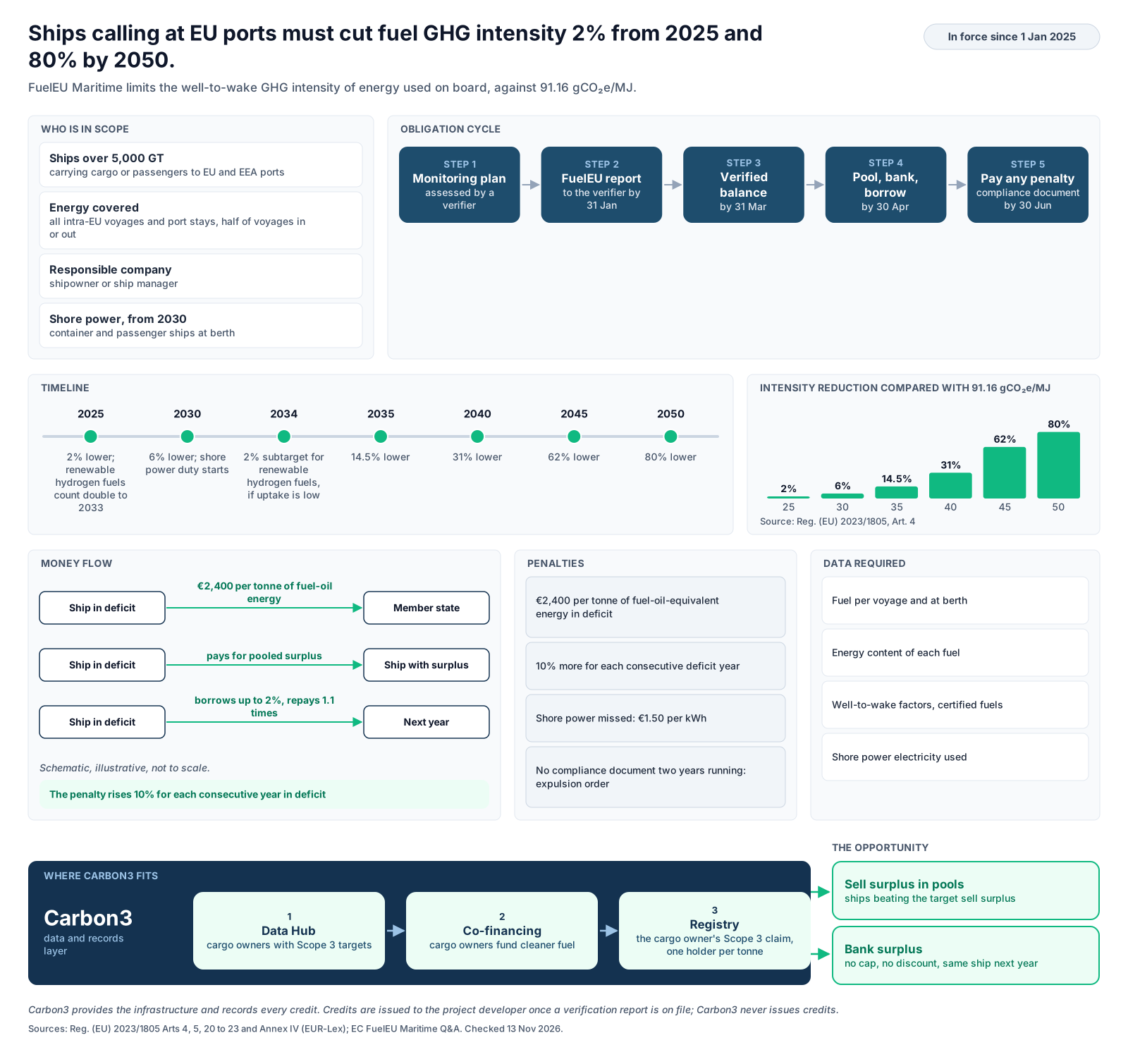
The required cut in fuel intensity grows from 2% in 2025 to 80% in 2050.
The limit tightens every five years, to 6% in 2030, 14.5% in 2035, 31% in 2040, 62% in 2045 and 80% in 2050, all compared with 91.16 gCO₂e (grams of CO₂-equivalent) per megajoule. Renewable fuels of non-biological origin, such as e-methanol and e-ammonia, count double until 2033, and a 2% subtarget for them applies from 2034 if their uptake stays under 1% in 2031.
The FuelEU limit falls from 89.3 gCO₂e per MJ in 2025 to 18.2 in 2050.
| Year | Cut | Limit, gCO₂e per MJ |
|---|---|---|
| 2025 | 2% | 89.34 |
| 2030 | 6% | 85.69 |
| 2035 | 14.5% | 77.94 |
| 2040 | 31% | 62.90 |
| 2045 | 62% | 34.64 |
| 2050 | 80% | 18.23 |
A container ship that sails between EU ports counts all of its energy on that leg.
FuelEU covers ships over 5,000 gross tonnage that carry cargo or passengers. The ship counts 100% of the energy used on voyages between ports in the EU or European Economic Area (EEA) and at berth. Voyages into or out of the EU count at 50%. From 2030, container and passenger ships must also plug into shore power at berth in the larger EU ports.
2025
2% cut, renewable fuels of non-biological origin count double to 2033
2030
6% cut, shore power duty starts
2034
2% subtarget for those fuels if uptake stays under 1% in 2031 (conditional) (not in force yet)
2035
14.5%
2040
31%
2045
62%
2050
80%
Each year closes with a verified balance and a FuelEU Document of Compliance by 30 June.
The shipowner or ISM company, meaning the company responsible for the ship's safety management, sends a FuelEU report to its verifier by 31 January. The verified balance follows by 31 March, and pooling, banking or borrowing closes by 30 April. Any penalty is paid before the FuelEU Document of Compliance (DoC) is issued by 30 June.
Each step down sets a fixed limit in grams of CO₂e per megajoule.
| From | Reduction | Limit (g CO₂e/MJ) |
|---|---|---|
| 2025 | 2% | 89.34 |
| 2030 | 6% | 85.69 |
| 2035 | 14.5% | 77.94 |
| 2040 | 31% | 62.90 |
| 2045 | 62% | 34.64 |
| 2050 | 80% | 18.23 |
A ship's compliance balance can be banked, borrowed against or pooled.
Each ship’s compliance balance is the difference between the limit and its actual GHG intensity, multiplied by the energy it used. A positive balance is a surplus, and a negative balance is a deficit. A verifier checks the figures in the FuelEU database.
- Banking: a verified surplus can be carried forward to the ship’s next reporting period (Article 20).
- Borrowing: a ship with a deficit can borrow an advance surplus of up to 2% of its limit multiplied by its energy use. The borrowed amount is repaid in the next period with a 1.1 multiplier, and borrowing cannot be used in two consecutive periods.
- Pooling: ships can combine their balances (Article 21).
In a pool, ships in surplus cover ships in deficit, and the total must stay positive.
Pooling lets two or more ships, from the same company or different companies, add up their compliance balances. A ship sailing on biofuel or an RFNBO with a large surplus can cover the deficits of ships still on fossil fuel. The terms between the companies, including any payment for the surplus, are a commercial matter between them.
- The pool’s total compliance balance must be positive.
- No ship may end with a larger deficit than it brought in, and no ship with a surplus may end in deficit.
- Each ship can belong to one pool per reporting period. Separate pools may be formed for the GHG intensity requirement and for the RFNBO subtarget.
- The pool is registered in the FuelEU database, and the verifier records it by 30 April of the verification period.
- A surplus left in the pool after the allocation can be banked by the ships that hold it.
A deficit that remains after banking, borrowing and pooling pays the FuelEU penalty. For consecutive periods in deficit, the penalty is multiplied by 1 + (n − 1)/10, where n is the number of consecutive periods. Ships that fail to use on-shore power at berth where required pay €1.50 per kilowatt of established power demand multiplied by the hours at berth.
What it costs to fall short
A ship in deficit pays €2,400 per tonne of VLSFO-equivalent energy, and the amount rises 10% for each consecutive year in deficit. A missed shore power connection costs €1.50 per kilowatt hour, and a ship without a FuelEU Document of Compliance for two years running can be expelled from EU ports.
Where Carbon3 fits
Carbon3 provides the financial infrastructure that helps FuelEU Maritime succeed in practice.
The Data Hub surfaces cargo owners with Scope 3 targets among about 28,000 companies, as of November 2026. Shipowners and fuel producers can see that demand without waiting for voluntary interest. Those buyers can co-finance the green premium, meaning the extra cost of cleaner fuel, so shipowners do not carry it alone or only pay the penalty. Structured co-financing de-risks the fuel switch and unlocks investment in lower-intensity energy.
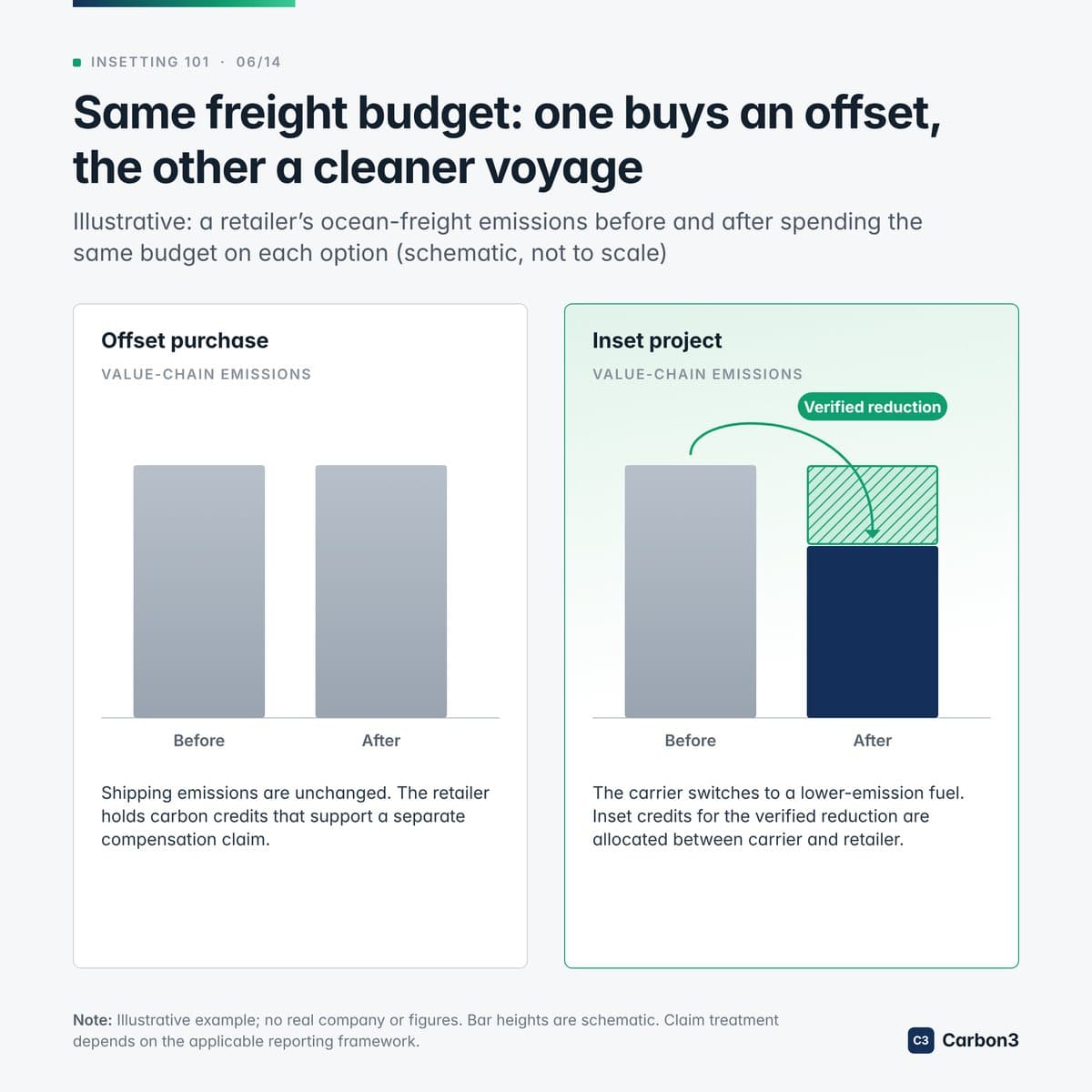
Carbon3 records each resulting inset credit once, checked against a verification report on file, for the cargo owner's Scope 3 claim. Inset credits are not FuelEU surplus, do not enter a pool, and do not change a ship's compliance balance.
Claim treatment depends on the applicable reporting framework.