Insetting for shipping and the cargo it carries
A tonne of emissions reduced at sea matters to the shipowner, the cargo owner and the lender. An independent verifier confirms it once, Carbon3 records it, and each party claims only its share. Carbon3 covers fuel switching, wind-assisted propulsion, efficiency retrofits and shore power as well as certified fuel.
Why insetting fits shipping
The fuels and retrofits already exist, and the open question is who pays for them.
One tonne, several claimants
A tonne abated at sea appears in the shipowner’s Scope 1, the cargo owner’s Scope 3 and the lender’s financed emissions.
The fuel rarely reaches the cargo
Green fuels are still a tiny share of bunker fuel, and e-methanol supply is far below the demand from methanol-capable ships already on order. Most cargo owners will therefore never have the physical fuel on their own voyage.
The functional-unit gap
Maritime buyers transact in four different units: transport work such as TEU-miles or tonne-kilometers, the number of containers shipped, the volume of fuel consumed and tonnes of CO₂e.
Demand is coming from cargo owners
With the IMO framework stalled, voluntary demand from cargo owners has become the marginal price-setter, and that is the demand an inset is built to serve.
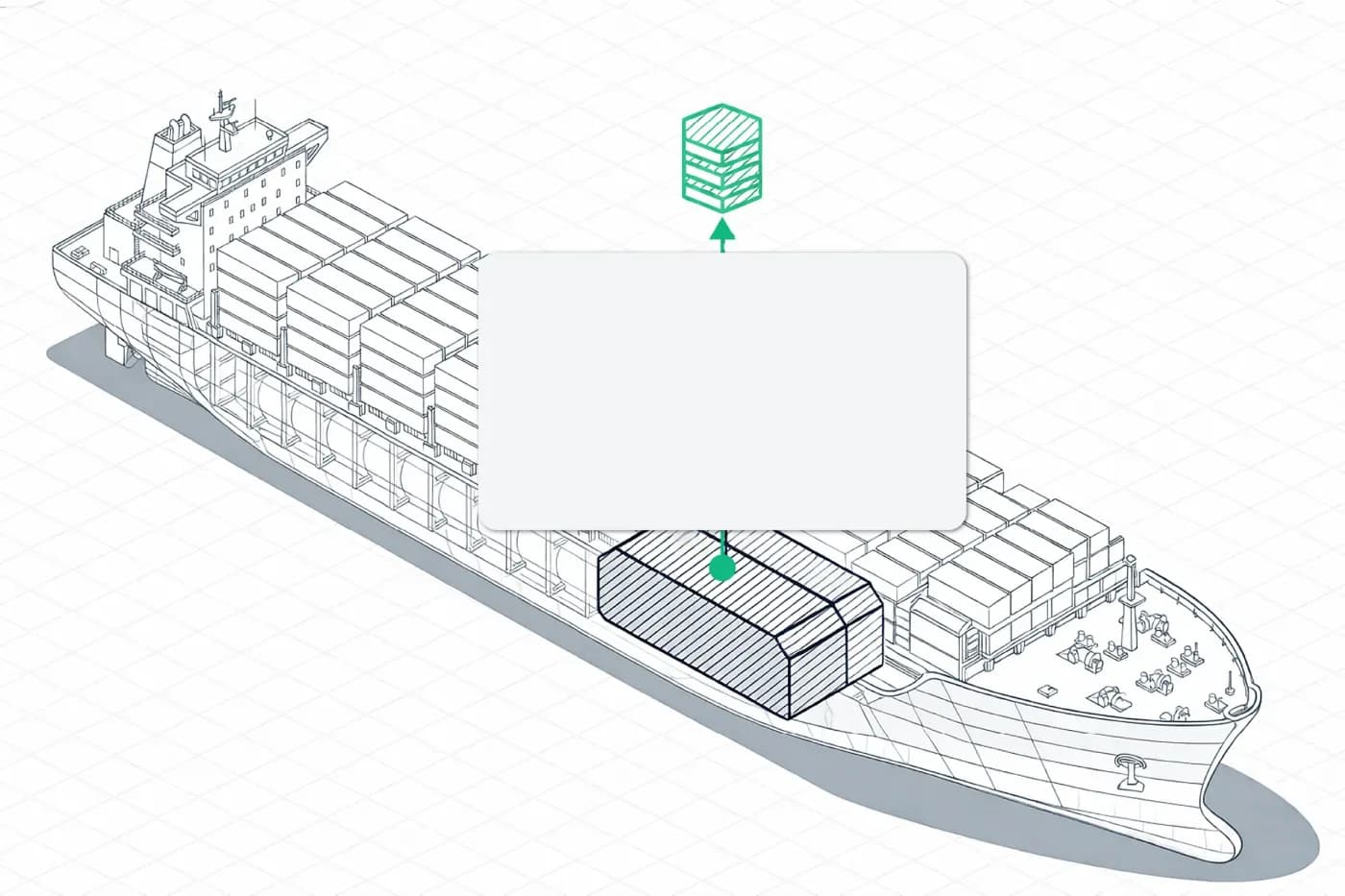
Illustrative
One tonne, one holder
- Reported by
- Shipowner, cargo owner, lender
- Retired
- Once
Typical inset projects in shipping
- 01
Alternative fuels
Bio-methanol, e-methanol, ammonia or waste-based biofuel replaces fossil marine fuel on named container or bulk routes. The reduction is calculated over the fuel’s life cycle against the fossil fuel it displaces, using its certified carbon intensity. Cargo owners whose goods sail on other ships claim their share through book and claim.
- 02
Wind-assisted propulsion
Rotor sails, rigid wing sails or suction wings are fitted to an existing ship, so the engine needs less power for the same speed. Savings are measured against the ship’s own consumption on comparable voyages, corrected for weather and speed, and vary with route and season.
- 03
Air lubrication and efficiency retrofits
Air lubrication blows a layer of bubbles under the hull to reduce friction. Other retrofits include propeller and bow modifications, shaft generators and waste heat recovery. Each is metered at the fuel line and compared with the pre-retrofit baseline, and suits ships with many years of service left.
- 04
Slow steaming and voyage optimization
Lower speeds, just-in-time arrival and weather routing reduce fuel per voyage. Because a slower ship carries less cargo per year, the baseline is set per unit of transport work, such as tonne-kilometers, and agreed between shipowner and charterer before the project starts.
- 05
Shore power and methane-slip control
At berth, ships plug into shore power instead of running auxiliary engines, and the grid’s carbon intensity is part of the baseline. On LNG-fueled ships, engine upgrades and after-treatment reduce methane slip, the unburnt methane that escapes through the exhaust and has a far stronger warming effect than CO₂.
How a shipping inset works
The cargo does not need to sail on the ship, because book and claim carries the reduction to the funders.
- 1Shipowner and funders
Scoping and project definition
Shipowner, charterer and cargo owners define the lever (a fuel, wind assist or a retrofit), the ships and routes, the baseline per voyage or per tonne-kilometer, and each funder’s share.
- 2Independent verifier
Validation report
An independent verifier confirms the scope, baseline and methodology, and that the credited reduction goes beyond what the ship needs for FuelEU and the EU ETS.
- 3Shipowner
Implementation
The retrofit is installed or the fuel is bunkered. Fuel use and voyage data are recorded per voyage, using the data the ship already reports under EU monitoring rules.
- 4Independent verifier
Verification report
After the monitoring period, the verifier checks the voyage data and states the verified reduction in tonnes of CO₂e.
- 5Project developer, on the Carbon3 registry
Issuance to the project developer
Realized credits, one per tonne in the verification report, are issued to the shipowner and recorded on the Carbon3 registry. Future credits can also be issued to it earlier, once the project is validated. They stay labeled Future, and buyers who take them carry the delivery risk.
- 6Shipowner
Allocation by book and claim
Credits are transferred to cargo owners and the charterer by share, whether or not their cargo sailed on that ship.
- 7Cargo owners
Retirement for Scope 3
Each cargo owner retires its credits against its transport emissions (Scope 3 category 4) or sells any surplus.
Who pays and gains at sea
Four parties are involved in the same voyage, and each one puts something in and receives something back.
Shipowner
Owns and operates the ship
Charterer
Hires the ship; on a time charter it usually pays for the fuel
Cargo owners
Retailers and manufacturers whose goods are shipped
Lender
Bank or fund financing the ship or the retrofit
The same tonne shows up in the shipowner’s Scope 1, the cargo owner’s Scope 3 and the lender’s financed emissions, but the credit has one holder and is retired once.
Rotor sails on one feeder container ship
A shipowner fits rotor sails to a feeder container ship on a fixed North Sea rotation. Two cargo owners and the time charterer share the cost.
Who pays what
Cargo owner A
Cargo owner B
Charterer
| Funder | Share | Pays | Credits, years 1 to 5 | Of which future credits (years 1 and 2) |
|---|---|---|---|---|
| Cargo owner A | 45% | €900,000 | 7,560 t | 2,160 t |
| Cargo owner B | 35% | €700,000 | 5,880 t | 1,680 t |
| Charterer | 20% | €400,000 | 3,360 t | 960 t |
| Total | 100% | €2,000,000 | 16,800 t | 4,800 t |
Future and realized credits in this example
1At validation
The 4,800 tonnes planned in years 1 and 2 are bought as future credits, so the money funds the implementation and the holders carry the delivery risk.
2After each verification
The 12,000 tonnes verified in years 3 to 5 are issued as realized credits, one per tonne in the verification report.
Cost per verified tonne
Spread over 5 years of credits, the project cost comes to €119 per verified tonne, a figure to compare with the internal carbon price or with the CBAM certificate cost an importer faces. Real prices are not shown.
Assumptions
- Retrofit cost €2,000,000.
- Fuel saved gives 4,000 t a year at full rate.
- Year 1 at 40% while the ship is fitted.
- Credits are split in line with what each funder paid.
- One credit equals one verified tonne of CO₂e.
- No real companies, prices or projects. Fees are not shown.
- Illustrative split: the credits for years 1 and 2 are bought as future credits at validation; later years are taken as realized credits after each verification. The real split is agreed project by project.
Five years of verified voyages
Credits per year by funder.
Credits per year, in tonnes
- Cargo owner A (45%)
- Cargo owner B (35%)
- Charterer (20%)
- Future credits, bought at validation
16,800 t in total over 5 years
Assumptions
- Same ship and shares as the worked example.
- Similar routes and use each year.
- Real savings depend on wind and routes.
- Illustrative split: the credits for years 1 and 2 are bought as future credits at validation; later years are taken as realized credits after each verification. The real split is agreed project by project.
Shipping rules and claims
Two EU rules set the ship’s own obligations. Two standards decide what the cargo owner can report.
The EU ETS and FuelEU Maritime apply to the ship on voyages to and from EU ports. Cargo owners report the carrier’s reduction in Scope 3 under the GHG Protocol and set targets with the SBTi on their physical inventory. The Carbon3 registry gives each inset credit one serial number and one holder, so each tonne is counted once.
- Ship calling at EU portsshipping company
- EU ETSAllowances for the ship’s own emissions.
- FuelEU MaritimeA limit on the greenhouse gas intensity of the energy on board, per ship.
- Cargo ownersretailers and manufacturers whose goods are shipped
- Cargo owner’s report
- GHG Protocol Scope 3A supplier’s reduction shows in Scope 3 when it is in the data the company uses, such as a supplier-specific factor.
- SBTiTargets are set on the physical inventory.
Counting each tonne once
Carbon3 registry: each inset credit has one serial number and one holder. A transfer moves it, retirement closes it.
SCHEMATIC, ILLUSTRATIVE. GENERAL INFORMATION AS OF OCTOBER 2026, NOT LEGAL ADVICE.
EU Emissions Trading System (EU ETS) for shipping
- What the standard is
- Since January 2024, the EU ETS has covered ships of 5,000 gross tonnage and above that call at EU ports, whatever their flag. It covers all emissions on voyages between EU ports and at berth, and half of the emissions on voyages into or out of the EU. Methane and nitrous oxide are included from 2026. Shipping companies surrendered allowances for 40% of their 2024 emissions and 70% of their 2025 emissions, and from 2026 onwards they surrender allowances for all emissions.
- A reduction in the company’s own supply chain
- The obligation sits with the shipping company. When a carrier that moves the company’s cargo reduces its emissions, the carrier surrenders fewer allowances. The cargo owner has no ETS obligation for that voyage.
- One in its industry, outside its chain
- A reduction on ships that do not carry the company’s cargo lowers only those ships’ allowance bills.
- What an inset credit does
- Inset credits are not allowances and cannot be surrendered. A fuel switch or retrofit lowers the ship’s reported emissions and therefore its allowance bill, whether or not it is inset. The credit is a separate, voluntary record of the same reduction for the cargo owners’ Scope 3, and validation documents how the two are kept apart.
FuelEU Maritime
- What the standard is
- Since 1 January 2025, FuelEU Maritime limits the greenhouse gas intensity of the energy used on board ships above 5,000 gross tonnage calling at EU ports, measured over the fuel’s life cycle. The limit tightens from 2% below the 2020 average in 2025 to 6% in 2030, 14.5% in 2035 and 80% in 2050. Ships can pool their compliance, and container and passenger ships must use shore power at the main EU ports from 2030.
- A reduction in the company’s own supply chain
- The limit applies to each ship. A carrier on the company’s routes that does better than its limit can pool the surplus with other ships.
- One in its industry, outside its chain
- Pooling moves surplus compliance between ships, including ships outside the company’s chain. Surplus transferred through pooling cannot also back a credit.
- What an inset credit does
- Only performance beyond what a ship needs for its own FuelEU compliance, and not already sold to another ship through pooling, should back an inset credit. Validation checks the project against the ship’s FuelEU records.
GHG Protocol: Scope 3 Standard
- What the standard is
- The Greenhouse Gas Protocol sets the accounting rules most companies use for their emissions. Its Corporate Value Chain (Scope 3) Standard, published in 2011, covers the emissions in a company’s value chain in 15 categories, from purchased goods and transport to the use of sold products. It has no market-based method for Scope 3, so purchased certificates or credits do not change the Scope 3 figure, unlike electricity in Scope 2.
- A reduction in the company’s own supply chain
- A reduction at a supplier the company buys from lowers its Scope 3 inventory when it shows up in the data the company uses, for example a supplier-specific emission factor for the goods it purchases. A spend-based average will not show it.
- One in its industry, outside its chain
- A reduction at a producer outside the company’s own supply chain is not part of its inventory under any method. It can be disclosed separately as an action, not as a lower Scope 3 figure.
- What an inset credit does
- When a supplier in the buyer’s own chain reduces emissions, the buyer’s Scope 3 goes down through lower supplier emissions data. The inset credit is the proof of that emissions reduction and who funded it, and it is not counted a second time. An emissions reduction outside the buyer’s own chain is reported separately, not as a lower Scope 3 figure. The GHG Protocol’s Actions and Market Instruments workstream is developing a market-based approach for Scope 3. A consolidated draft is expected for public consultation in the second quarter of 2027, and the revised standard in the fourth quarter of 2028. Each Carbon3 credit records the supplier, project, baseline and verification report, so it can be reported under the current rules and reassessed under the new ones.
Science Based Targets initiative (SBTi)
- What the standard is
- The SBTi validates whether a company’s emissions reduction targets are consistent with climate science. Its Corporate Net-Zero Standard V2.0 was published on 11 June 2026. Validations under it open on 1 February 2027, and it becomes mandatory for new target submissions from 1 February 2028. Targets already validated under the earlier version stay valid for their cycle. Target ambition is always set on the company’s physical inventory.
- A reduction in the company’s own supply chain
- Reductions that show up in the company’s inventory support emissions reduction claims. A project implemented by or on behalf of the company in its own value chain, with measured outcomes reported in proportion to its contribution, can support target implementation and an “alignment” claim.
- One in its industry, outside its chain
- Action in a shared system the company draws on, such as a supply shed or logistics network, or at sector level, counts only where direct action in its own chain is constrained. It supports a separate “system contribution” claim, reported apart from the inventory.
- What an inset credit does
- Projects must be measured, additional and verifiable. Their outcomes must be uniquely attributed, with serialized tracking to prevent double counting. Credits a company sells on cannot also count for that company. The SBTi plans interim guidance on reporting projects and market instruments for consultation in the fourth quarter of 2026, so how a received inset credit is assessed is not yet fully settled.
Counting each tonne once
- What the standard is
- Double counting happens when two companies claim the same tonne, when one tonne is sold twice, or when a reduction is credited by two programs. Standards such as the SBTi’s now require serialized tracking to prevent it.
- A reduction in the company’s own supply chain
- Several companies in one chain can fund the same project. Each receives its own serialized credits, so no tonne has two holders.
- One in its industry, outside its chain
- The same rule applies wherever the tonne sits: one serial number, one holder, and no credit for a reduction already credited by another program.
- What an inset credit does
- Each credit has a serial number and exactly one holder on the Carbon3 registry. A transfer moves it rather than copying it, and retirement closes it permanently. A reduction already credited elsewhere is excluded at validation.
General information as of October 2026, not legal, accounting or reporting advice. Standards and regulations change; check the current text.
Shipping questions
Book and claim separates the emissions benefit of a fuel or retrofit from the physical voyage. The shipowner uses the lower-emission fuel on one ship, the reduction is verified and recorded as credits, and the cargo owners who funded it receive the credits even if their containers sailed on a different ship or route. The registry ensures each tonne is claimed once. It matters because low-emission marine fuels are scarce and bunkered in few ports, so most cargo owners cannot get the fuel on their own voyages.
Talk to us about a route, a fuel or a fleet
Shipowners, charterers and cargo owners can see how one verified emissions reduction would be shared along their chain.