Published · Carbon3
The short answer
Offsetting means financing emissions reductions or removals outside a company’s value chain to compensate for its own emissions. Insetting means financing verified emissions reductions inside that value chain, at the suppliers, carriers or farms the company buys from. The reduction then appears in the emissions the company reports as Scope 3.
Neither replaces a company’s own emissions reductions, and each does a different job. An offset addresses emissions a company has not yet reduced, while an inset is one way to reduce the emissions in its supply chain.
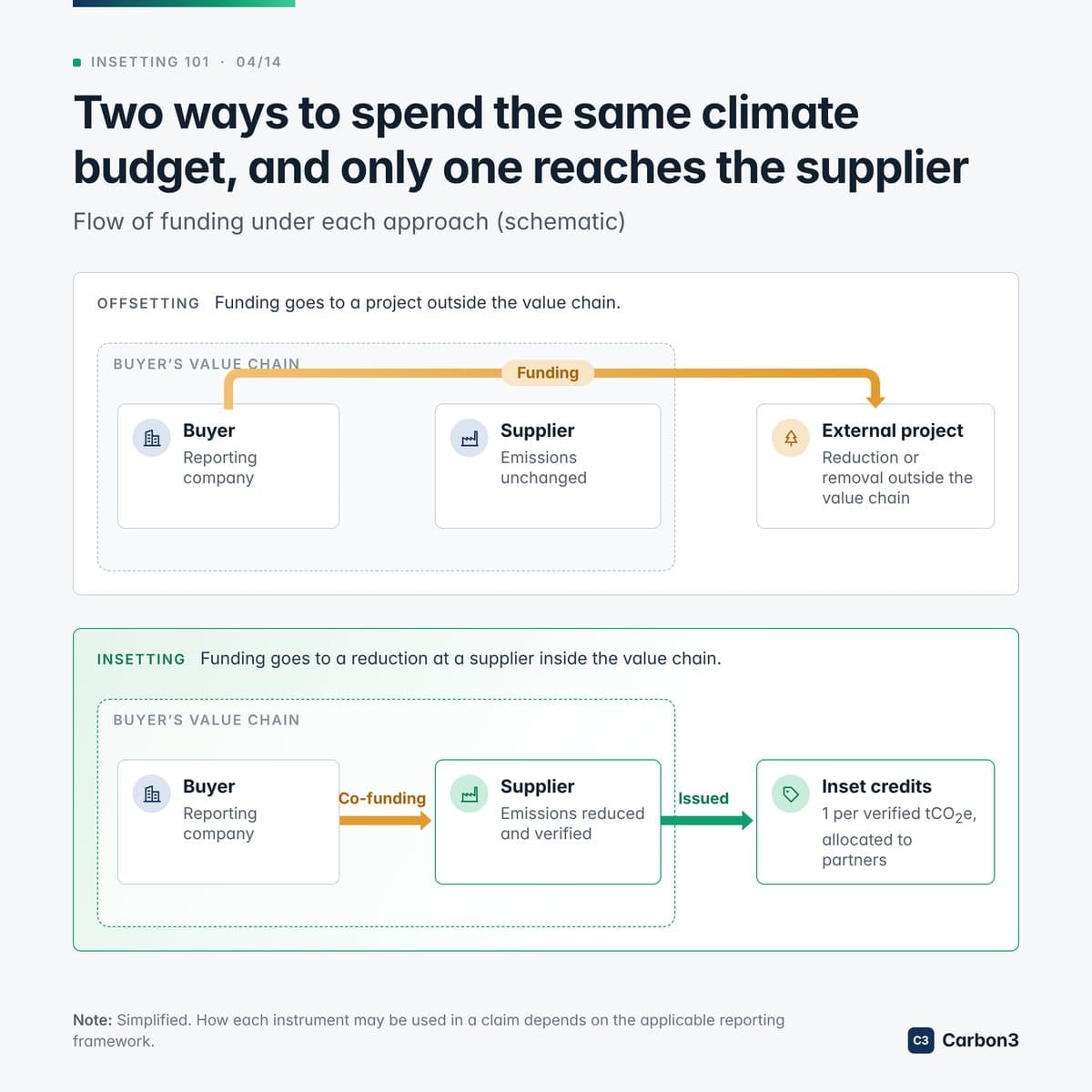
Side by side
| Offsetting | Insetting | |
|---|---|---|
| Where the project sits | Outside the buyer’s value chain | At a supplier or partner inside it |
| Effect on the buyer’s reported emissions | None: the inventory is unchanged and the credit is reported separately | When a supplier in the buyer’s own chain reduces emissions, the buyer’s Scope 3 goes down through lower supplier emissions data. The inset credit is the proof of that emissions reduction and who funded it, and it is not counted a second time. |
| Typical claim | Compensation for emissions that remain | A reduction in the buyer’s own value chain |
| Who benefits directly | The project and its host | The buyer’s own supplier, which shares the cost of its emissions reduction with its customers |
| Verification | Independent, under the crediting program’s rules | Independent: a validation report before work starts and a verification report after monitoring |
| Who issues the credits | The crediting program or registry, under its rules | On Carbon3, credits are issued to the project developer after independent verification, and Carbon3 records them |
| Sharing between funders | Not usually applicable | Credits are allocated between co-funders in line with what each paid |
| Financing before delivery | Varies by program | Future credits can be issued once the project is validated, so funders can pay for implementation |
| Where it fits under SBTi V2.0 | Carbon credits are treated separately, under Ongoing Emissions Responsibility | A project in the value chain may support target implementation if it meets the standard’s criteria; SBTi has not classified inset credits as such |
What changes in the emissions inventory
A company’s greenhouse gas inventory under the GHG Protocol records the emissions physically associated with its operations and value chain. Buying an offset does not change those emissions; the credit is reported separately from the inventory. An inset funds a change at a supplier, so the emissions the supplier reports as Scope 1 fall. When a supplier in the buyer’s own chain reduces emissions, the buyer’s Scope 3 goes down through lower supplier emissions data. The inset credit is the proof of that emissions reduction and who funded it, and it is not counted a second time. An emissions reduction outside the buyer’s own chain is reported separately, not as a lower Scope 3 figure.
The open question is how a buyer may count that reduction. When the physical product can be traced to the buyer, the reduction shows up through better supplier data. When it cannot, as with fuel delivered into a shared system, the buyer relies on a market instrument such as an inset credit or a book and claim certificate. The GHG Protocol’s actions and market instruments workstream is developing rules for this case. Feedback on its white paper closed on 31 May 2026 and showed strong support for a multi-statement reporting structure, a market-based inventory approach and a separate statement for the effects of actions. The white paper is not yet a draft standard.
What the rules say today
| Rule | Status | What it means here |
|---|---|---|
| GHG Protocol Scope 3 Standard and actions and market instruments standard | Under revision; consultation draft estimated 2027, revised standard estimated Q4 2028 | Will settle how a buyer reports a supplier’s reduction bought through a market instrument. Until then, Carbon3 builds to the strictest reading. |
| SBTi Corporate Net-Zero Standard V2.0 | Published 11 June 2026; validations from 1 February 2027; mandatory for new submissions from 1 February 2028 | Prioritizes direct decarbonization in operations and value chains. Recognizes projects implemented by or on behalf of the company, and energy and commodity certificates, that meet its integrity criteria; their outcomes are reported separately from the physical inventory. Carbon credits sit under Ongoing Emissions Responsibility. |
| SBTi Ongoing Emissions Responsibility | Introduced with V2.0 | Voluntary action on emissions released on the path to net zero, including removals and mitigation funding; from 2035, Category A companies must address part of their ongoing emissions with removals. |
| Directive (EU) 2024/825 | Applies from 27 September 2026 | Bans claims that a product has a neutral, reduced or positive greenhouse gas impact based on offsetting. Inset credits support Scope 3 reporting, not such product claims. |
When each fits
- Insetting fits when the emissions sit with identifiable suppliers or carriers that could reduce them with funding: a shipping line’s fuel, a steel mill’s process, farm practices in a sourcing region. See the sectors on the Insetting 101 page.
- Offsetting and removals fit emissions a company cannot yet reduce in its own operations or value chain, and the voluntary action on ongoing emissions that SBTi V2.0 encourages.
- Many companies use both: insetting for the supply-chain emissions they can influence, and high-quality offsets or removals for the rest, each reported in its own place.
Insetting through Carbon3
Carbon3 is a registry and marketplace for inset credits, not offsets. Each credit is issued to the project developer: realized credits after the independent verification report, and future credits once the project is validated. Carbon3 records every allocation, transfer, sale and retirement against the credit’s serial number, so each tonne is claimed once.
Read how it works, the methodology or the Insetting 101 guide.
Questions
Is insetting better than offsetting?
They do different jobs. Insetting reduces emissions inside a company’s value chain; offsetting compensates for emissions that remain. A credible climate plan puts its own emissions reductions first and reports each instrument for what it is.
Do inset credits reduce a company’s Scope 3 emissions?
The reduction happens at the company’s supplier, inside its value chain, which Scope 3 accounting covers. How a buyer may count a reduction bought through a credit is being settled in the GHG Protocol revision, estimated for the fourth quarter of 2028; claim treatment depends on the applicable reporting framework.
Can an inset credit be used for a carbon neutral product claim?
No. Inset credits support Scope 3 reporting. In the EU, Directive (EU) 2024/825 bans product claims of a neutral, reduced or positive greenhouse gas impact based on offsetting from 27 September 2026, and Carbon3 does not support product neutrality claims from credits.
Who verifies inset credits on Carbon3?
Independent bodies. A validator checks the scope, baseline and method before work starts; an independent verifier confirms the tonnes after monitoring. Carbon3 never validates, verifies or issues; credits are issued to the project developer and Carbon3 records them.
Sources
- GHG Protocol, Actions and Market Instruments Standard. White paper and request for information; not yet a draft standard
- GHG Protocol, key standard development updates: FAQ. Preliminary feedback on the actions and market instruments white paper
- GHG Protocol, Consolidated Corporate Standard: Standard Development Plan (29 July 2026). Request for information 31 March to 31 May 2026; consultation draft estimated Q2 2027; revised standard estimated Q4 2028
- SBTi, From Ambition to Action: Actions and Market Instruments in the Corporate Net-Zero Standard Version 2.0. Projects, market instruments, claims and the treatment of carbon credits
- SBTi, Introducing the Corporate Net-Zero Standard Version 2.0 (11 June 2026). Implementation hierarchy, market instruments, Ongoing Emissions Responsibility
- SBTi Services, Guide for Companies in the Transition to Corporate Net-Zero Standard Version 2.0 (June 2026). Key dates
- Directive (EU) 2024/825 on empowering consumers for the green transition. Applies from 27 September 2026
- Carbon3 methodology and standards map
Read next
The Carbon3 Newsletter
Weekly analysis of industrial decarbonization and insetting across Scope 1 to 3, from the Carbon3 team.