Insetting for sustainable aviation fuel
Sustainable aviation fuel (SAF) costs more than fossil jet fuel, and airlines cannot close that gap alone. Travel and cargo buyers can share the cost and receive inset credits for their share.
Why insetting fits aviation
A clear beneficiary
Corporate travel and air cargo customers have identifiable Scope 3 claims, the fuel difference can be audited, and retirement through the IATA SAF Registry keeps a single claim chain.
The constraint is financial
Producers cannot invest without offtake, and airlines will not commit without customers sharing the premium. Customers will only pay for verified claims that are counted once, and that is where Carbon3 comes in.
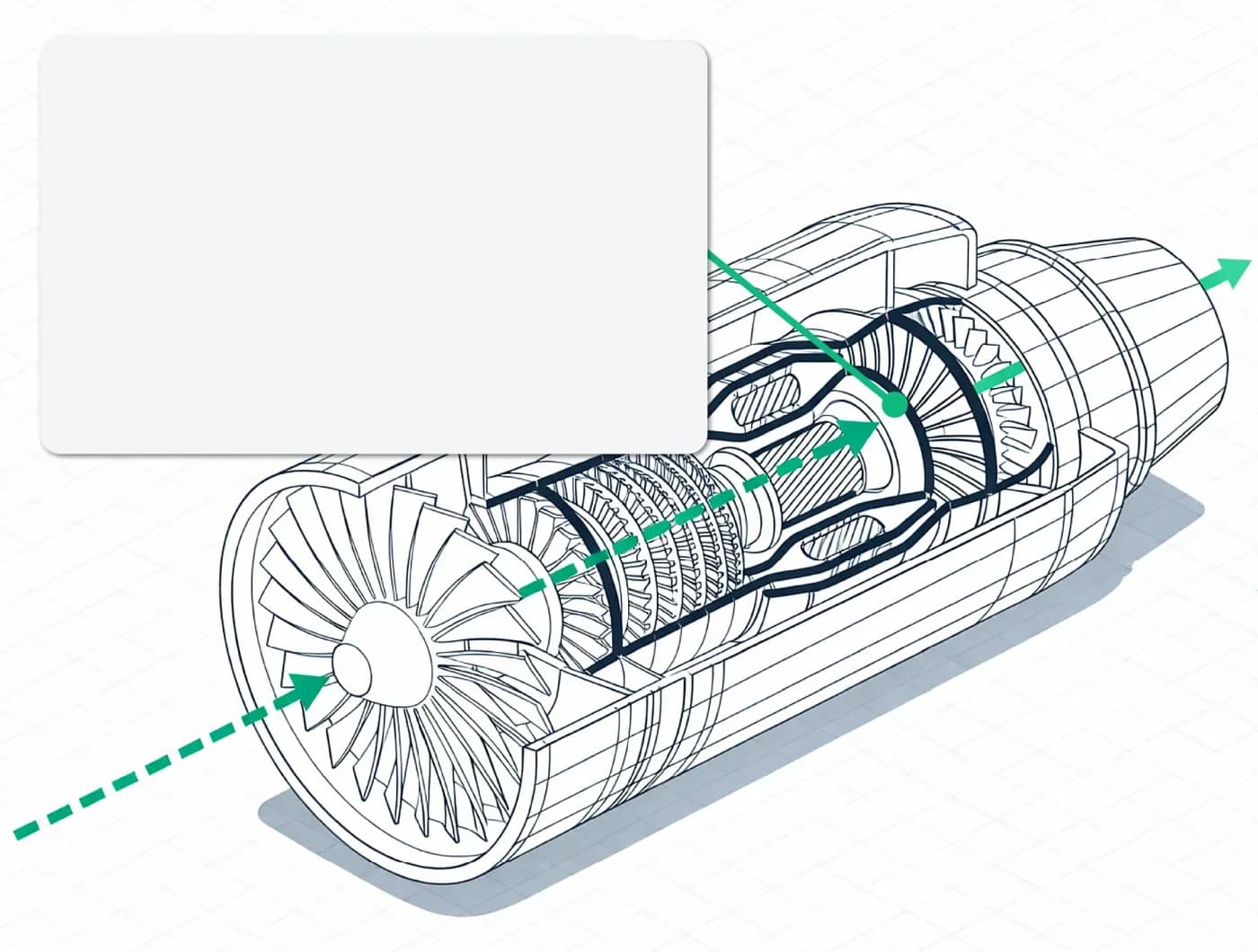
Illustrative
Only fuel above the mandate
- Counts
- SAF above the ReFuelEU share
- Funders
- Travel and cargo customers
- Credit records
- The fuel batch
Typical inset projects in aviation
- 01
Corporate travel programs
Companies with large business travel programs fund SAF above the mandate with the airlines they fly most. Each receives credits in proportion to its contribution and retires them against business travel emissions in Scope 3.
- 02
Air cargo lanes
Shippers and forwarders fund SAF on the cargo routes they use. The verified reduction is allocated per shipment or per tonne of freight, and forwarders can pass credits on to their own customers.
- 03
e-SAF offtake
Buyers make multi-year commitments to buy synthetic fuel made from green hydrogen and captured CO₂. Offtake from several buyers gives a new plant the contracted demand it needs to reach an investment decision.
How an aviation inset works
Only fuel above the ReFuelEU mandate counts. Customers share the premium and receive the credits.
- 1Airline
Scope the fuel purchase
An airline defines a volume of sustainable aviation fuel (SAF) beyond what the law requires, with its feedstock and certified life-cycle emissions.
- 2Airline and customers
Agree on the split
Corporate travel and air cargo customers each take a share of the premium and of the credits.
- 3Independent verifier
Validation report
An independent verifier confirms the volume, the fossil jet fuel baseline and that the fuel is above mandate and not claimed under CORSIA.
- 4Airline, fuel supplier
Fuel supply
The SAF is delivered into the airport fuel system, with its sustainability certificates.
- 5Independent verifier
Verification report
The verifier checks delivery records and certificates and states the verified reduction.
- 6Project developer, on the Carbon3 registry
Issuance to the project developer
Realized credits, one per tonne in the verification report, are issued to the airline and recorded on the Carbon3 registry. Future credits can also be issued to it earlier, once the project is validated. They stay labeled Future, and buyers who take them carry the delivery risk.
- 7Airline
Allocation by book and claim
Customers receive their credits without the fuel being on their own flights.
- 8Customers
Retirement
Each customer retires its credits against business travel or freight emissions in Scope 3.
Travel and cargo share the cost
The airline buys the fuel. The customers whose Scope 3 benefits pay part of the premium.
Airline
Buys and uplifts the fuel
Travel buyer
Company with a corporate travel program
Air cargo customer
Shipper or freight forwarder
Travel and cargo customers have clear Scope 3 claims. The fuel difference can be audited, and the credit records which batch it came from.
SAF above the mandate on one route
An airline buys extra SAF for its flights between two European hubs. A professional services firm with heavy business travel and a freight forwarder fund it.
Who pays what
Travel buyer
Freight forwarder
| Funder | Share | Pays | Credits, years 1 to 5 | Of which future credits (years 1 and 2) |
|---|---|---|---|---|
| Travel buyer | 60% | €720,000 | 8,280 t | 2,880 t |
| Freight forwarder | 40% | €480,000 | 5,520 t | 1,920 t |
| Total | 100% | €1,200,000 | 13,800 t | 4,800 t |
Future and realized credits in this example
1At validation
The 4,800 tonnes planned in years 1 and 2 are bought as future credits, so the money funds the implementation and the holders carry the delivery risk.
2After each verification
The 9,000 tonnes verified in years 3 to 5 are issued as realized credits, one per tonne in the verification report.
Cost per verified tonne
Spread over 5 years of credits, the project cost comes to €87 per verified tonne, a figure to compare with the internal carbon price or with the CBAM certificate cost an importer faces. Real prices are not shown.
Assumptions
- SAF premium of €1,200,000 in total.
- Full rate of 3,000 t a year from year 2.
- Only fuel above the mandate counts.
- Credits are split in line with what each funder paid.
- One credit equals one verified tonne of CO₂e.
- No real companies, prices or projects. Fees are not shown.
- Illustrative split: the credits for years 1 and 2 are bought as future credits at validation; later years are taken as realized credits after each verification. The real split is agreed project by project.
Five years of extra SAF
Credits per year by customer.
Credits per year, in tonnes
- Travel buyer (60%)
- Freight forwarder (40%)
- Future credits, bought at validation
13,800 t in total over 5 years
Assumptions
- Same volume above the mandate each year.
- The mandate rises over time; only volume above it counts.
- Real results depend on supply and verification.
- Illustrative split: the credits for years 1 and 2 are bought as future credits at validation; later years are taken as realized credits after each verification. The real split is agreed project by project.
Aviation rules and claims
Two schemes set what airlines must do. Inset credits sit on top of both.
ReFuelEU Aviation applies to fuel suppliers at EU airports and CORSIA to airlines on covered international routes. Travel and cargo customers report the reduction in Scope 3 under the GHG Protocol and set targets with the SBTi on their physical inventory. The Carbon3 registry gives each inset credit one serial number and one holder, so each tonne is counted once.
- Fuel supplier at an EU airport
- ReFuelEU AviationA minimum SAF share. Only SAF above it backs a credit.
- Airlinebuys and uplifts the fuel
- CORSIAThe airline’s own obligation on covered international routes. Fuel claimed there does not also back a credit.
- Travel and cargo customers’ report
- GHG Protocol Scope 3A supplier’s reduction shows in Scope 3 when it is in the data the company uses, such as a supplier-specific factor.
- SBTiTargets are set on the physical inventory.
Counting each tonne once
Carbon3 registry: each inset credit has one serial number and one holder. A transfer moves it, retirement closes it.
SCHEMATIC, ILLUSTRATIVE. GENERAL INFORMATION AS OF OCTOBER 2026, NOT LEGAL ADVICE.
ReFuelEU Aviation
- What the standard is
- ReFuelEU Aviation obliges fuel suppliers at EU airports to blend a minimum share of sustainable aviation fuel (SAF) into jet fuel. The share is 2% from 2025 and 6% from 2030, of which 1.2% must be synthetic fuel made from hydrogen, and it rises to 70% in 2050, with 35% synthetic.
- A reduction in the company’s own supply chain
- The blending obligation sits with fuel suppliers at EU airports, not with airlines or their customers. SAF up to the mandated share is part of the baseline.
- One in its industry, outside its chain
- Mandated SAF supplied at other airports or to other airlines counts only towards the fuel supplier’s own obligation.
- What an inset credit does
- Only SAF supplied above the mandated share can back an inset credit. Volumes a fuel supplier counts towards its own mandate are excluded.
CORSIA
- What the standard is
- CORSIA is the International Civil Aviation Organization’s scheme for CO₂ from international flights. Airlines on covered routes must compensate growth above a baseline, and can lower that obligation with eligible fuels. Participation was voluntary until 2026. From 2027, its second phase covers states above set aviation-activity thresholds. Least developed countries and small island and landlocked developing states are exempt unless they volunteer. 134 states take part from 2027.
- A reduction in the company’s own supply chain
- The obligation sits with airlines on covered international routes. An airline that flies the company’s staff or cargo can lower its own obligation with eligible fuels.
- One in its industry, outside its chain
- Fuel an airline claims under CORSIA counts for that airline’s obligation only, whoever it flies.
- What an inset credit does
- Inset credits are not CORSIA eligible emissions units. Fuel an airline claims to lower its own CORSIA obligation should not also back an inset credit for a customer.
GHG Protocol: Scope 3 Standard
- What the standard is
- The Greenhouse Gas Protocol sets the accounting rules most companies use for their emissions. Its Corporate Value Chain (Scope 3) Standard, published in 2011, covers the emissions in a company’s value chain in 15 categories, from purchased goods and transport to the use of sold products. It has no market-based method for Scope 3, so purchased certificates or credits do not change the Scope 3 figure, unlike electricity in Scope 2.
- A reduction in the company’s own supply chain
- A reduction at a supplier the company buys from lowers its Scope 3 inventory when it shows up in the data the company uses, for example a supplier-specific emission factor for the goods it purchases. A spend-based average will not show it.
- One in its industry, outside its chain
- A reduction at a producer outside the company’s own supply chain is not part of its inventory under any method. It can be disclosed separately as an action, not as a lower Scope 3 figure.
- What an inset credit does
- When a supplier in the buyer’s own chain reduces emissions, the buyer’s Scope 3 goes down through lower supplier emissions data. The inset credit is the proof of that emissions reduction and who funded it, and it is not counted a second time. An emissions reduction outside the buyer’s own chain is reported separately, not as a lower Scope 3 figure. The GHG Protocol’s Actions and Market Instruments workstream is developing a market-based approach for Scope 3. A consolidated draft is expected for public consultation in the second quarter of 2027, and the revised standard in the fourth quarter of 2028. Each Carbon3 credit records the supplier, project, baseline and verification report, so it can be reported under the current rules and reassessed under the new ones.
Science Based Targets initiative (SBTi)
- What the standard is
- The SBTi validates whether a company’s emissions reduction targets are consistent with climate science. Its Corporate Net-Zero Standard V2.0 was published on 11 June 2026. Validations under it open on 1 February 2027, and it becomes mandatory for new target submissions from 1 February 2028. Targets already validated under the earlier version stay valid for their cycle. Target ambition is always set on the company’s physical inventory.
- A reduction in the company’s own supply chain
- Reductions that show up in the company’s inventory support emissions reduction claims. A project implemented by or on behalf of the company in its own value chain, with measured outcomes reported in proportion to its contribution, can support target implementation and an “alignment” claim.
- One in its industry, outside its chain
- Action in a shared system the company draws on, such as a supply shed or logistics network, or at sector level, counts only where direct action in its own chain is constrained. It supports a separate “system contribution” claim, reported apart from the inventory.
- What an inset credit does
- Projects must be measured, additional and verifiable. Their outcomes must be uniquely attributed, with serialized tracking to prevent double counting. Credits a company sells on cannot also count for that company. The SBTi plans interim guidance on reporting projects and market instruments for consultation in the fourth quarter of 2026, so how a received inset credit is assessed is not yet fully settled.
Counting each tonne once
- What the standard is
- Double counting happens when two companies claim the same tonne, when one tonne is sold twice, or when a reduction is credited by two programs. Standards such as the SBTi’s now require serialized tracking to prevent it.
- A reduction in the company’s own supply chain
- Several companies in one chain can fund the same project. Each receives its own serialized credits, so no tonne has two holders.
- One in its industry, outside its chain
- The same rule applies wherever the tonne sits: one serial number, one holder, and no credit for a reduction already credited by another program.
- What an inset credit does
- Each credit has a serial number and exactly one holder on the Carbon3 registry. A transfer moves it rather than copying it, and retirement closes it permanently. A reduction already credited elsewhere is excluded at validation.
General information as of October 2026, not legal, accounting or reporting advice. Standards and regulations change; check the current text.
Aviation questions
Not necessarily. SAF is blended into the shared fuel system at the airport, so no passenger or shipment can be tied to a particular liter. With book and claim, the customer that funded the SAF receives the verified reduction as credits, and the registry makes sure each tonne is claimed once.
Talk to us about an aviation fuel program
Travel buyers, cargo shippers, airlines and fuel producers can see how an inset program would be scoped, verified and allocated.