On this page
Why it matters
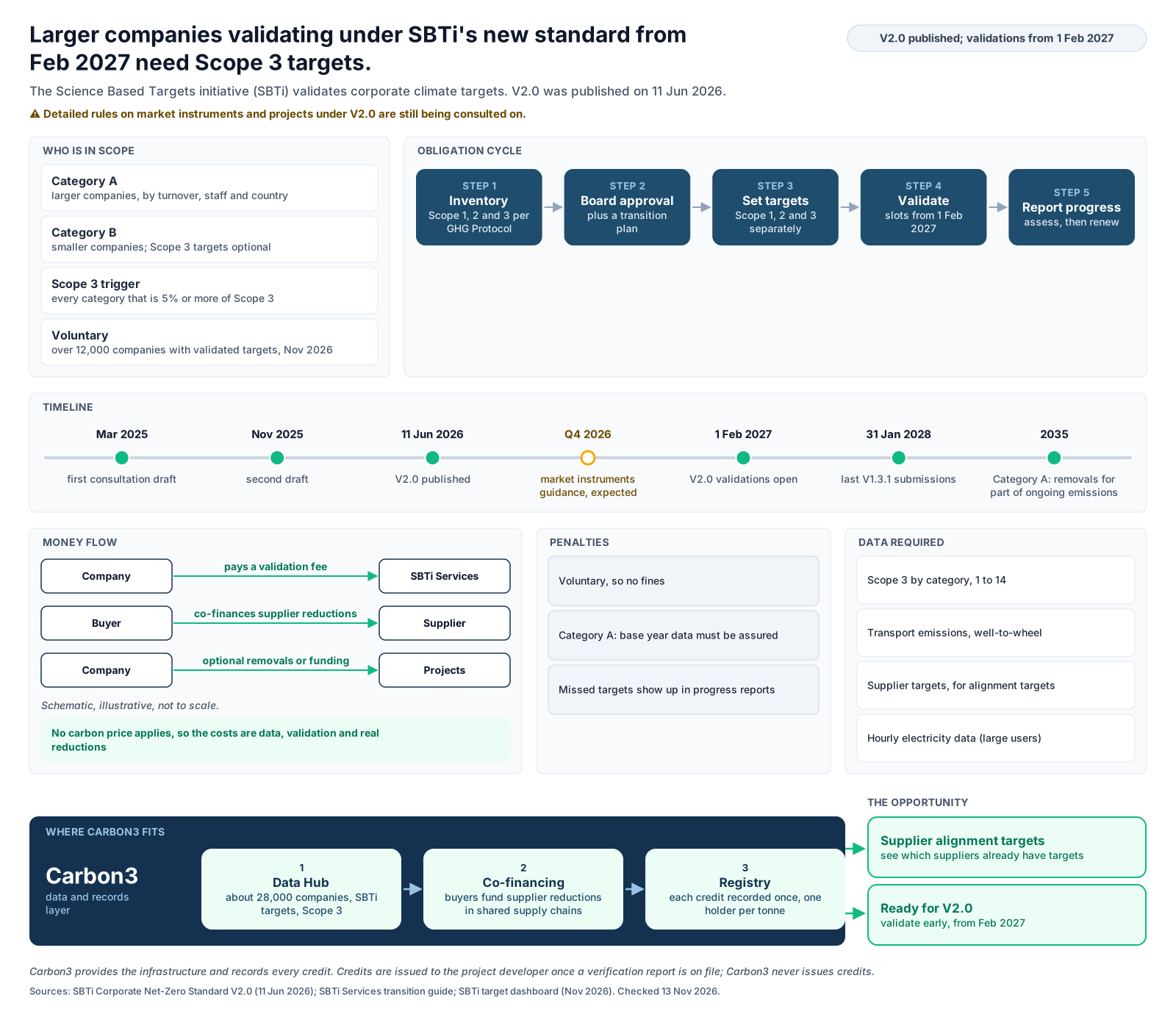
More than 12,000 companies have validated science-based targets, as of November 2026. Under V2.0, larger companies need a Scope 3 target for every category that makes up 5% or more of their Scope 3 emissions.
Scope 3 means the emissions in a company's value chain, from purchased goods to transport and the use of sold products. Buyers that know which suppliers already have targets and sourced data can plan those reductions earlier and with fewer surveys.
Every Scope 3 category above 5% of the total now needs its own target.
Category A companies are those with turnover over €50 million in high-income countries or over €450 million elsewhere. They set separate targets for Scope 1, 2 and 3, have their base year data assured and, from 2035, address part of their ongoing emissions with removals. Category B covers smaller companies, for which Scope 3 targets are optional.
In this illustrative company, six of 15 Scope 3 categories reach 5% and each needs its own target.
| Category | Share of Scope 3 | Target needed |
|---|---|---|
| 1. Purchased goods and services | 38% | Yes |
| 11. Use of sold products | 22% | Yes |
| 4. Upstream transport | 9% | Yes |
| 12. End-of-life treatment | 7% | Yes |
| 2. Capital goods | 6% | Yes |
| 9. Downstream transport | 5.5% | Yes |
| 3. Fuel and energy activities | 4% | No |
| 6. Business travel | 2% | No |
| 5. Waste | 1.5% | No |
| 7. Employee commuting | 1.5% | No |
| 10. Processing of sold products | 1.5% | No |
| 8. Upstream leased assets | 0.5% | No |
| 13. Downstream leased assets | 0.5% | No |
| 14. Franchises | 0.5% | No |
| 15. Investments | 0.5% | No |
Companies can still submit under the old criteria until 31 Jan 2028.
The first consultation draft came out in March 2025 and a second in November 2025, before V2.0 was published on 11 Jun 2026. Guidance on market instruments is expected in the fourth quarter of 2026, and validations under V2.0 open on 1 Feb 2027. The last submissions under version 1.3.1 are due by 31 Jan 2028.
Mar 2025
first consultation draft
Nov 2025
second draft
11 Jun 2026
V2.0 published
Q4 2026
market instruments guidance, expected (proposed) (not in force yet)
1 Feb 2027
V2.0 validations open
31 Jan 2028
last V1.3.1 submissions
2035
Category A removals for part of ongoing emissions
A company needs a full inventory and board approval before it applies.
The company builds a Scope 1, 2 and 3 inventory under the GHG Protocol, gets board approval together with a transition plan, and sets separate targets per scope. After validation it reports progress every year and renews its targets when they are assessed.
Scope 3 coverage now follows significance, not fixed percentages.
- Companies are sorted into Category A and Category B, by turnover, geography, emissions and employees, with different obligations. Category A companies have more requirements, including third-party assurance.
- Fixed coverage percentages are replaced by significance. Scope 3 targets must cover every category that is 5% or more of Categories 1 to 14. Optional exclusions apply in named categories (3, 7, 8, 9, 10 and 14) where a company cannot practically influence outcomes, and each must be justified.
- Category A companies must identify emissions-intensive activities and report those that are 5% or more of Scope 3 emissions.
- Alongside emissions reduction targets, companies can set supplier and customer alignment targets, and new volume, product-use and end-of-life methods.
- Long-term Scope 3 targets become optional.
V2.0 was adopted by SBTi’s Board of Trustees on 21 May 2026, after approval by the Technical Council on 8 May. Targets already validated under V1 remain valid for their target cycle.
An implementation hierarchy sets the order of action behind each target.
Targets remain based on the physical GHG inventory. To deliver them, V2.0 sets out an order of action:
- Activity level: direct emissions reductions in the company’s operations and value chain, such as efficiency, electrification or switching to lower-emission suppliers.
- Activity pool: action in the shared systems the company draws on, such as electricity grids, supply sheds and logistics networks.
- Sector level: action that helps transform the wider sector, where barriers prevent enough decarbonization at the first two levels and the company can show a geographical or systemic link.
Projects can support target implementation when they are implemented by or on behalf of the company and relate to the relevant underlying activity. They must also deliver measurable outcomes and meet the standard’s integrity criteria, which include additionality and leakage. Market instruments, meaning energy and commodity certificates, are recognized where they accurately convey emissions attributes, are volume-matched and are tracked in transparent, secure registries.
| Claim | Based on |
|---|---|
| Emissions reduction claim | Changes in the physical GHG inventory |
| Alignment claim | Activity-level actions that cause measurable changes within the company’s operations or value chain |
| System contribution claim | Activity pool or sector-level actions that support decarbonization of the systems the value chain is part of |
Carbon credits sit apart, under Ongoing Emissions Responsibility.
SBTi treats carbon credits separately from market instruments, under an optional Ongoing Emissions Responsibility framework that recognizes companies supporting mitigation beyond their own targets. From 2035, Category A companies must support carbon removals for part of their ongoing emissions. Credits complement decarbonization and do not substitute for it.
What it costs to fall short
SBTi is voluntary, so there are no fines. The cost of a weak submission is a rejected or delayed validation, and missed targets show up in the public progress reports that customers and investors read.
Where Carbon3 fits
Carbon3 provides the financial infrastructure that turns SBTi Scope 3 targets into co-financing that suppliers can invest against.
The Data Hub lists about 28,000 companies with their targets and Scope 3 emissions by category, including about 7,800 SBTi target records, as of November 2026. Buyers can pool demand around shared suppliers and co-finance the green premium, meaning the extra cost of the cleaner option, so suppliers do not carry the upfront cost alone. That demand de-risks and unlocks supplier investment against a shared financing commitment.
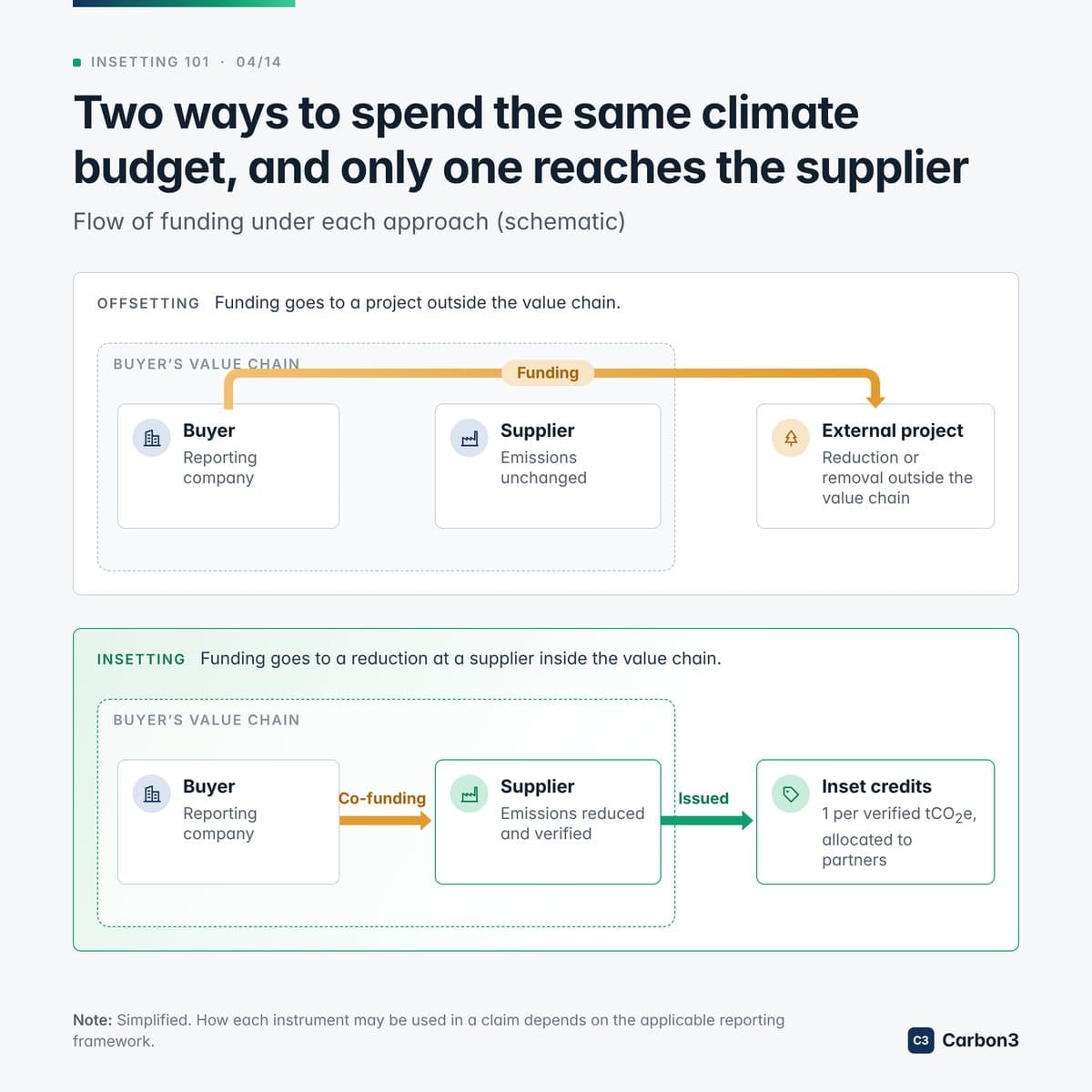
Carbon3 records each inset credit once in its registry, checked against a verification report on file. Inset credits are not offsets; they record emissions reductions inside a buyer's own value chain.
Claim treatment depends on the applicable reporting framework.