On this page
Why it matters
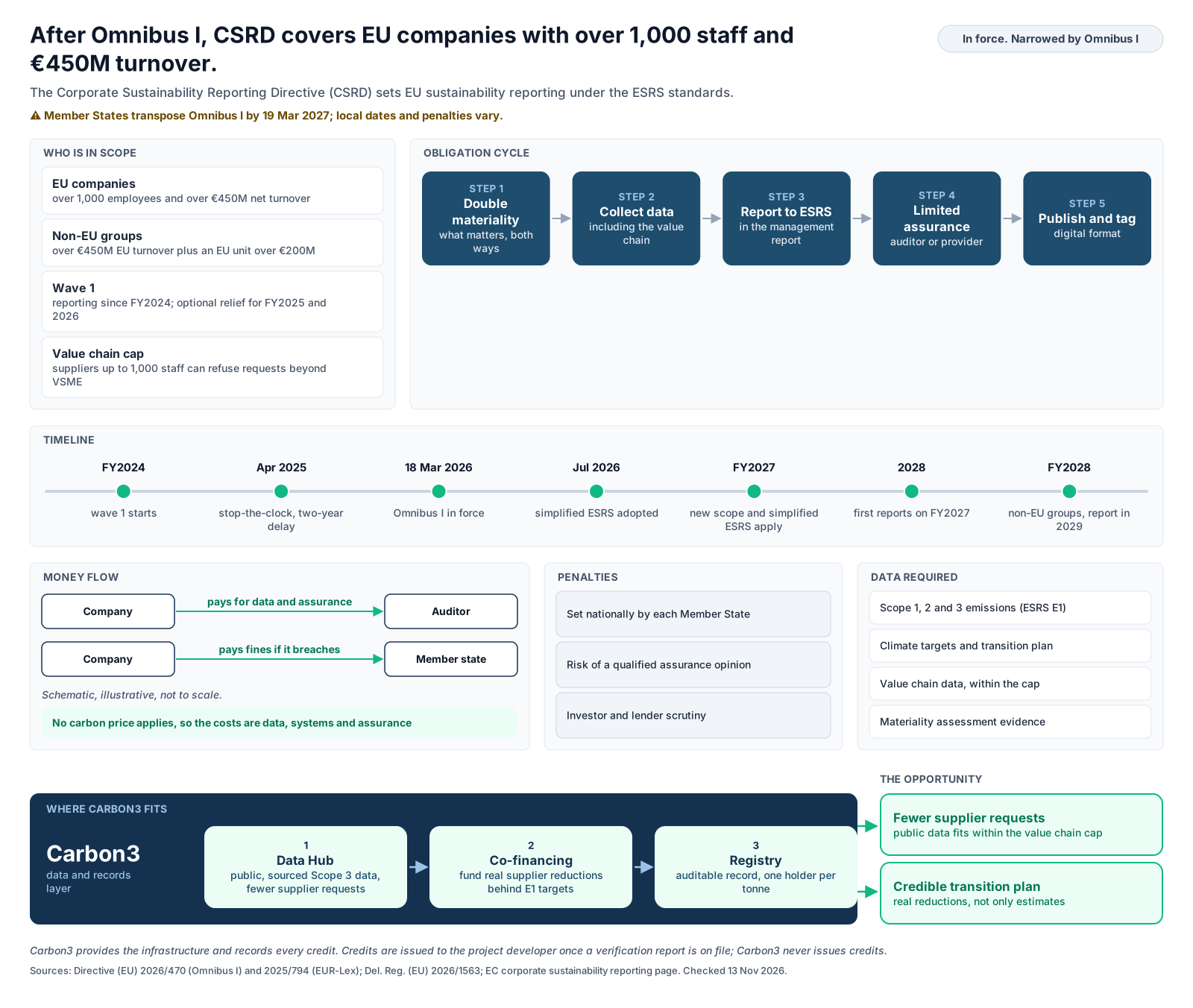
Omnibus I cut the number of companies that must report, and it also limits what they can ask of smaller suppliers. Suppliers with up to 1,000 staff can now refuse data requests that go beyond the voluntary reporting standard for small and medium-sized companies (VSME).
Large reporters still need Scope 3 figures. Sourced public data fills part of that gap without months of supplier surveys, and real supplier reductions give a transition plan more weight than estimates.
Omnibus I raised the reporting threshold to more than 1,000 employees and €450 million turnover.
EU companies are in scope when they have over 1,000 employees and over €450 million net turnover. Non-EU groups are in scope with over €450 million EU turnover and an EU subsidiary or branch over €200 million. Wave 1 companies have reported since financial year 2024 and may use optional relief for 2025 and 2026.
From financial year 2027, a company reports only when it passes both thresholds.
| Who | Both conditions | From |
|---|---|---|
| EU companies | Over 1,000 employees and Over €450 million net turnover | In scope from financial year 2027 |
| Non-EU groups | Over €450 million EU turnover and EU subsidiary or branch over €200 million | In scope from financial year 2028, reports in 2029 |
Directive (EU) 2026/470 has applied since March 2026, and national laws follow by March 2027.
The 2025 stop-the-clock directive delayed later reporting waves by two years. Omnibus I, Directive (EU) 2026/470, entered into force on 18 Mar 2026, and Member States must transpose it by 19 Mar 2027. The simplified ESRS, Delegated Regulation (EU) 2026/1563 of 3 Jul 2026, apply to financial years from 1 Jan 2027.
FY2024
wave 1 starts
Apr 2025
stop-the-clock, two-year delay
18 Mar 2026
Omnibus I in force
3 Jul 2026
simplified ESRS adopted
19 Mar 2027
transposition deadline
FY2027
new scope and simplified ESRS apply
2028
first reports on FY2027
FY2028
non-EU groups, reports in 2029
A CSRD report starts with a double materiality assessment and ends with assurance.
The company starts with a double materiality assessment, which checks both how climate affects the company and how the company affects the climate. It then collects data across its value chain, reports under ESRS in the management report, obtains limited assurance from an auditor or another provider, and publishes the report in a tagged digital format.
What it costs to fall short
Each Member State sets its own penalties. Beyond fines, a company risks a qualified assurance opinion and closer scrutiny from investors and lenders.
Where Carbon3 fits
Carbon3 provides the financial infrastructure that turns CSRD transition plans into funded emissions reductions.
The Data Hub provides public, sourced Scope 3 data on about 28,000 companies, as of November 2026, which cuts down supplier questionnaires and surfaces shared buyer demand. Reporters can co-finance the green premium, meaning the extra cost of the cleaner option, at suppliers behind their ESRS E1 targets, de-risking and unlocking supplier capex while backing transition plans with real action.
Carbon3 records each resulting emissions reduction once in its registry, checked against a verification report on file, with one holder per tonne.
Claim treatment depends on the applicable reporting framework.