On this page
Why it matters
Many companies already pay for emissions reductions outside their own operations, through green steel, sustainable aviation fuel, biomethane certificates or co-financed upgrades at a supplier. The GHG Protocol is now writing the rules for how such actions and market instruments appear in a climate report.
The final standard is planned for the fourth quarter of 2028, so the rules are still open. Buyers that keep traceable, single-claim records from today will have a usable history whatever the final text says.
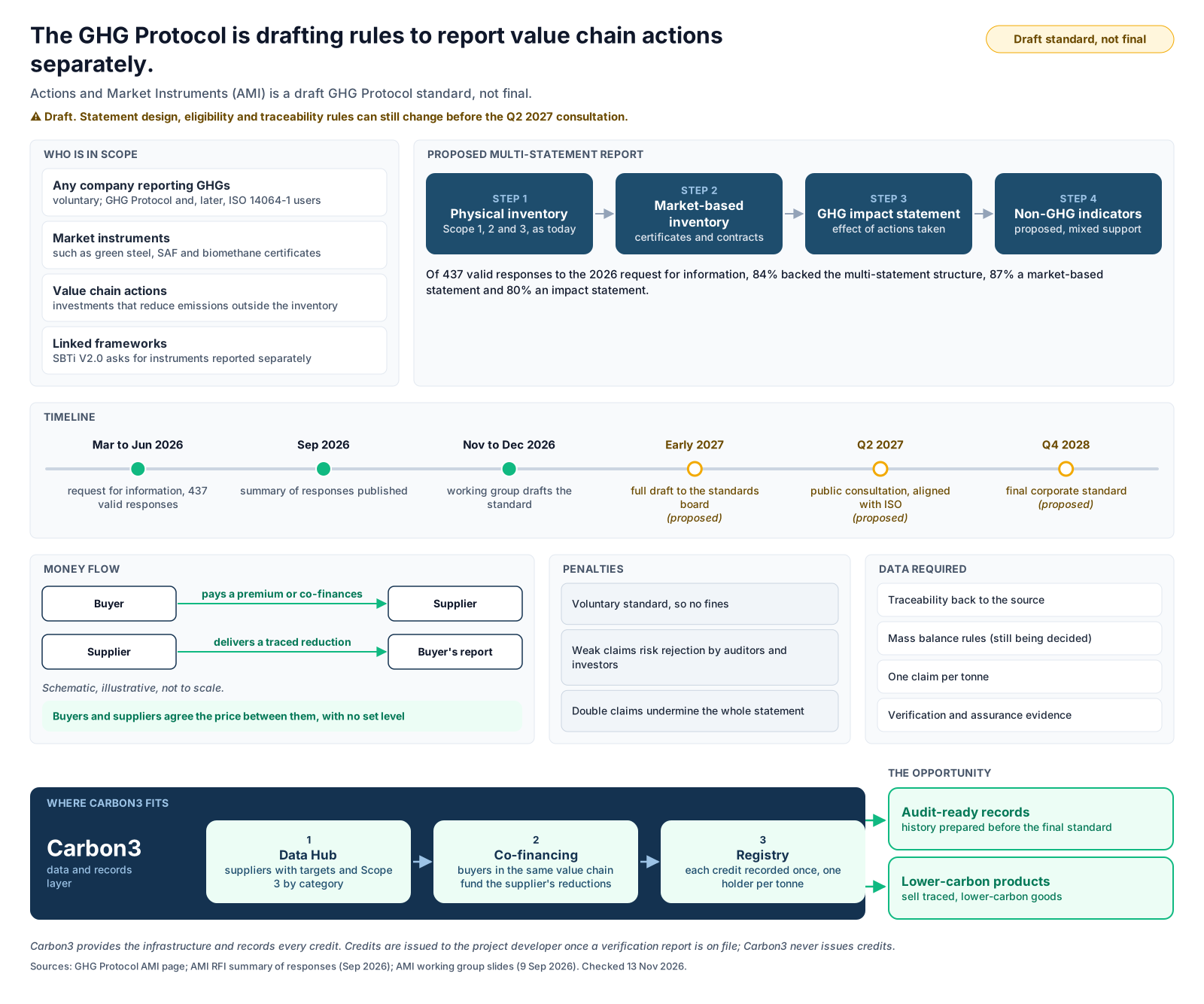
The draft splits a climate report into an inventory and separate statements for actions.
The physical inventory keeps Scope 1, 2 and 3 emissions as companies report them today. A market-based inventory would add certificates and contracts, a GHG impact statement would show the effect of actions on emissions, and non-GHG indicators remain a proposal. In the RFI, 87% supported the market-based statement and 80% the impact statement, while only 33% supported non-GHG indicators.
Most respondents backed separate statements, while only a third backed non-GHG indicators.
| Statement | What it covers | Support |
|---|---|---|
| Physical inventory | Scope 1, 2 and 3 as today | 84% |
| Market-based inventory | Certificates and contracts | 87% |
| GHG impact statement | Effect of actions on emissions | 80% |
| Non-GHG indicators | Still a proposal | 33% |
A final corporate standard is not expected before the fourth quarter of 2028.
The RFI ran from March to June 2026 and its summary came out on 23 Sep 2026. A working group drafts the standard in November and December 2026. A full draft goes to the standards board at the end of January 2027. A public consultation, merged with the ISO 14064-1 inventory standard, is planned for the second quarter of 2027.
Mar to Jun 2026
RFI open, 437 valid responses
23 Sep 2026
feedback summary published
Nov to Dec 2026
working group drafts the standard
End Jan 2027
full draft to the standards board (planned) (not in force yet)
Q2 2027
public consultation, merged with ISO (planned) (not in force yet)
Q4 2028
final corporate standard (planned) (not in force yet)
Buyers that fund supplier reductions will need traceable records claimed only once.
The working group is still deciding the evidence rules. The draft points to four needs, which are traceability back to the source, proportional mass balance rules, one claim per tonne, and verification and assurance evidence.
What it costs to fall short
AMI carries no fines because it is a voluntary standard. The cost of weak evidence is reputational, since auditors, the Science Based Targets initiative (SBTi) and investors can reject claims they cannot trace, and a double claim undermines the whole statement.
Where Carbon3 fits
Carbon3 provides the financial infrastructure that lets buyers and suppliers fund emissions reductions now, while the AMI rules are still being written.
The Data Hub surfaces buyers with Scope 3 targets among about 28,000 companies, as of November 2026, so suppliers can see real demand before the standard is final. Buyers and suppliers can co-finance the green premium, meaning the extra cost of the cleaner option, today, which de-risks and unlocks value chain investment on both sides, while building an auditable history whatever statement format AMI adopts.
Carbon3 records each inset credit once, checked against a verification report on file, with a single holder per tonne. Inset credits record emissions reductions inside a company's own value chain, which is called insetting, and they are different from offsets.
Claim treatment depends on the applicable reporting framework.