Policy & guides

A global carbon price for shipping is drafted, but countries have not adopted it yet.

The International Maritime Organization (IMO) Net-Zero Framework would set a global fuel standard for ships of 5,000 gross tonnage and above. The IMO says these ships produce over 85% of global shipping emissions. Countries meet from 30 Nov to 3 Dec 2026, and a resumed adoption session is planned for 4 Dec 2026, subject to confirmation.

Proposed rules. The text and prices can still change before any adoption vote.

Proposed, vote 4 Dec 2026 if confirmedDownload one-page summary
On this page

Why it matters

For the first time, every large ship would face a limit on the greenhouse gas intensity of its fuel wherever it sails. The limit is measured from well to wake, meaning from fuel production to use on board, against a 2008 reference of 93.3 gCO₂e (grams of CO₂-equivalent) per megajoule. Ships that beat the stricter target would earn surplus units they can sell or bank, so cleaner fuel would become a source of revenue as well as a cost.

Everything on this page describes the April 2025 draft. The text and prices can still change, and the United States opposes the framework.

Ships above the base target would pay $380 per tonne, nearly 4 times the Tier 1 price.

Each ship's fuel intensity would be compared with two targets every year. A ship between the stricter direct compliance target and the base target would pay $100 per tonne of CO₂e for that gap, called Tier 1. A ship above the base target would pay $380 per tonne for the part above the base target, called Tier 2, plus $100 per tonne for the gap between the two targets. These prices are fixed for 2028 to 2030 only.

Ships above the base target would pay $380 per tonne on that part, and $100 per tonne between the two targets.

Proposed, draft April 2025
Fuel intensity (higher is worse)Tier 2, $380 per tCO₂e on thepart above the base target,plus Tier 1 below itTier 1, $100 per tCO₂eSurplus units, to bank ortransferBase targetDirect compliance target
Draft IMO remedial unit prices, fixed for 2028 to 2030
Ship's fuel intensityResult
Above the base target$380 per tCO₂e on the part above the base target, plus $100 per tCO₂e between the two targets
Between the two targets$100 per tCO₂e for the gap
Below the direct compliance targetSurplus units to bank for up to two years or transfer
Source: IMO MEPC 83 draft; GCMD; Carbon3 analysis.

The draft targets tighten from 4% in 2028 to 30% by 2035 for the base target.

The base target asks for a 4% cut in fuel intensity in 2028, 8% in 2030 and 30% in 2035, compared with 2008. The direct compliance target is stricter, at 17% in 2028, 21% in 2030 and 43% in 2035.

The draft base target cuts fuel intensity 30% by 2035, and the direct target 43%, compared with 2008.

Proposed
Base targetDirect compliance target20284%17%20308%21%203216.8%29.8%203530%43%
Draft IMO fuel intensity cuts compared with 2008 (93.3 gCO₂e per MJ)
YearBase targetDirect compliance target
20284%17%
20308%21%
203216.8%29.8%
203530%43%
Source: IMO MEPC 83 draft MARPOL Annex VI amendments (April 2025); Carbon3 analysis.
  1. Apr 2025

    MEPC 83 approves the draft

  2. Oct 2025

    adoption adjourned for one year

  3. Apr 2026

    MEPC 84 works to rebuild consensus

  4. 23 to 27 Nov 2026

    working group meets

  5. 30 Nov to 3 Dec 2026

    MEPC 85

  6. 4 Dec 2026

    resumed vote, if confirmed (proposed) (not in force yet)

  7. 2028

    first fuel intensity year, if adopted (proposed) (not in force yet)

  8. 2035

    base target 30%, direct target 43% (proposed) (not in force yet)

A container line would earn surplus units by switching to cleaner fuel early.

A container line that bunkers a zero or near-zero fuel on part of its fleet would beat the direct target on those ships. The surplus units could cover another ship's deficit or be banked for up to two years, and the IMO Net-Zero Fund would pay rewards for zero or near-zero fuels under the proposal.

What it costs to fall short

A ship in deficit must cover it with surplus units or remedial units bought from the IMO Net-Zero Fund. Flag states would enforce the rules under MARPOL, the international convention on pollution from ships.

Where Carbon3 fits

Carbon3 turns cargo-owner demand into early co-financing ahead of a future IMO fuel standard.

Among about 28,000 companies in the Data Hub as of November 2026, shipowners and fuel producers can identify cargo owners with Scope 3 targets on their shipping lanes today. Co-financing cleaner fuel lets buyers and operators share the green premium, meaning the extra cost of cleaner fuel, before any mandatory target starts, which de-risks and unlocks early fuel supply.

Carbon3 records each resulting inset credit once, checked against a verification report on file, for the cargo owner's Scope 3 claim. Inset credits are not IMO surplus or remedial units.

Claim treatment depends on the applicable reporting framework.

One-page summary

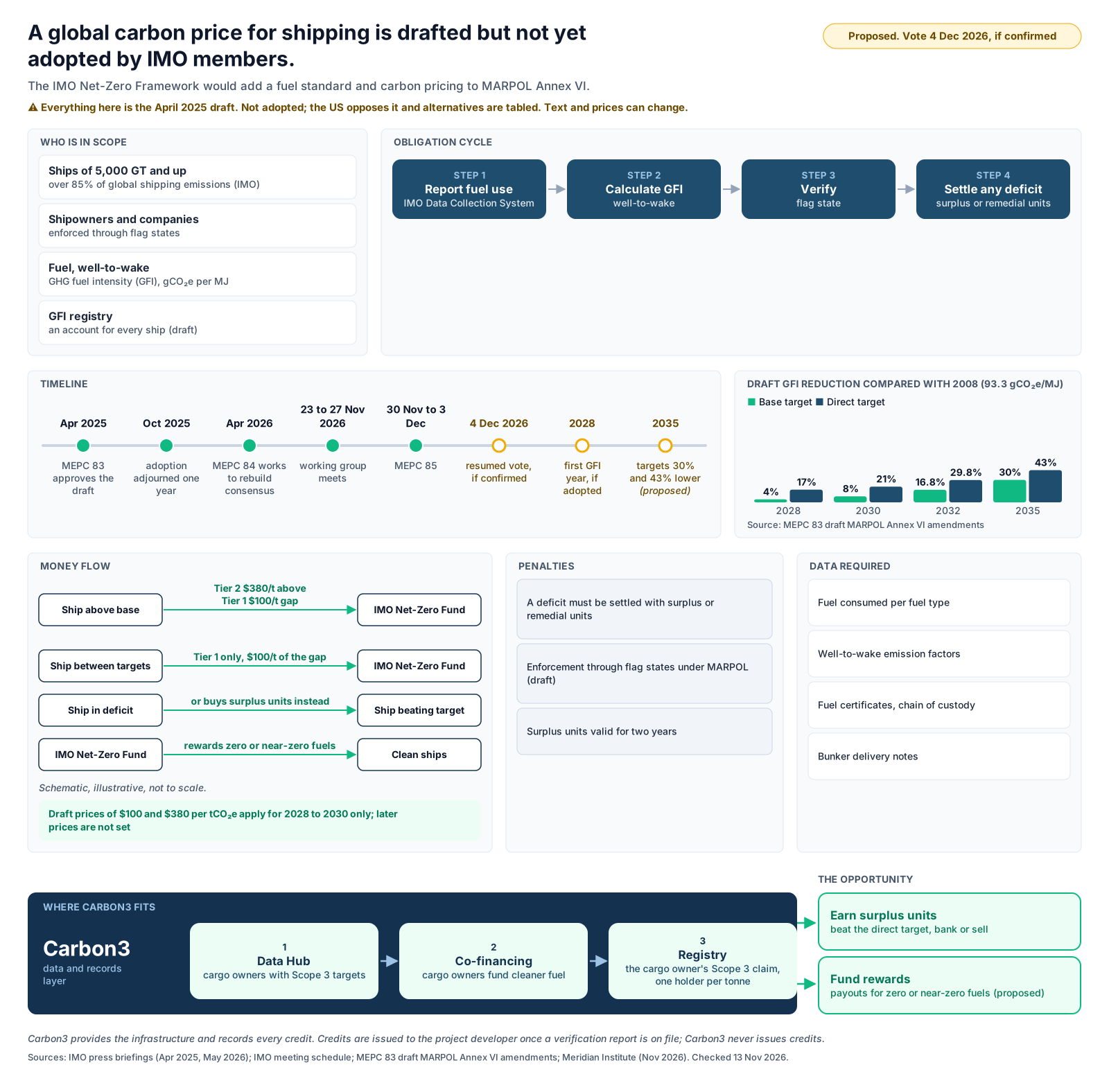
IMO Net-Zero Framework, one-page summaryOne-page summary of IMO Net-Zero Framework: scope, key dates, money, penalties, data and sources. Checked 13 Nov 2026.WHO IS IN SCOPEShips of 5,000 GT and upover 85% of global shipping emissions (IMO)Shipowners and companiesenforced through flag statesFuel, well-to-wakeGHG fuel intensity (GFI), gCO₂e per MJGFI registryan account for every ship (draft)OBLIGATION CYCLESTEP 1Report fuel useIMO Data Collection SystemSTEP 2Calculate GFIwell-to-wakeSTEP 3Verifyflag stateSTEP 4Settle any deficitsurplus or remedial unitsTIMELINEApr 2025MEPC 83 approves the draftOct 2025adoption adjourned one yearApr 2026MEPC 84 works to rebuild consensus23 to 27 Nov 2026working group meets30 Nov to 3 DecMEPC 854 Dec 2026resumed vote, if confirmed2028first GFI year, if adopted2035targets 30% and 43% lower (proposed)DRAFT GFI REDUCTION COMPARED WITH 2008 (93.3gCO₂e/MJ)■ Base target ■ Direct target4%17%20288%21%203016.8%29.8%203230%43%2035Source: MEPC 83 draft MARPOL Annex VI amendmentsMONEY FLOWShip above baseIMO Net-Zero FundTier 2 $380/t aboveTier 1 $100/t gapShip betweentargetsIMO Net-Zero FundTier 1 only, $100/t of the gapShip in deficitShip beatingtargetor buys surplus units insteadIMO Net-Zero FundClean shipsrewards zero or near-zero fuelsSchematic, illustrative, not to scale.Draft prices of $100 and $380 per tCO₂eapply for 2028 to 2030 only; laterprices are not setPENALTIESA deficit must be settled with surplus orremedial unitsEnforcement through flag states underMARPOL (draft)Surplus units valid for two yearsDATA REQUIREDFuel consumed per fuel typeWell-to-wake emission factorsFuel certificates, chain of custodyBunker delivery notesWHERE CARBON3 FITSCarbon3data and records layer1Data Hubcargo owners with Scope 3 targets2Co-financingcargo owners fund cleaner fuel3Registrythe cargo owner's Scope 3 claim, one holderper tonneTHE OPPORTUNITYEarn surplus unitsbeat the direct target, bank or sellFund rewardspayouts for zero or near-zero fuels (proposed)
Schematic. Checked 13 Nov 2026.Download one-page summary (SVG)

Questions

Is the IMO Net-Zero Framework law yet?

The framework is a draft. Adoption was adjourned in October 2025, and a resumed session is planned for 4 Dec 2026 if the IMO's Marine Environment Protection Committee confirms it at its 85th session (MEPC 85). If adopted, the first compliance year would be 2028.

Would a ship pay $380 on all of its emissions?

A ship would pay $380 per tonne only for the part of its deficit above the base target, and $100 per tonne for the part between the base target and the direct compliance target.

How does this relate to FuelEU Maritime?

Both rules measure fuel intensity from well to wake. FuelEU Maritime is EU law and applies today to ships calling at EU ports, while the IMO framework would apply worldwide if adopted.

Sources

  1. The IMO Net-Zero Framework: FAQs. IMO, accessed 13 Nov 2026. intermittent 500 to automated fetchers; click-check or verify in browser
  2. Preview of MEPC 85, 30 Nov to 3 Dec 2026. IMO, accessed 13 Nov 2026.
  3. MEPC 84 summary. IMO, Apr to May 2026, accessed 13 Nov 2026. accessed 13 Nov 2026; temporary URL
  4. press release on the draft net-zero regulations. IMO, Apr 2025, accessed 13 Nov 2026.
  5. Two-tier GFI pricing explainer. Global Centre for Maritime Decarbonisation, accessed 13 Nov 2026.
  6. The IMO Net-Zero Framework before December 2026. Meridian Institute, accessed 13 Nov 2026.

This page explains the rules in short. It is not legal advice.

The Carbon3 team can show how co-financing would work under this rule.

Tell us where the companies in scope sit, and which buyers or suppliers share the chain. A person on the Carbon3 team reads every message and replies by email.

Carbon3 provides the infrastructure and records every credit. Credits are issued to the project developer once a verification report is on file; Carbon3 never issues credits.