Policy & guides

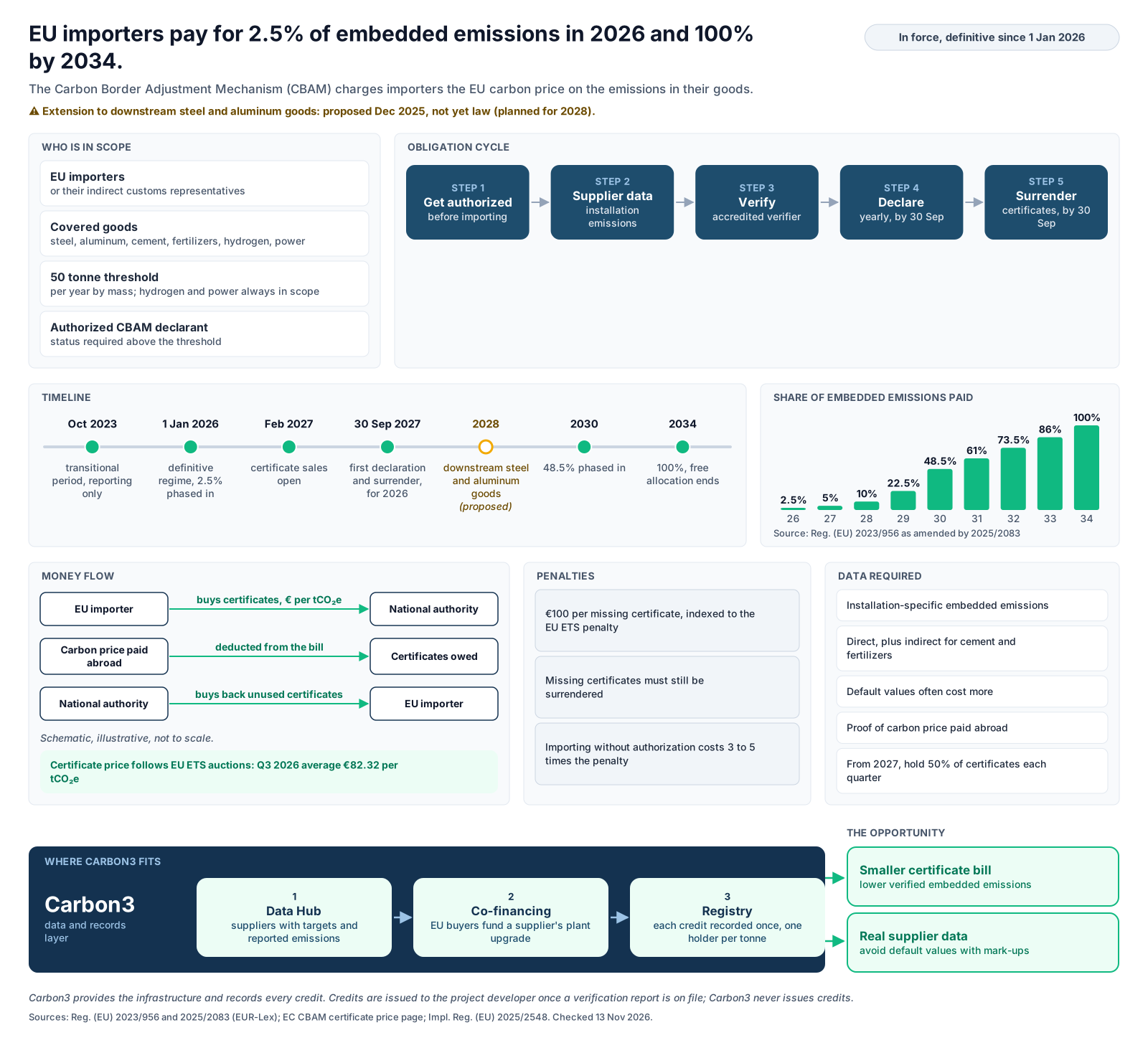
EU importers pay for 2.5% of embedded emissions in 2026 and 100% by 2034.

The Carbon Border Adjustment Mechanism, or CBAM, charges importers of steel, aluminum, cement, fertilizers, hydrogen and electricity the EU carbon price on the emissions in those goods, known as embedded emissions, meaning the emissions released while making them. The first declaration and surrender, meaning hand in to the authorities, is due on 30 Sep 2027, for 2026 imports.

In force, definitive since 1 Jan 2026Download one-page summary
On this page

Why it matters

The CBAM bill follows the plant that made the goods, so a supplier with lower verified emissions costs its EU customers less on every tonne they import. Real supplier data matters too, because the default values used when data is missing are often less favorable.

The price tracks EU carbon allowance auctions. The third-quarter 2026 certificate price was €82.32 per tonne of CO₂e, up from €75.28 in the second quarter, and from 2027 the Commission publishes a price every week.

The share of embedded emissions that importers pay rises every year until 2034.

CBAM replaces the free allowances that EU producers of the same goods receive, so it phases in as those allowances are withdrawn. Importers pay for 2.5% of embedded emissions in 2026, 10% in 2028, 48.5% in 2030 and the full amount from 2034.

Importers pay for a rising share of embedded emissions, from 2.5% in 2026 to 100% in 2034.

0%25%50%75%100%20262.5%203048.5%2034100%Q3 2026 price €82.32 per tCO₂e
Share of embedded emissions paid under CBAM
YearShare paid
20262.5%
20275%
202810%
202922.5%
203048.5%
203161%
203273.5%
203386%
2034100%
Source: Regulation (EU) 2023/956 as amended; climat.be phase-in table; Carbon3 analysis.

Certificate sales open in February 2027, and the first bill is due that September.

The transitional period, which only asked for reports, ran from October 2023 to the end of 2025. On 12 Nov 2026, the Court of Justice of the European Union dismissed Poland's legal challenge in Case C-512/23 and confirmed that CBAM stands in EU law. Certificate sales open on 1 Feb 2027, and importers declare and surrender certificates for 2026 imports by 30 Sep 2027. A December 2025 proposal would extend CBAM to downstream steel and aluminum goods from 2028, but it is not law yet.

  1. Oct 2023

    transitional period, reporting only

  2. 1 Jan 2026

    definitive regime, 2.5% phased in

  3. 1 Feb 2027

    certificate sales open

  4. 30 Sep 2027

    first declaration and surrender, for 2026

  5. 2028

    downstream steel and aluminum goods (proposed) (not in force yet)

  6. 2030

    48.5% phased in

  7. 2034

    100%, free allocation ends

Importers above 50 tonnes a year need authorization and verified supplier data.

An importer that brings in more than 50 tonnes of covered goods a year must become an authorized CBAM declarant before importing, while hydrogen and electricity are always in scope. The importer then collects installation emissions from each supplier, has them checked by an accredited verifier, and declares and surrenders certificates once a year by 30 Sep. From 2027 the importer must also hold certificates for 50% of embedded emissions at the end of each quarter.

Year by year, the CBAM share rises as free allocation is withdrawn.

CBAM phase-in against the phase-out of free EU ETS allocation for covered sectors
YearShare of embedded emissions priced through CBAM
20262.5%
20275%
202810%
202922.5%
203048.5%
203161%
203273.5%
203386%
2034100%
CBAM obligations fall as free allocation to EU producers in the same sectors is withdrawn, so that EU and imported goods carry the same carbon cost.

Certificates for 2026 imports are priced at the quarterly average of EU ETS auction prices, and from 2027 at the weekly average. Importers below 50 tonnes of covered goods a year are exempt; the threshold does not apply to hydrogen or electricity.

For the buyer, the embedded emissions of CBAM goods are Scope 3 emissions.

For the company that buys imported steel, aluminum or cement, the embedded emissions of those goods are Scope 3 emissions, under Category 1, purchased goods and services, or Category 2, capital goods. CBAM obliges importers to collect independently verified, installation-level emissions data for those same goods.

That makes CBAM a source of primary supplier data. A buyer that has relied on industry-average emission factors for purchased metals can ask for the embedded-emissions figures its suppliers already report, and use them to calculate and track its Scope 3 emissions.
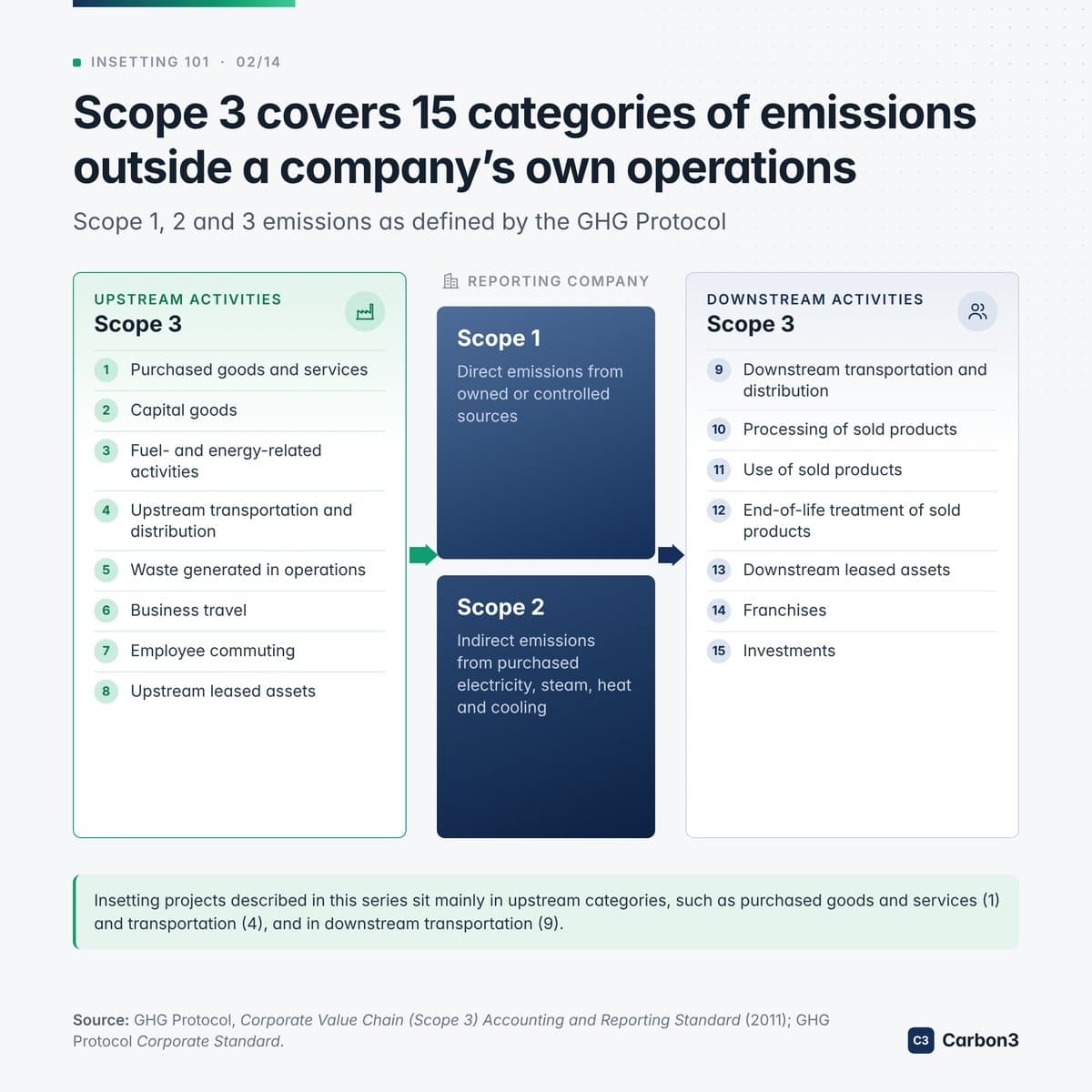
Diagram of Scope 1, 2 and 3 as defined by the GHG Protocol: eight upstream Scope 3 categories on the left, from purchased goods and services to upstream leased assets, the reporting company’s Scope 1 and 2 in the center, and seven downstream categories on the right, from downstream transportation to investments.
CBAM goods mostly appear in Category 1, purchased goods and services, and Category 2, capital goods. Source: GHG Protocol Scope 3 Standard.

What it costs to fall short

A missing certificate costs €100 per tonne, indexed in line with the EU ETS penalty, and the certificate must still be surrendered. Importing above the threshold without authorization can cost 3 to 5 times that penalty. A carbon price already paid in the country of production is deducted from the bill.

Where Carbon3 fits

Carbon3 provides the financial infrastructure that helps EU buyers and non-EU plants act on CBAM.

The Data Hub surfaces EU buyer demand and supplier emissions data across about 28,000 companies, as of November 2026, giving non-EU producers visibility before committing capital. EU buyers can co-finance the green premium, meaning the extra cost of the cleaner option, so the producer does not bear the abatement cost alone, which de-risks and unlocks the investment. Lower verified embedded emissions then mean fewer CBAM certificates on future imports.

Carbon3 records the buyer's inset credits once, checked against a verification report on file, with a single holder per tonne. Inset credits do not reduce a CBAM obligation and cannot be surrendered as CBAM certificates, so the certificate record and the Scope 3 claim stay distinct.

Claim treatment depends on the applicable reporting framework.

One-page summary

EU CBAM, one-page summaryOne-page summary of EU CBAM: scope, key dates, money, penalties, data and sources. Checked 13 Nov 2026.WHO IS IN SCOPEEU importersor their indirect customs representativesCovered goodssteel, aluminum, cement, fertilizers,hydrogen, power50 tonne thresholdper year by mass; hydrogen and power alwaysin scopeAuthorized CBAM declarantstatus required above the thresholdOBLIGATION CYCLESTEP 1Get authorizedbefore importingSTEP 2Supplier datainstallation emissionsSTEP 3Verifyaccredited verifierSTEP 4Declareyearly, by 30 SepSTEP 5Surrendercertificates, by 30 SepTIMELINEOct 2023transitional period, reporting only1 Jan 2026definitive regime, 2.5% phased inFeb 2027certificate sales open30 Sep 2027first declaration and surrender, for 20262028downstream steel and aluminum goods(proposed)203048.5% phased in2034100%, free allocation endsSHARE OF EMBEDDED EMISSIONS PAID2.5%265%2710%2822.5%2948.5%3061%3173.5%3286%33100%34Source: Reg. (EU) 2023/956 as amended by 2025/2083MONEY FLOWEU importerNationalauthoritybuys certificates, € per tCO₂eCarbon price paidabroadCertificates oweddeducted from the billNationalauthorityEU importerbuys back unused certificatesSchematic, illustrative, not to scale.Certificate price follows EU ETSauctions: Q3 2026 average €82.32 pertCO₂ePENALTIES€100 per missing certificate, indexed tothe EU ETS penaltyMissing certificates must still besurrenderedImporting without authorization costs 3 to5 times the penaltyDATA REQUIREDInstallation-specific embedded emissionsDirect, plus indirect for cement andfertilizersDefault values often cost moreProof of carbon price paid abroadFrom 2027, hold 50% of certificates eachquarterWHERE CARBON3 FITSCarbon3data and records layer1Data Hubsuppliers with targets and reportedemissions2Co-financingEU buyers fund a supplier's plant upgrade3Registryeach credit recorded once, one holder pertonneTHE OPPORTUNITYSmaller certificate billlower verified embedded emissionsReal supplier dataavoid default values with mark-ups
Schematic. Checked 13 Nov 2026.Download one-page summary (SVG)

Questions

Do inset credits reduce a CBAM bill?

Inset credits do not reduce a CBAM obligation, and they cannot be surrendered as CBAM certificates. A CBAM bill falls only when the verified embedded emissions of the imported goods fall, for example after a supplier upgrades its plant.

What happens when a supplier has no emissions data?

The importer must use default values, which are often less favorable than real data. Installation-specific data checked by an accredited verifier usually gives a lower and more defensible bill.

Does a carbon price paid abroad count?

A carbon price that was actually paid in the country of production is deducted from the number of certificates owed, provided the importer can prove it.

Which Scope 3 categories are affected by CBAM goods?

Mostly Category 1, purchased goods and services, and Category 2, capital goods, for the company that buys the imported materials or products made from them.

Sources

  1. Regulation (EU) 2023/956 (CBAM). EUR-Lex, accessed 13 Nov 2026.
  2. Regulation (EU) 2025/2083 (CBAM simplification, 50 tonnes threshold). EUR-Lex, accessed 13 Nov 2026.
  3. Price of CBAM certificates, Q3 2026 published 5 Oct 2026. European Commission, accessed 13 Nov 2026.
  4. CBAM main page and Q&A. European Commission, accessed 13 Nov 2026.
  5. Proposal COM(2025) 989 on downstream goods and anti-circumvention. European Commission, Dec 2025, accessed 13 Nov 2026.
  6. CBAM sanctioning. DEHSt (German Emissions Trading Authority), accessed 13 Nov 2026.
  7. Gradual CBAM phase-in. climat.be (Belgian federal climate service), accessed 13 Nov 2026.
  8. Press Release No 163/26 on Cases C-512/23 and C-505/23. Court of Justice of the European Union, 12 Nov 2026, accessed 13 Nov 2026.
  9. Case C-512/23 docket (Poland v Parliament and Council). Court of Justice of the European Union, accessed 13 Nov 2026.
  10. Corporate Value Chain (Scope 3) Accounting and Reporting Standard. GHG Protocol, accessed 20 Oct 2026. Categories 1 and 2.

This page explains the rules in short. It is not legal advice.

The Carbon3 team can show how co-financing would work under this rule.

Tell us where the companies in scope sit, and which buyers or suppliers share the chain. A person on the Carbon3 team reads every message and replies by email.

Carbon3 provides the infrastructure and records every credit. Credits are issued to the project developer once a verification report is on file; Carbon3 never issues credits.