Published · Carbon3
Who reports under the CSRD after the Omnibus
Directive (EU) 2026/470, part of the Omnibus I simplification package, entered into force on 18 March 2026. It limits mandatory CSRD reporting to undertakings and groups with more than 1,000 employees on average and net turnover above €450 million. Companies below either threshold fall outside the mandatory scope.
Companies that are not in scope are often still asked for emissions data by customers that are. For those requests, the Omnibus introduces a value-chain cap. A reporting company may not require more than the Commission’s voluntary reporting standard from value-chain companies with up to 1,000 employees, and those companies may decline anything beyond it.
What ESRS E1 asks for
- A transition plan for climate change mitigation, where the company has one, and GHG emissions reduction targets.
- Gross Scope 1, Scope 2 and Scope 3 emissions in tonnes of CO₂e, with Scope 3 reported by significant category.
- Energy consumption and mix.
- GHG removals and GHG mitigation projects financed through carbon credits (disclosure requirement E1-9), reported separately from gross emissions.
- Climate-related physical and transition risks and their anticipated financial effects.
Scope 3 under the simplified standard
The simplified ESRS keep Scope 3 in E1, reported by significant category. The Omnibus confirms that value-chain information can come directly from suppliers or from estimates, as appropriate, within the value-chain cap. Scope 3 is calculated in line with the GHG Protocol, so changes to the GHG Protocol’s standards over 2027 and 2028 will matter for E1 reporting.
How this connects to insetting on Carbon3
An inset project changes the emissions of an activity in the reporting company’s own value chain. Where the reduction shows up in the supplier data the company uses, it lowers gross Scope 3 emissions. Where the company holds or retires inset credits, those are disclosed separately, as E1 requires for carbon credits.
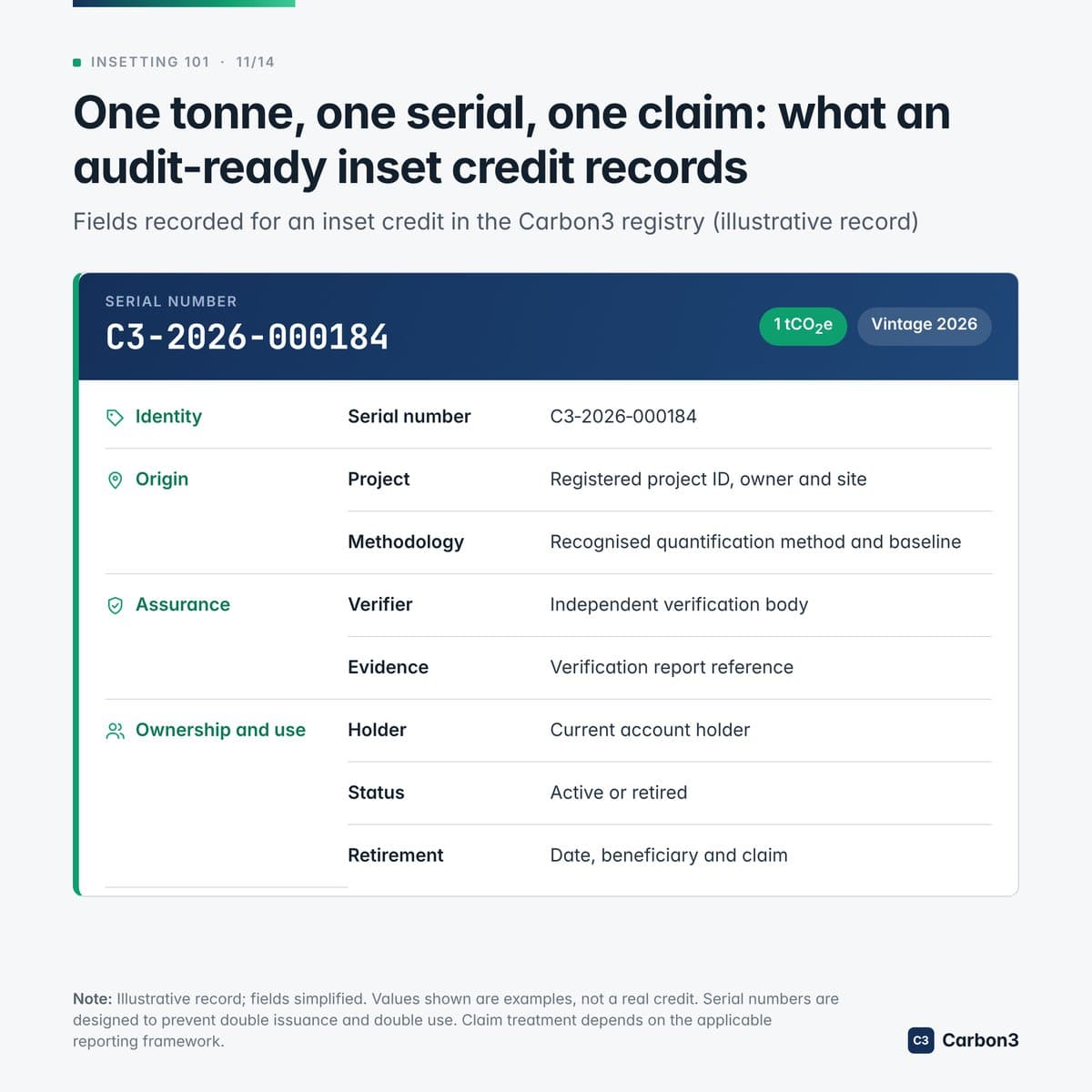
Either way, the evidence matters. Each inset credit on Carbon3 is issued to the project developer after independent verification and carries its project, verifier, funders and retirement in the registry record. See the methodology and the Insetting 101 guide.
Questions
Does ESRS E1 still require Scope 3 emissions?
Yes. The simplified ESRS adopted as Delegated Regulation (EU) 2026/1563 keep gross Scope 3 emissions by significant category. Value-chain data can be estimated where suppliers do not provide it.
Can carbon credits be netted from emissions under ESRS E1?
No. Credits and removals are disclosed separately and do not reduce reported gross emissions or count towards gross emissions reduction targets.
Sources
- Directive (EU) 2026/470 (Omnibus I) amending the CSRD and CSDDD. In force 18 March 2026; thresholds of 1,000 employees and €450 million turnover; value-chain cap; transposition by 19 March 2027
- Commission Delegated Regulation (EU) 2026/1563, simplified European Sustainability Reporting Standards. Published 21 September 2026; applies to financial years from 1 January 2027
- European Commission, Corporate sustainability reporting
- Council of the EU, simplification of sustainability reporting and due diligence requirements signed off (24 February 2026)
Read next
The Carbon3 Newsletter
Weekly analysis of industrial decarbonization and insetting across Scope 1 to 3, from the Carbon3 team.