Published · Carbon3
Who has to report
SB 253, the Climate Corporate Data Accountability Act (Health and Safety Code section 38532), applies to partnerships, corporations, limited liability companies and other business entities formed under US law with total annual revenues above $1 billion that do business in California. Each company determines for itself whether it meets the definition, using the definitions in section 96072 of the Initial Regulation and CARB’s FAQ.
The first report: 10 November 2026
The first reports cover Scope 1 and Scope 2 emissions for the preceding fiscal year and are due on or before 10 November 2026. CARB has said it will exercise enforcement discretion for this first cycle:
- Companies may report on the basis of data they already had, or were collecting, when CARB issued its enforcement notice in December 2024.
- Submissions are accepted whether or not the data has received limited assurance, although the statute requires limited assurance from 2026.
- Companies that were not collecting the data at that time are not expected to report Scope 1 and 2 figures this year. CARB asks them to submit a statement of non-reporting instead.
- Reports can be filed through CARB’s voluntary intake platform or by email. CARB’s draft reporting template is optional.
Scope 3 from 2027
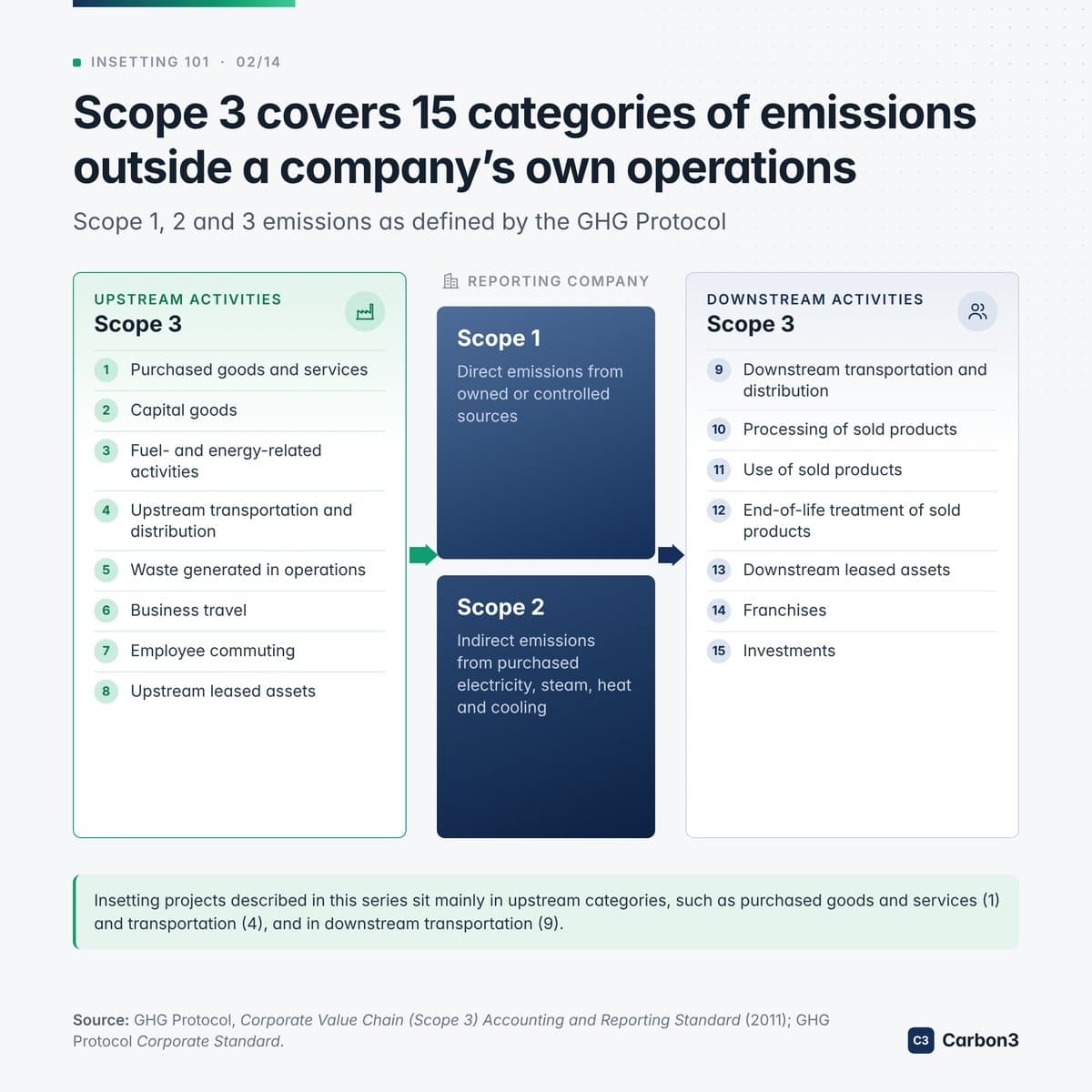
From 2027, annual disclosures must include Scope 3 emissions. CARB is developing the methods, deadlines, assurance requirements and formats for 2027 onwards in a second rulemaking. Under the statute, emissions are reported in conformance with the GHG Protocol standards, including the Scope 3 Standard. Assurance for Scope 1 and 2 moves from limited to reasonable in 2030. For Scope 3, CARB may require limited assurance from 2030.
How this connects to insetting on Carbon3
SB 253 asks companies to disclose emissions rather than reduce them. Disclosure still makes Scope 3 visible to investors and customers. For many companies covered, most emissions sit in the value chain.
Inset projects address those emissions where they arise. On Carbon3, each inset credit is issued to the project developer after independent verification and recorded through allocation and retirement, so the reductions a company points to can be traced. How credits may be shown in an SB 253 disclosure will depend on CARB’s Scope 3 rules and the GHG Protocol. See GHG Protocol and market instruments.
Questions
When is the first SB 253 report due?
On or before 10 November 2026, covering Scope 1 and Scope 2 emissions for the preceding fiscal year, under CARB’s Initial Regulation.
When does Scope 3 reporting start under SB 253?
From 2027. CARB is setting the detailed requirements in a second rulemaking. Under the statute, CARB may require limited assurance for Scope 3 from 2030.
Sources
- CARB, California Corporate Greenhouse Gas Reporting bulletin (12 October 2026). OAL approval and effective date of the Initial Regulation; 10 November 2026 deadline
- CARB, Guidance for SB 253 2026 Reporting Submittals (1 September 2026). Enforcement discretion, assurance, statement of non-reporting
- California Health and Safety Code section 38532 (SB 253). Applicability, Scope 3 from 2027, assurance timeline
- GHG Protocol, Corporate Value Chain (Scope 3) Accounting and Reporting Standard
Read next
The Carbon3 Newsletter
Weekly analysis of industrial decarbonization and insetting across Scope 1 to 3, from the Carbon3 team.