Published · Carbon3
What FuelEU Maritime requires
FuelEU Maritime applies to ships above 5,000 gross tonnes carrying passengers or cargo for commercial purposes. It covers all the energy used on voyages and at berth within the EU, and half of the energy used on voyages into or out of the EU. The obligation sits with the shipping company responsible for the ship.
The measure is the well-to-wake greenhouse gas intensity of that energy, in grams of CO₂e per megajoule, against a reference value of 91.16 g CO₂e/MJ. The limit tightens every five years.
| From | Reduction | Limit (g CO₂e/MJ) |
|---|---|---|
| 2025 | 2% | 89.34 |
| 2030 | 6% | 85.69 |
| 2035 | 14.5% | 77.94 |
| 2040 | 31% | 62.90 |
| 2045 | 62% | 34.64 |
| 2050 | 80% | 18.23 |
Renewable fuels of non-biological origin (RFNBOs), such as e-methanol and e-ammonia, count double until the end of 2033. If their share in 2031 is below 1%, a 2% RFNBO subtarget applies from 2034.
Compliance balance, banking and borrowing
Each ship’s compliance balance is the difference between the limit and its actual GHG intensity, multiplied by the energy it used. A positive balance is a surplus, and a negative balance is a deficit. A verifier checks the figures in the FuelEU database.
- Banking: a verified surplus can be carried forward to the ship’s next reporting period (Article 20).
- Borrowing: a ship with a deficit can borrow an advance surplus of up to 2% of its limit multiplied by its energy use. The borrowed amount is repaid in the next period with a 1.1 multiplier, and borrowing cannot be used in two consecutive periods.
- Pooling: ships can combine their balances, described below (Article 21).
How pooling works
Pooling lets two or more ships, from the same company or different companies, add up their compliance balances. A ship sailing on biofuel or an RFNBO with a large surplus can cover the deficits of ships still on fossil fuel. The terms between the companies, including any payment for the surplus, are a commercial matter between them.
- The pool’s total compliance balance must be positive.
- No ship may end with a larger deficit than it brought in, and no ship with a surplus may end in deficit.
- Each ship can belong to one pool per reporting period. Separate pools may be formed for the GHG intensity requirement and for the RFNBO subtarget.
- The pool is registered in the FuelEU database, and the verifier records it by 30 April of the verification period.
- A surplus left in the pool after the allocation can be banked by the ships that hold it.
How the penalty is calculated
A deficit that remains after banking, borrowing and pooling pays the FuelEU penalty. It is set at €2,400 per tonne of VLSFO-equivalent energy, which is about €58.5 per gigajoule of the deficit. A ship that has a deficit for consecutive periods pays 10% more for each additional period. The penalty is multiplied by 1 + (n − 1)/10, where n is the number of consecutive periods.
| Date | Step |
|---|---|
| 31 January 2026 | Shipping companies report 2025 data to the verifier |
| 31 March 2026 | Verifier records the verified compliance balance in the FuelEU database |
| 30 April 2026 | Pools, banking and borrowing recorded by the verifier |
| 30 June 2026 | FuelEU document of compliance held; any penalty paid |
Separate penalties apply to the RFNBO subtarget, once it applies, and to ships that fail to use on-shore power at berth where required: €1.50 per kilowatt of established power demand multiplied by the hours at berth.
How this connects to insetting on Carbon3
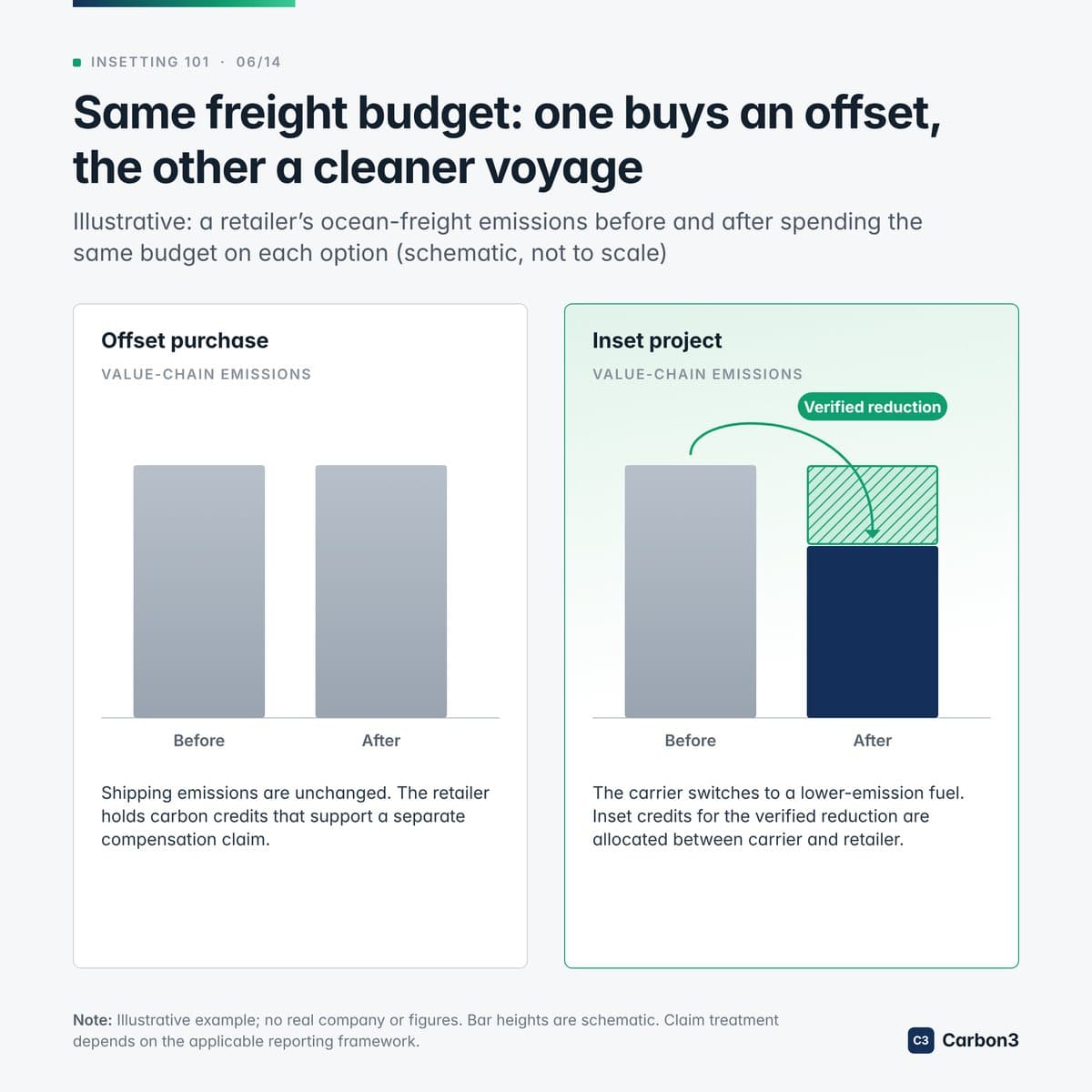
FuelEU compliance belongs to the shipping company. A cargo owner’s Scope 3 emissions from transport (Categories 4 and 9) are a separate question, and that is where insetting comes in. A cargo owner can co-fund lower-emission fuel on the routes its goods use and receive inset credits for the verified emissions reductions.
Inset credits are not FuelEU compliance units and do not change a ship’s compliance balance. A project should state how the same fuel is treated under FuelEU and the EU ETS, so the reductions behind an inset credit are not also sold as a FuelEU surplus. On Carbon3, credits are issued to the project developer after independent verification, and the registry records which buyer holds and retires each one. See the maritime page and book and claim.
Questions
Can companies outside shipping join a FuelEU pool?
No. Pools are formed between ships, each represented by the shipping company responsible for it under the regulation. Cargo owners cannot hold a compliance balance.
Is the FuelEU penalty the same as the EU ETS cost?
No. FuelEU Maritime limits the GHG intensity of ship energy, while the EU ETS prices CO₂, methane and nitrous oxide emissions through allowances. Ships on EU voyages are covered by both.
Do inset credits count towards FuelEU compliance?
No. Only the GHG intensity of the energy the ship uses, adjusted by banking, borrowing and pooling, counts. Inset credits address the cargo owner’s Scope 3 emissions.
Sources
- Regulation (EU) 2023/1805 on the use of renewable and low-carbon fuels in maritime transport (FuelEU Maritime). Article 4 limits, Article 5 RFNBOs, Article 20 banking and borrowing, Article 21 pooling, Article 23 penalties, Annex IV penalty formula
- European Commission, FuelEU Maritime: questions and answers
- European Commission, Reducing emissions from the shipping sector (EU ETS for maritime)
Read next
The Carbon3 Newsletter
Weekly analysis of industrial decarbonization and insetting across Scope 1 to 3, from the Carbon3 team.