Published · Carbon3
What book and claim is
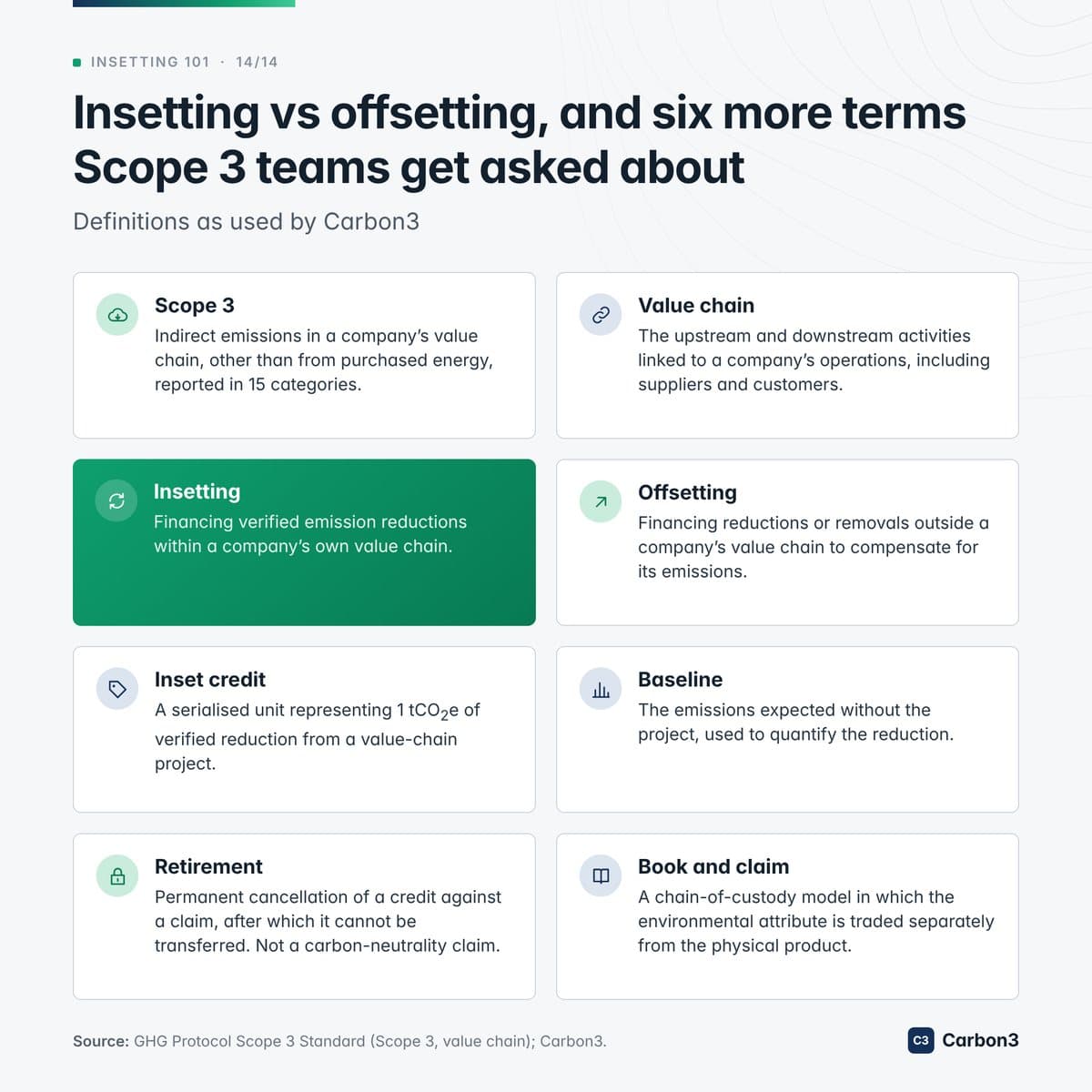
Book and claim is a chain-of-custody model in which the environmental attribute of a product, such as the lower emissions of a fuel, is traded separately from the physical product. The producer or user of the low-carbon product books the attribute in a registry. A buyer elsewhere in the same system buys it and claims it, and the registry records that the attribute has been used once.
It exists because physical delivery is often impossible. Fuel goes into shared bunkering, pipeline or airport systems, and steel from one plant is mixed with steel from others before it reaches a car maker. Without book and claim, a company that wants to pay for a lower-emission version of a product it buys has no way to do so unless the product happens to reach it.
| Model | Physical link to the buyer | Example |
|---|---|---|
| Identity preserved or segregated | The buyer receives the certified product itself | A dedicated low-carbon fuel delivery |
| Mass balance | Certified and conventional product are mixed; the certified share is tracked through the chain | Biofuel blended into a fuel batch |
| Book and claim | None: the attribute moves through a registry, separate from the product | A certificate for sustainable aviation fuel used at another airport |
How shipping, aviation and steel use it
Maritime. A carrier burns a lower-emission fuel on one vessel, and cargo owners whose goods travel on other vessels in the same network buy certificates for the emissions benefit. The Mærsk Mc-Kinney Møller Center for Zero Carbon Shipping has published a maritime book and claim methodology, and the Book and Claim Community, founded by the Smart Freight Centre and RMI, has published principles and best practices for book and claim in heavy transport.
Aviation. Sustainable aviation fuel (SAF) is supplied into airport fuel systems, so the airline or corporate buyer rarely receives the molecules it paid for. Registries such as the RSB Book and Claim Registry and the SAFc Registry record SAF certificates. The Sustainable Aviation Buyers Alliance publishes a list of registries it considers eligible. Corporate buyers typically relate SAF claims to Scope 3 Category 6, business travel, or Category 4 for air freight.
Steel. RMI published a Book and Claim Framework for the Iron and Steel Sector in February 2026. It sets out how certificates for low-emissions steel could be issued against verified emissions performance, transferred, retired and tracked in a registry. It is guidance for pilots, not yet an operating certification scheme. For imported steel, the EU’s border carbon price adds a separate data requirement; see CBAM and Scope 3.
What makes a book and claim system credible
- A defined system boundary in geography and time, so the attribute is claimed within a system the buyer draws on.
- Independent verification of the emissions benefit at the source, against a stated baseline or reference fuel.
- A registry that gives each certificate one identifier and one holder, records every transfer and retires it permanently, so no tonne or tonne of fuel is claimed twice.
- Clear rules on which claims a certificate supports, and disclosure of whether it is reported within the inventory or separately.
How this connects to insetting on Carbon3
An inset credit and a book and claim certificate solve the same problem from different ends. Book and claim schemes certify a product attribute. An inset credit represents one verified tonne of CO₂e reduced at a named project in a value chain, co-funded by the buyers who share it.
On Carbon3, credits are issued to the project developer after independent verification, or as future credits once the project is validated, and Carbon3 records each allocation, transfer and retirement against the credit’s serial number. Carbon3 builds on chain-of-custody schemes such as ISCC and RSB rather than replacing them. See the standards map and the maritime, fuels, aviation and steel and cement pages.
Questions
Is book and claim the same as offsetting?
No. An offset compensates for emissions with a project outside the buyer’s value chain. Book and claim transfers the attribute of a low-carbon product within the same system the buyer draws on, such as a fuel network or a steel market.
Can a book and claim certificate reduce a company’s Scope 3 emissions?
That depends on the reporting framework. SBTi V2.0 recognizes certificates that meet its criteria as support for target implementation, reported separately. The GHG Protocol is still deciding how market instruments are reported, with a revised standard estimated for the fourth quarter of 2028.
Sources
- ISO 22095-3:2026, Chain of custody: Requirements and guidelines for book and claim. Published January 2026
- Mærsk Mc-Kinney Møller Center for Zero Carbon Shipping, Maritime Book & Claim methodology report
- Book and Claim Community, Principles and Best Practices for Book and Claim Systems in Heavy Transport (June 2024)
- RSB, Book and Claim program and registry
- Sustainable Aviation Buyers Alliance, eligible registries (March 2026)
- RMI, Book and Claim Framework for the Iron and Steel Sector (February 2026)
- SBTi, From Ambition to Action: Actions and Market Instruments in the Corporate Net-Zero Standard Version 2.0
Read next
The Carbon3 Newsletter
Weekly analysis of industrial decarbonization and insetting across Scope 1 to 3, from the Carbon3 team.