Published · Carbon3
Timeline
| Date | Step |
|---|---|
| 21 May 2026 | Adopted by SBTi’s Board of Trustees, after approval by the Technical Council on 8 May |
| June 2026 | Published |
| Q1 2027 | Validations against V2.0 available; the standard is in effect from 31 January 2027 |
| 31 January 2028 | Last date to submit targets against Corporate Net-Zero Standard V1.3.1 and Near-Term Criteria V5.3 |
Targets already validated under V1 remain valid for their target cycle.
What changes for Scope 3 targets
- Companies are sorted into Category A and Category B, by turnover, geography, emissions and employees, with different obligations. Category A companies have more requirements, including third-party assurance.
- Fixed coverage percentages are replaced by significance. Scope 3 targets must cover every category that is 5% or more of Categories 1 to 14. Optional exclusions apply in named categories (3, 7, 8, 9, 10 and 14) where a company cannot practically influence outcomes, and each must be justified.
- Category A companies must identify emissions-intensive activities and report those that are 5% or more of Scope 3 emissions.
- Alongside emissions reduction targets, companies can set supplier and customer alignment targets, and new volume, product-use and end-of-life methods.
- Long-term Scope 3 targets become optional.
The implementation hierarchy
Targets remain based on the physical GHG inventory. To deliver them, V2.0 sets out an order of action:
- Activity level: direct emissions reductions in the company’s operations and value chain, such as efficiency, electrification or switching to lower-emission suppliers.
- Activity pool: action in the shared systems the company draws on, such as electricity grids, supply sheds and logistics networks.
- Sector level: action that helps transform the wider sector, where barriers prevent enough decarbonization at the first two levels and the company can show a geographical or systemic link.
Projects can support target implementation when they are implemented by or on behalf of the company and relate to the relevant underlying activity. They must also deliver measurable outcomes and meet the standard’s integrity criteria, which include additionality and leakage. Market instruments, meaning energy and commodity certificates, are recognized where they accurately convey emissions attributes, are volume-matched and are tracked in transparent, secure registries.
| Claim | Based on |
|---|---|
| Emissions reduction claim | Changes in the physical GHG inventory |
| Alignment claim | Activity-level actions that cause measurable changes within the company’s operations or value chain |
| System contribution claim | Activity pool or sector-level actions that support decarbonization of the systems the value chain is part of |
Carbon credits and Ongoing Emissions Responsibility
SBTi treats carbon credits separately from market instruments, under an optional Ongoing Emissions Responsibility framework that recognizes companies supporting mitigation beyond their own targets. From 2035, Category A companies must support carbon removals for part of their ongoing emissions. Credits complement decarbonization and do not substitute for it.
How this connects to insetting on Carbon3
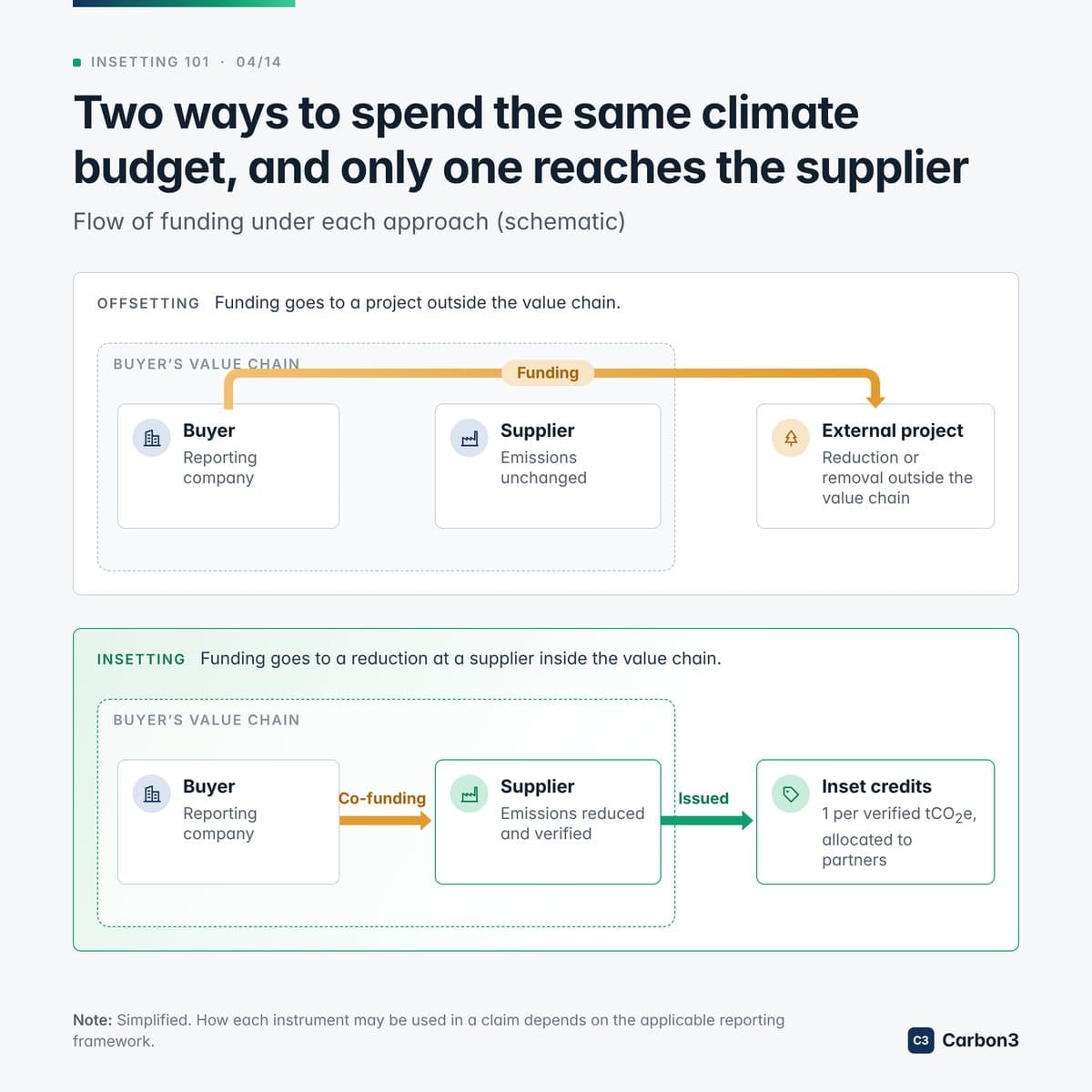
An inset project is a project in the company’s own value chain or the shared systems behind it, which is why V2.0’s implementation hierarchy matters for insetting. Whether a given project counts towards target implementation depends on meeting SBTi’s criteria. SBTi has not ruled on inset credits as a category, and its interim guidance on projects and instruments is still to be consulted on.
Carbon3 provides the record those criteria ask for. That means an independent verifier’s report, issuance to the project developer, volume matching to verified tonnes, and a registry entry for every transfer and retirement, so a tonne is not counted twice. See Insetting vs offsetting and the methodology.
Questions
When does SBTi’s Corporate Net-Zero Standard V2.0 become mandatory?
Validations against V2.0 open in the first quarter of 2027. Companies can still submit targets against V1.3.1 until 31 January 2028, after which V2.0 applies to new submissions.
Does V2.0 allow carbon credits to count towards targets?
Carbon credits are treated separately, under Ongoing Emissions Responsibility. Projects and energy or commodity certificates that meet the integrity criteria can support target implementation, reported separately from the physical inventory.
Which Scope 3 categories must a V2.0 target cover?
Every category that accounts for 5% or more of Categories 1 to 14, with optional, justified exclusions in Categories 3, 7, 8, 9, 10 and 14 where the company cannot practically influence outcomes.
Sources
- SBTi, Corporate Net-Zero Standard Version 2.0
- SBTi, Corporate Net-Zero Standard V2.0 Main Changes Document (June 2026). Adoption, effective date, categories, Scope 3 boundary, integrity criteria, post-2035 removals
- SBTi, From Ambition to Action: Actions and Market Instruments in the Corporate Net-Zero Standard Version 2.0. Hierarchy, claims, carbon credits, interim guidance in Q4 2026
- SBTi Services, Guide for Companies in the Transition to Corporate Net-Zero Standard Version 2.0 (June 2026)
Read next
The Carbon3 Newsletter
Weekly analysis of industrial decarbonization and insetting across Scope 1 to 3, from the Carbon3 team.