Inter IKEA: the collaborative model in action
$500 million in supplier renewables, $200 million in regenerative forestry, $300 million in circular initiatives.
By Carbon3 team2 min read
Engaging suppliers on emissions reductions remains one of the toughest parts of Scope 3 decarbonization, yet insetting offers a compelling path forward by aligning incentives rather than imposing mandates
This Carbon3 report (link: carbon3.net/data/companies) framed around Inter IKEA Group, paints a clear picture of this collaborative model in action
-
A $500 million joint investment in supplier renewable electricity programs across multiple markets, working with partners like Ørsted and Siemens Energy to achieve 1.2 million tonnes of annual CO₂ equivalent reductions while pushing toward 100 percent renewable energy by 2030.
-
Similarly, regenerative forestry partnerships with WWF and The Nature Conservancy involve $200 million to regenerate 100,000 hectares and sequester 500,000 tonnes yearly, supporting sustainable wood sourcing that already reaches over 98 percent FSC-certified.
-
Circular initiatives with Loop Industries and Redwood Materials commit $300 million to reuse materials and reduce emissions by 800,000 tonnes a year.
These projects create mutual gains: suppliers receive funding and technical support, while the brand secures credible Scope 3 progress and inset credit value that can be shared. The result is a stronger, more resilient supply chain where decarbonization becomes a shared business opportunity.
Curious how your organization can bridge the gap from ambition to execution? Learn more at carbon3.net
Originally published on LinkedIn, 10 March 2026.
The Carbon3 Newsletter
Weekly analysis of industrial decarbonization and insetting across Scope 1 to 3, from the Carbon3 team.
Read more from the research team.
Field notes
Cummins' Destination Zero and product-driven reductions
347k tCO2e Scope 1, 435k Scope 2, and a target of 55 million tonnes of cumulative product-enabled reductions by 2030.
Read the articleField notes
Flex: 115 million tonnes of shared value-chain emissions
Manufacturers share supplier networks, materials pathways and regulatory exposure.
Read the articleField notes
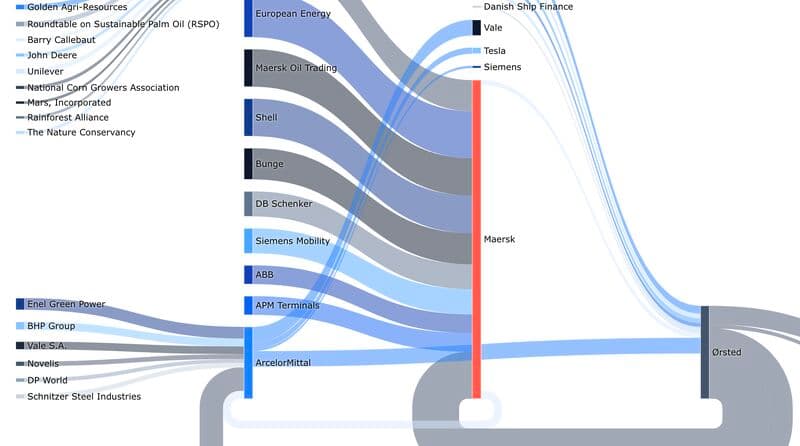
Maersk: $2.1 billion and 7 million tonnes with its Scope 3 partners
Collaborative initiatives with Shell, Cargill, Bunge, Orsted and others across maritime and logistics.
Read the article
See the companies behind these figures in the Data Hub.
Look up your suppliers’ emissions and targets, free.