About 13 billion tonnes of the reductions needed in 2040 sit in value chains
Carbon3's scenario model asks how much of the world's emissions gap buyers could close by paying their own suppliers to reduce emissions. It is a scenario, not a forecast.
By Carbon3 team2 min read
Carbon3 has published a scenario model that asks a simple question: how much of the world's emissions gap could buyers close by paying their own suppliers to reduce emissions?
The gap
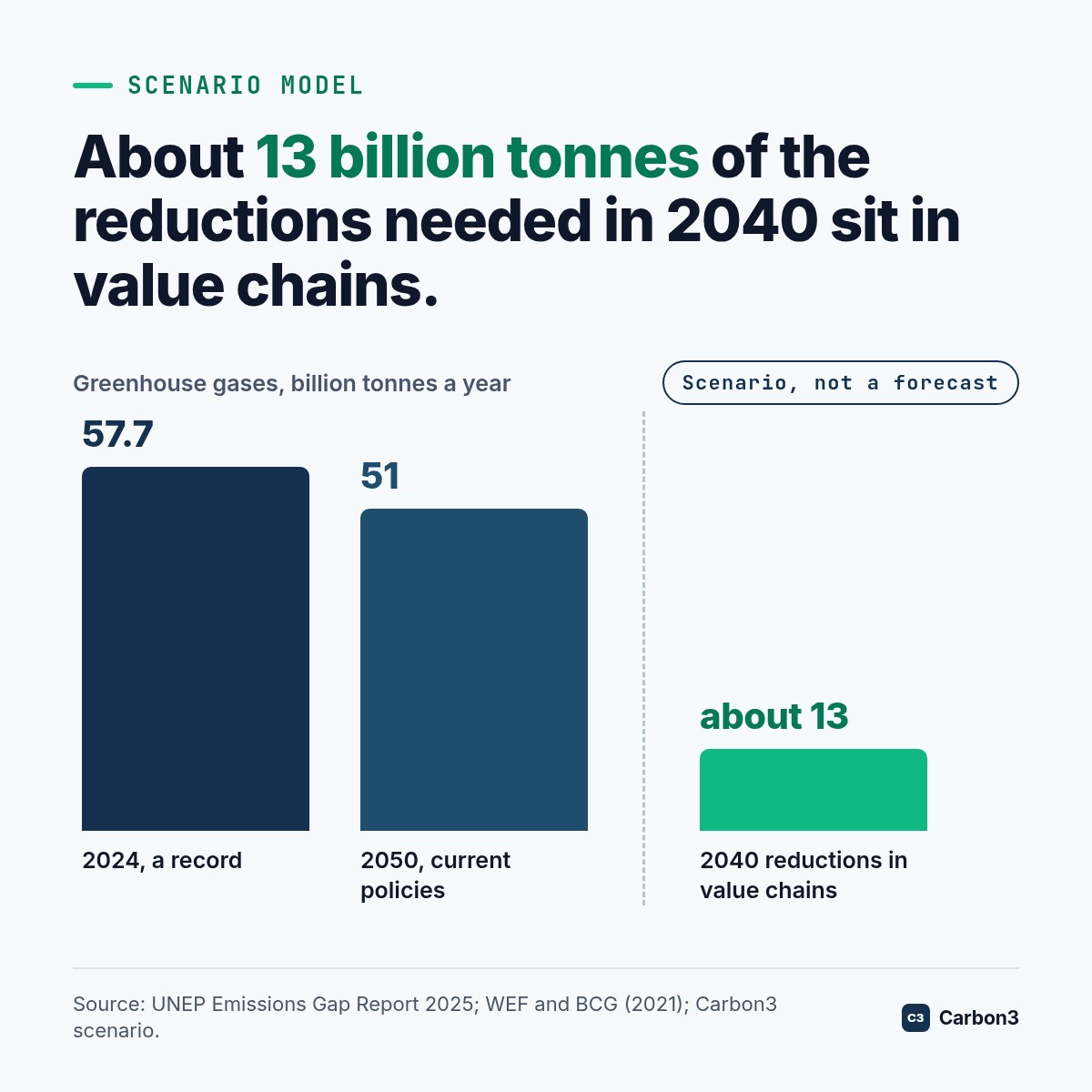
The world emitted a record 57.7 billion tonnes of greenhouse gases in 2024, according to the UNEP Emissions Gap Report 2025. Under current policies, the same report finds emissions still at 51 billion tonnes a year in 2050. Policy alone leaves most of the gap open.
Why value chains matter
The answer depends on who pays. Work by the World Economic Forum and BCG in 2021 found that eight supply chains account for more than half of global emissions. The buyers at the end of those chains set the terms for their suppliers, through contracts, specifications and price, so they hold purchasing power that reaches far beyond their own sites.
In Carbon3's scenario, about 13 billion tonnes of the reductions needed in 2040 sit in those value chains. The model is a scenario, not a forecast, and it does not describe Carbon3 activity. It shows the size of the opportunity if buyers fund emissions reductions at the suppliers they already work with.
From purchasing power to funded reductions
Most of a typical company's footprint sits in its supply chain, as Scope 3 emissions. A buyer can ask suppliers to reduce those emissions, but the investment usually has to come from somewhere. Insetting, which means financing emissions reductions in a company's own value chain, lets the buyer and the supplier co-finance the work and keep a record of who paid for what.
Once a reduction has been checked against a verification report, the project developer issues inset credits on the Carbon3 registry, so each reduction is claimed only once. This is insetting, not offsetting, and the difference is explained at carbon3.net/insets-vs-offsets.
Claim treatment depends on the applicable reporting framework.
If buyers hold that much purchasing power, the open question is why so few fund emissions reductions at their own suppliers.
Sources: UNEP Emissions Gap Report 2025; World Economic Forum and BCG, Net-Zero Challenge: The Supply Chain Opportunity (2021); Carbon3 scenario model.
Learn more
How insetting works, step by step
Originally published on LinkedIn, 2 November 2026.
Read more from the research team.
Outlook
The hydrogen projects that start by 2030 are being decided in the coming months
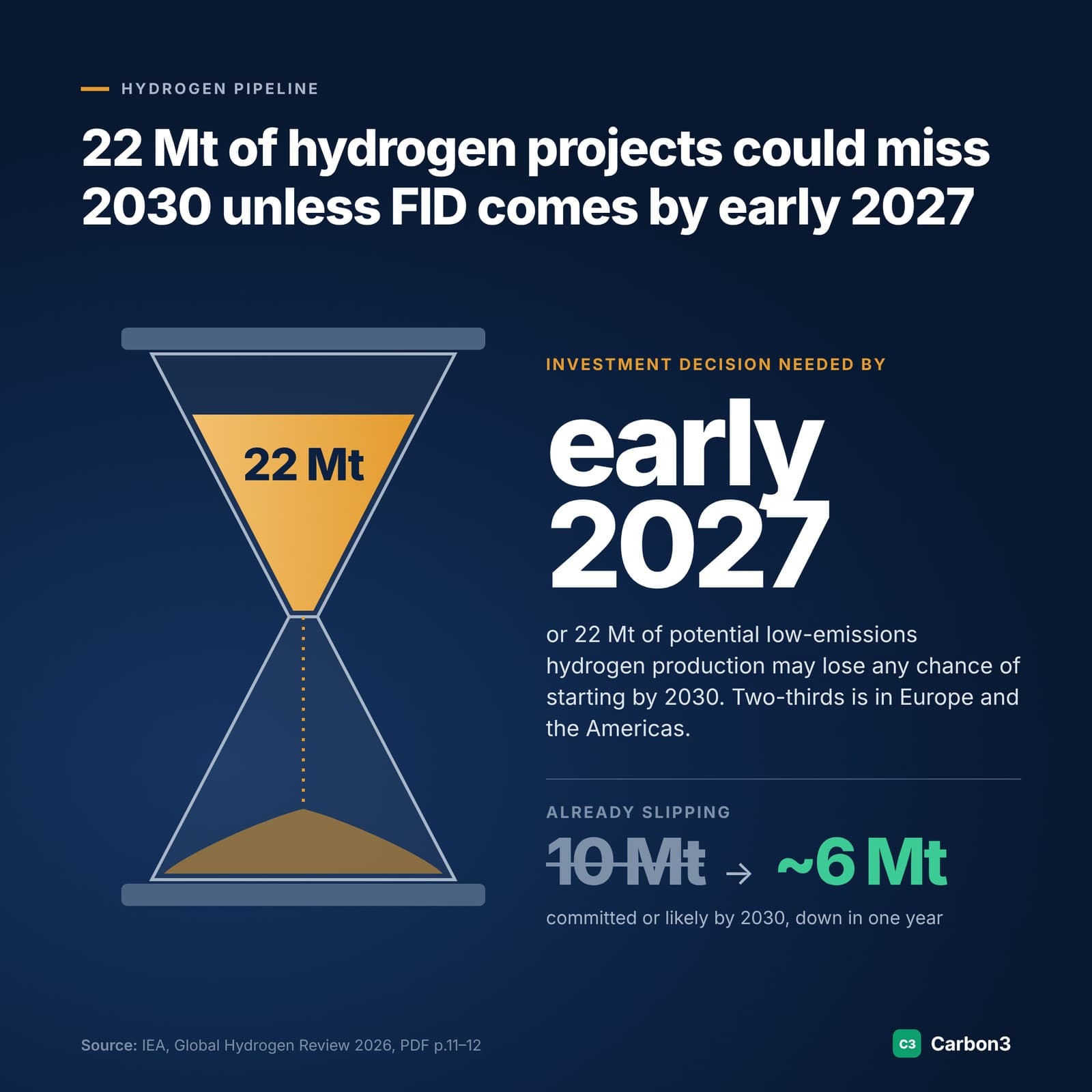
The IEA estimates 22 Mt of announced low-emissions hydrogen production may miss 2030 if investment decisions are not taken by early 2027.
Read the articleOutlook
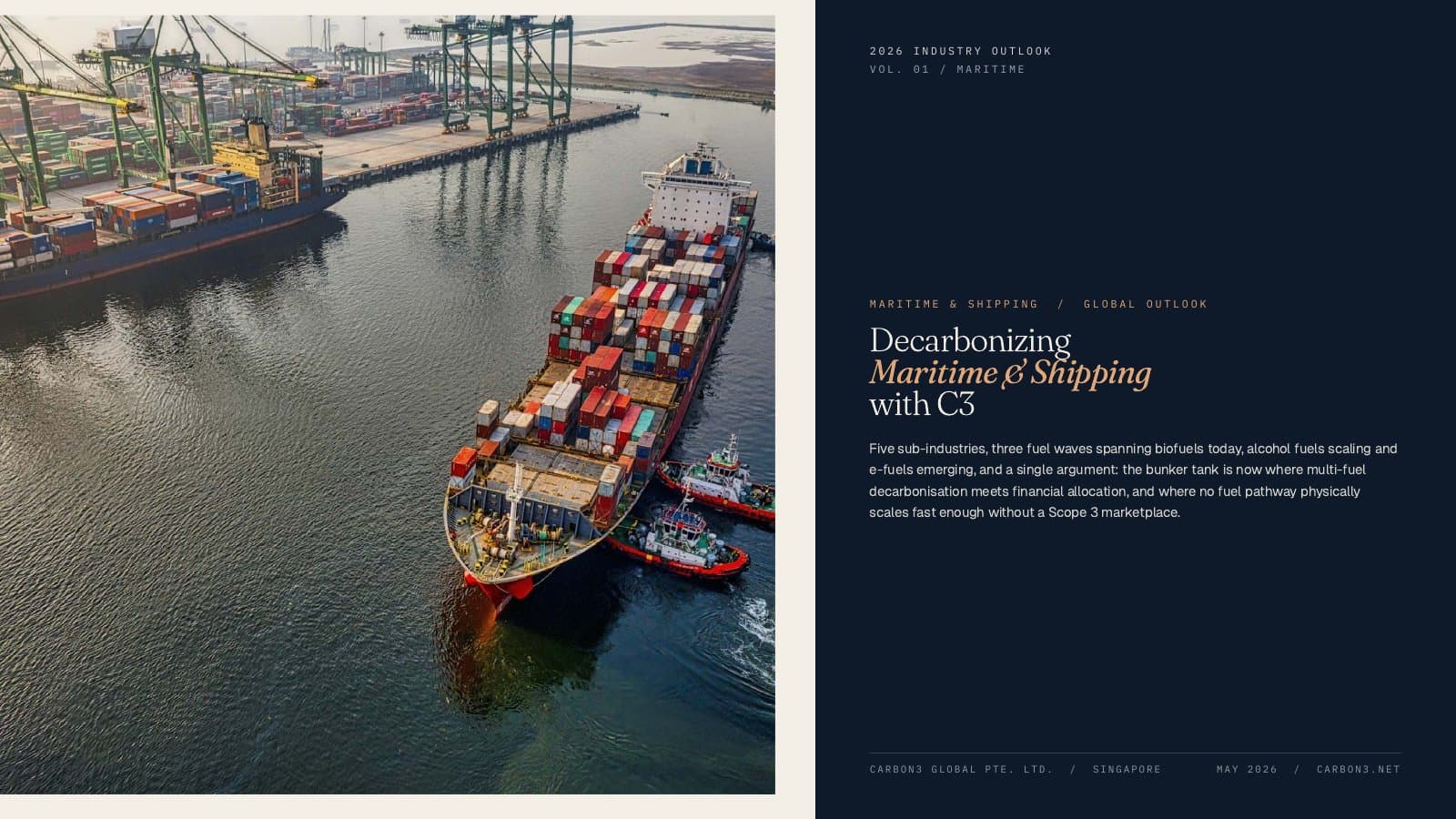
The Maritime & Shipping Outlook 2026
Carbon just became a P&L line.
Read the articlePolicy
Near-zero steel and cement will be built when buyers commit to the first tonnes
The COP31 Presidency's Antalya Green Industrialisation Compact sets out an investment gap of more than $500 billion for near-zero steel and cement.
Read the article
See the companies behind these figures in the Data Hub.
Look up your suppliers’ emissions and targets, free.