The hydrogen projects that start by 2030 are being decided in the coming months
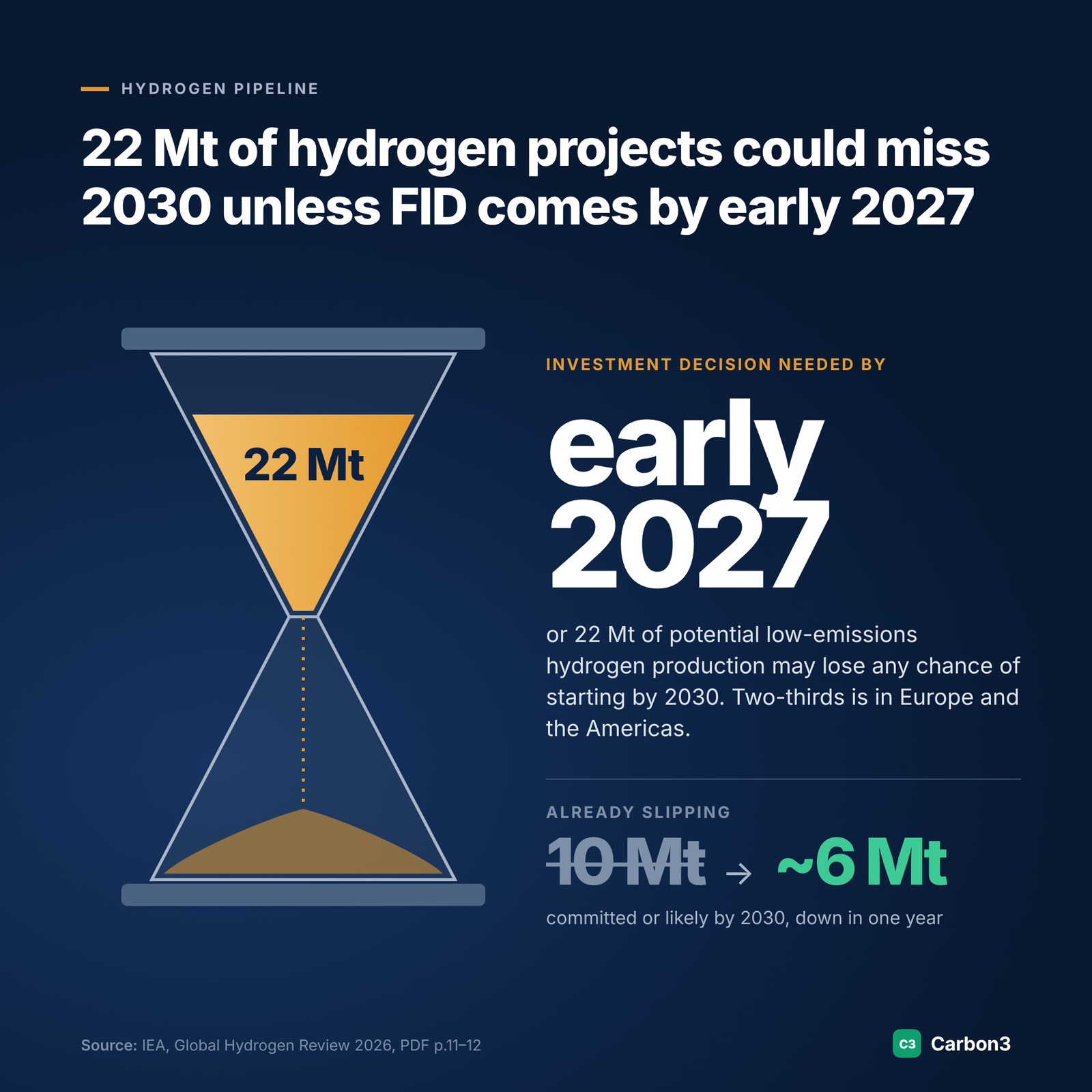
The IEA estimates 22 Mt of announced low-emissions hydrogen production may miss 2030 if investment decisions are not taken by early 2027.
By Carbon3 team2 min read
The hydrogen projects that start by 2030 are being decided in the coming months.
The International Energy Agency's Global Hydrogen Review 2026 makes the timing problem for low-emissions hydrogen explicit. Plants take years to build, so the projects that will be running by the end of the decade need their investment decisions soon.
The deadline in numbers
The IEA estimates that 22 Mt of potential low-emissions hydrogen production in announced projects may lose any chance to begin operation by 2030 if investment decisions are not taken by early 2027. About two-thirds of that volume is in Europe, North America and Latin America.
The pipeline is already shrinking. In a single year, the volume of projects that are committed or have strong potential to run by 2030 fell from 10 Mt to just above 6 Mt, according to the IEA.
Why the gap is demand
For developers and financiers, the missing piece is rarely the technology. It is buyers that commit to volumes firmly enough for a plant to be financed.
A project listed in an industry database is not yet a project that will produce hydrogen. It becomes one when its developer can show lenders contracted revenue and reach final investment decision. Without that, an announced project stays a pipeline entry, and the 2030 window closes on it.
What early buyers can do
To address this, buyers in the supply chains that use hydrogen can co-fund early volumes rather than wait for the market to mature. That gives developers the demand signal they need to take a final investment decision within the window the IEA describes.
Next, the emissions reduction from that early supply needs to be measured and credited to the right party. On Carbon3, the verified reduction can be recorded as inset credits and held by the buyers that funded it. The project developer issues credits on the Carbon3 registry once a verification report is on file, so the reduction is claimed only once.
For project developers, this turns buyer interest into a firmer commitment. For buyers, it links their spending to a reduction inside their own value chain, which is the basis of insetting.
Claim treatment depends on the applicable reporting framework.
Correction, 30 October 2026: An earlier version of this article said the reductions behind Carbon3 credits are independently verified. Credits are issued once a verification report is on file. Carbon3 asks for a verifier that is independent of the project, but the registry does not yet check who wrote the report.
Source: IEA, Global Hydrogen Review 2026.
Learn more
How insetting works for low-carbon fuels
Originally published on LinkedIn, 25 October 2026.
Read more from the research team.
Outlook
Most CSOs still frame sustainability as compliance
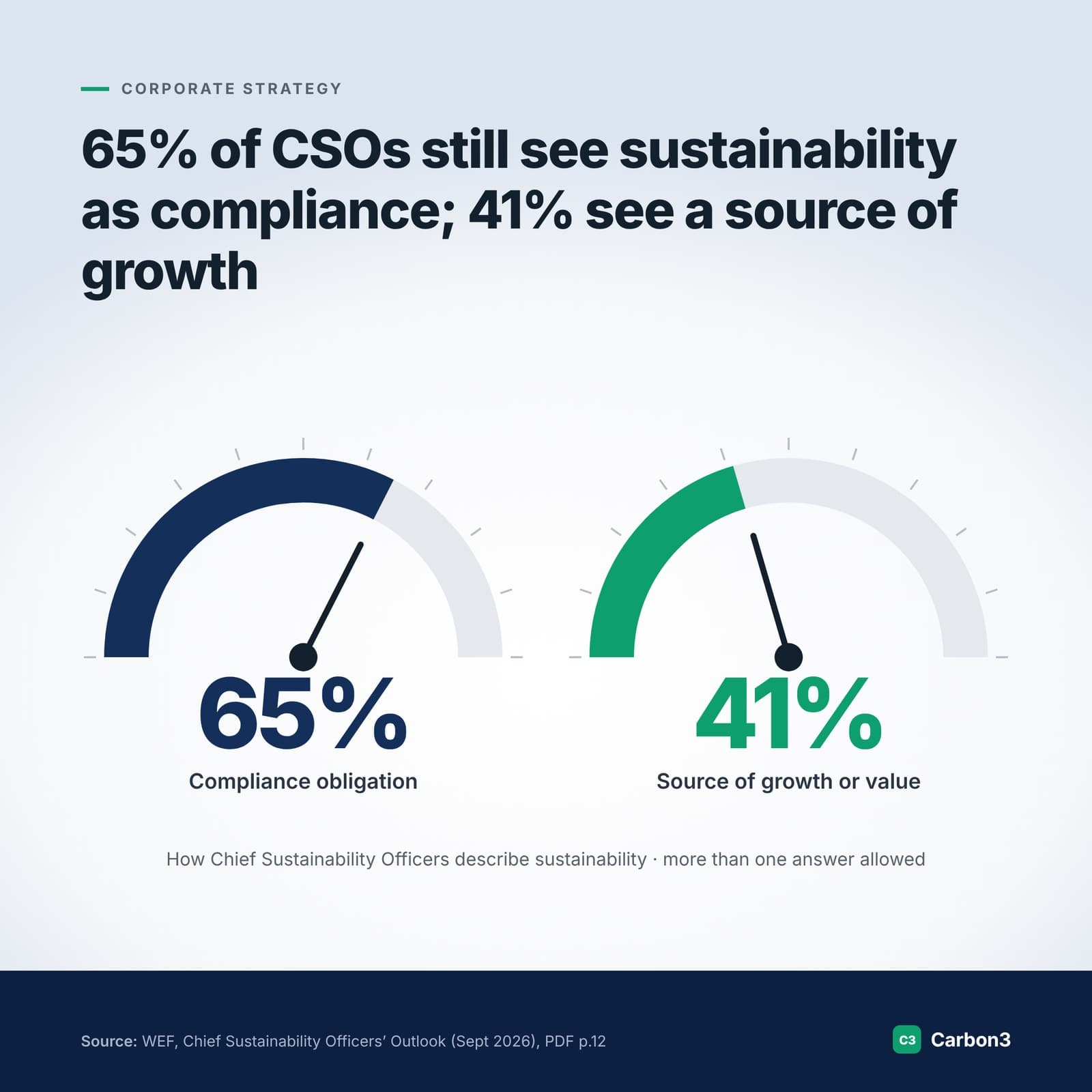
In the World Economic Forum's 2026 CSO Outlook, 65% of respondents described sustainability primarily as a compliance obligation, and 41% as a source of growth or value.
Read the articleOutlook
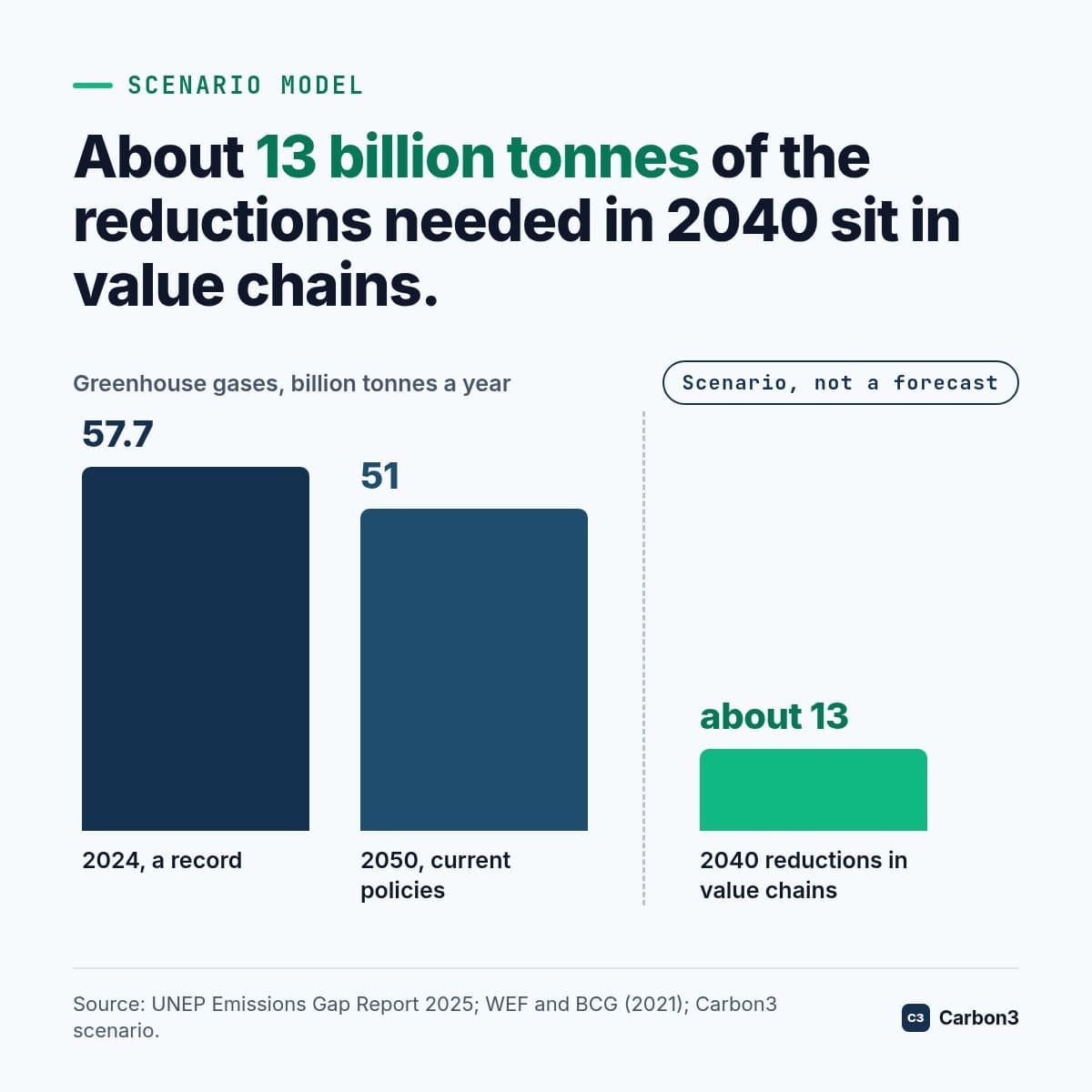
About 13 billion tonnes of the reductions needed in 2040 sit in value chains
Carbon3's scenario model asks how much of the world's emissions gap buyers could close by paying their own suppliers to reduce emissions.
Read the articleSector: Maritime
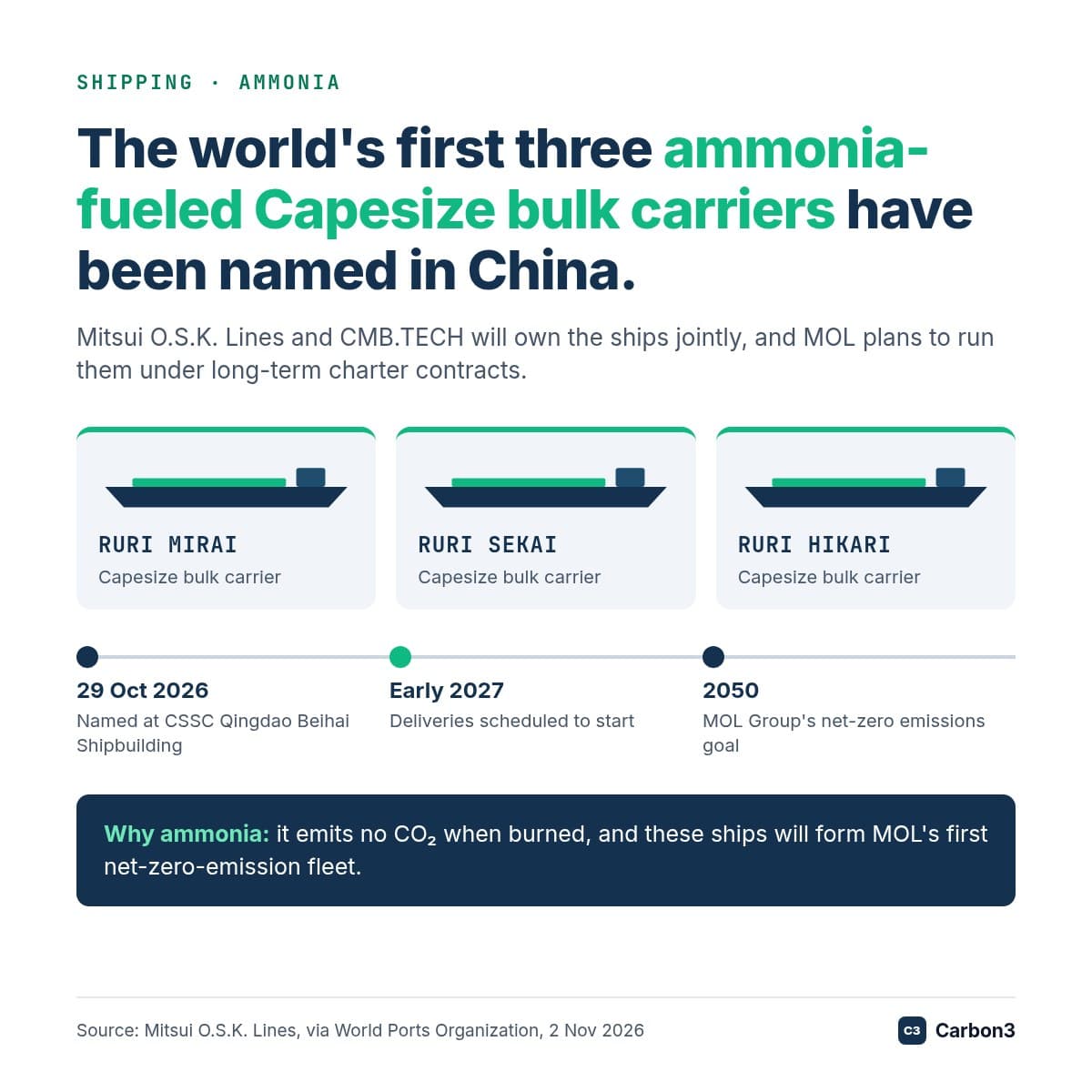
The first three ammonia-fueled Capesize bulk carriers have been named in China
Mitsui O.S.K.
Read the article
See the companies behind these figures in the Data Hub.
Look up your suppliers’ emissions and targets, free.