The first three ammonia-fueled Capesize bulk carriers have been named in China
Mitsui O.S.K. Lines and CMB.TECH named the ships at CSSC Qingdao Beihai Shipbuilding, with deliveries scheduled to start around early 2027. Their emissions will land in the Scope 3 footprint of the customers whose cargo they carry.
By Carbon3 team2 min read
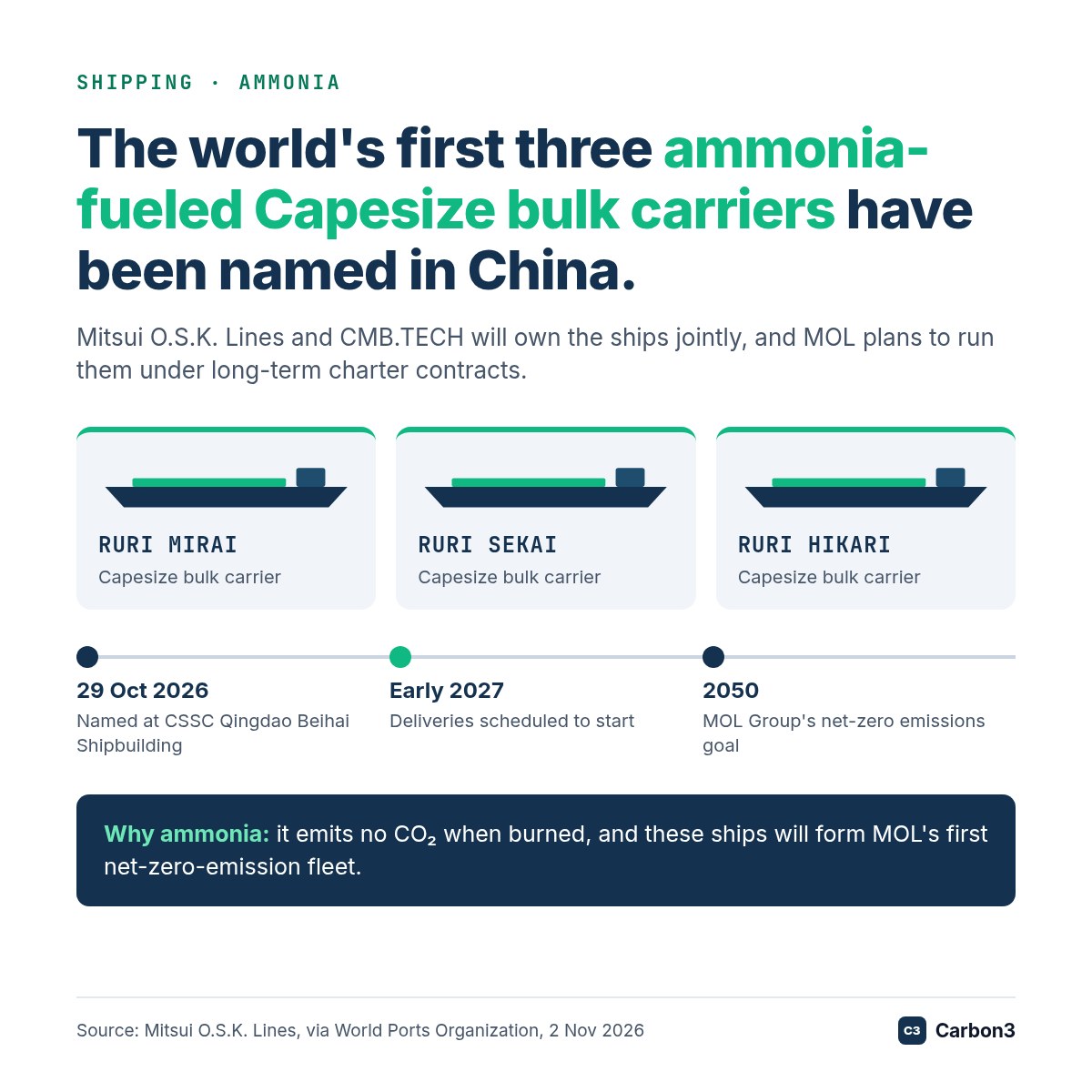
Mitsui O.S.K. Lines (MOL) and CMB.TECH have named the world's first three ammonia-fueled Capesize bulk carriers at CSSC Qingdao Beihai Shipbuilding in China. The ships, Ruri Mirai, Ruri Sekai and Ruri Hikari, were named on 29 October 2026, and deliveries are scheduled to start around early 2027, according to MOL as reported by the World Ports Organization.
A first fleet built around a zero-carbon fuel
The two companies will own the ships jointly, and MOL plans to run them under long-term charter contracts. Together they will form MOL's first net-zero-emission fleet, a step towards the MOL Group's goal of net-zero emissions by 2050. Ammonia emits no CO₂ when it burns, which is why it is one of the fuels the shipping industry is watching most closely for its largest vessels.
Capesize carriers are among the biggest bulk ships at sea, and they move the raw materials that heavy industry runs on. That makes the first ammonia-fueled examples a test of whether a zero-carbon fuel can work at the scale of the bulk trades.
Why the charterers matter most
These ships matter most to the companies whose cargo they will carry. The emissions of every voyage end up in those customers' Scope 3 footprint, so a cleaner voyage is a reduction that shows up in the cargo owner's own value chain.
That raises two practical questions for the charterers. The first is who pays for the cleaner fuel, since a ship that can burn ammonia only reduces emissions once the fuel is bought and burned. The second is how a reduction is proven to belong to a particular customer, so that it is counted once and not claimed twice along the chain.
Where insetting comes in
Insetting, which means financing emissions reductions in a company's own value chain, is built for that kind of arrangement. Once a reduction has been checked against a verification report, the project developer issues inset credits on the Carbon3 registry, so each reduction is claimed only once. This is insetting, not offsetting, and the difference is explained at carbon3.net/insets-vs-offsets.
Claim treatment depends on the applicable reporting framework.
When these ships start sailing, the open question is which charterers will pay for the cleaner voyages, and how they will prove the emissions reductions belong to them.
Source: Mitsui O.S.K. Lines, via World Ports Organization, 2 November 2026
Learn more
How insetting works in shipping
Originally published on LinkedIn, 3 November 2026.
Read more from the research team.
Sector: Maritime
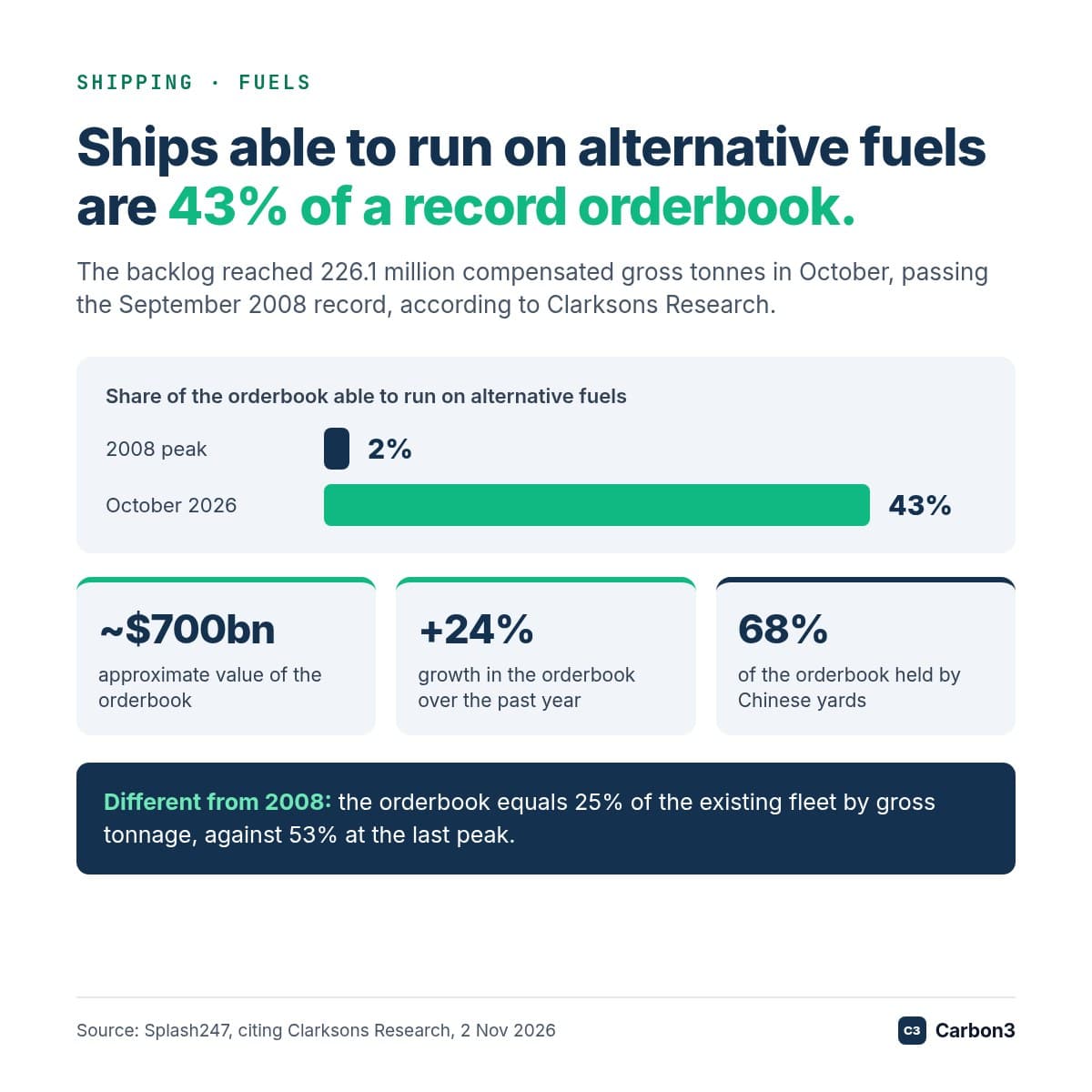
Ships able to run on alternative fuels are 43% of a record orderbook
The global shipbuilding backlog reached 226.1 million compensated gross tonnes in October, passing its 2008 record, according to Clarksons Research.
Read the articleSector: Maritime
Maersk and Hapag-Lloyd differ in size, but their footprints share the same shape
Maersk reported about 2.2 times Hapag-Lloyd's Scope 1 and 2 emissions in 2024, yet Scope 3 makes up 59% and 58% of their reported footprints.
Read the articleSector: Maritime
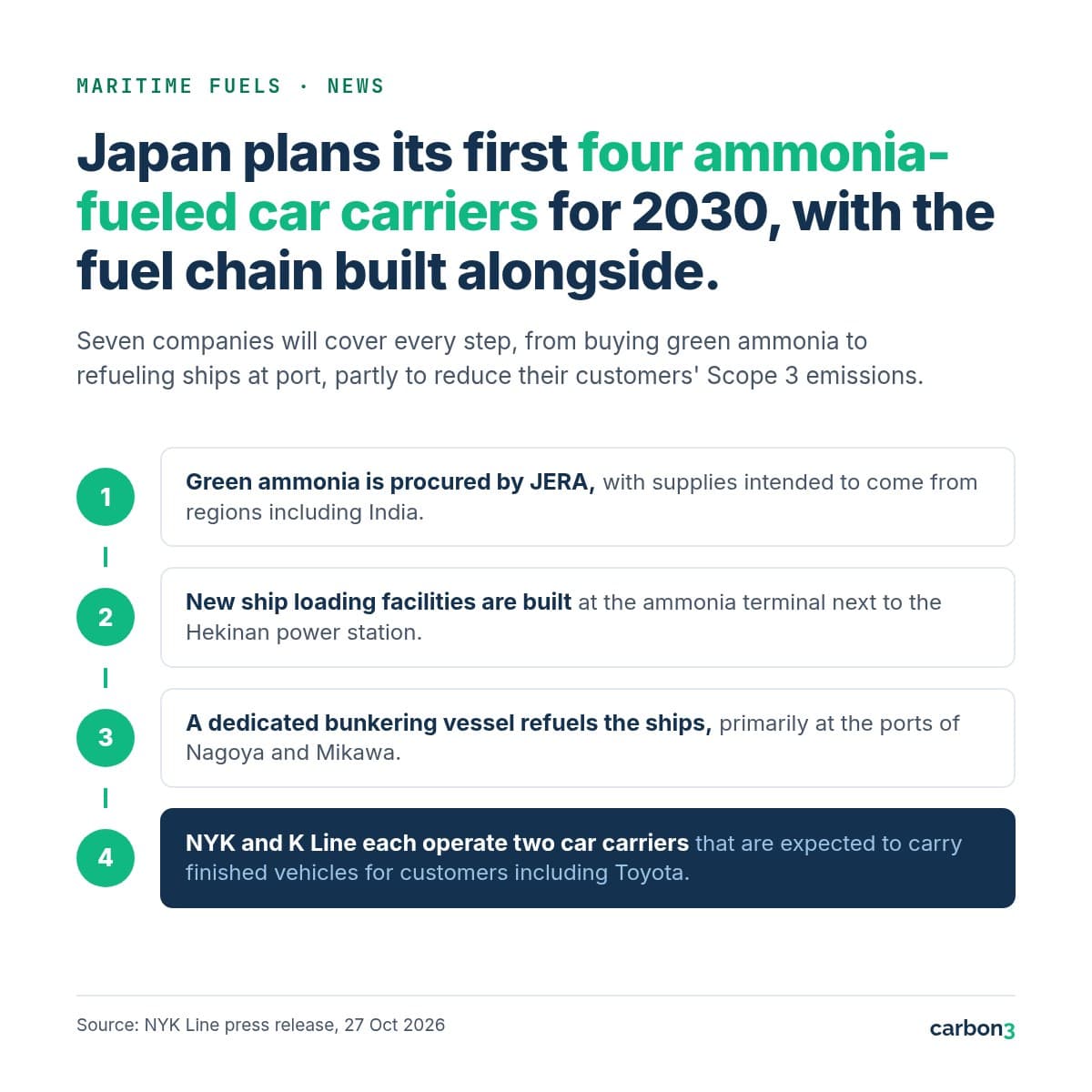
Japan will build its first ammonia-fueled car carriers, with their own fuel supply
Seven Japanese companies, including NYK, K Line and JERA, plan four ammonia-fueled car carriers for 2030, built together with the green ammonia supply and bunkering needed to run them.
Read the article
See the companies behind these figures in the Data Hub.
Look up your suppliers’ emissions and targets, free.