Near-zero steel and cement will be built when buyers commit to the first tonnes
The COP31 Presidency's Antalya Green Industrialisation Compact sets out an investment gap of more than $500 billion for near-zero steel and cement. The Compact lists three public levers, and the companies that buy these materials hold a fourth.
By Carbon3 team3 min read
The Antalya Green Industrialisation Compact, published by the COP31 Presidency, quotes a gap that no negotiating text will close on its own. Citing the IEA and OECD, it says near-zero steel and cement need more than $500 billion of investment from 2026 to 2035. Against that need, just under $20 billion has been committed to projects that have reached a final investment decision.
A final investment decision is the point at which a project's backers commit the money and construction can begin. The distance between the two figures shows where the transition for heavy materials is stuck: the technology is described and the need is quantified, yet most of the capital has not moved.
What gets plants built
Steel and cement plants get built when someone commits to buy the output and shares the cost of the first tonnes. Near-zero production carries a higher cost at the start, and lenders and investors want to see demand that will cover it before they fund a new furnace or kiln.
That makes the buyer as important as the producer. A firm order for lower-emission material turns a technical plan into a project that can be financed.
The levers the Compact names
The Compact lists three policy levers to close the gap:
- Green public procurement, where governments buy lower-emission materials for public works.
- Contracts for difference, where the public side covers the gap between the cost of cleaner production and the market price.
- Carbon pricing, which raises the cost of high-emission production.
All three depend on public budgets, public tenders or regulation.
A fourth lever for buyers
Companies that buy steel and cement have a fourth lever of their own: insetting. Insetting means co-financing emissions reductions at a company's own suppliers, so that the reductions count in the buyer's Scope 3, the emissions in its value chain.
For a buyer, this turns spending on cleaner materials into an emissions reduction it can report. For a supplier, it brings a committed partner into the cost of the first tonnes, which is the part of the investment that lenders find hardest to fund.
Carbon3 coordinates this co-financing between buyers and their suppliers and records each emissions reduction once. The project developer issues credits on the Carbon3 registry after a verification report is on file. Claim treatment depends on the applicable reporting framework.
The open question
The Compact quantifies the gap, and the public levers will take time to reach scale. What stops more steel and cement buyers from committing to the first tonnes now? Carbon3 would like to hear from buyers and producers working through that question.
More on how co-financing works in a company's own value chain is on the Carbon3 insetting page.
Sources: COP31 Presidency, Antalya Green Industrialisation Compact; IEA and OECD, as cited in the Compact.
Learn more
How insetting works in steel and cement
Originally published on LinkedIn, 19 November 2026.
Read more from the research team.
Policy
Under CBAM, who pays for the emissions embedded at the supplier?
COP31 opened without a formal agenda item on climate-related trade measures, and the EU CBAM stays on its own legal timetable.
Read the articlePolicy
EU importers can now deduct a supplier's home carbon price from their CBAM bill
Commission Implementing Regulation (EU) 2026/2498 lets importers deduct carbon prices already paid outside the EU, and admits international credits only if they are authorized and issued under Article 6.
Read the articleSector: Maritime
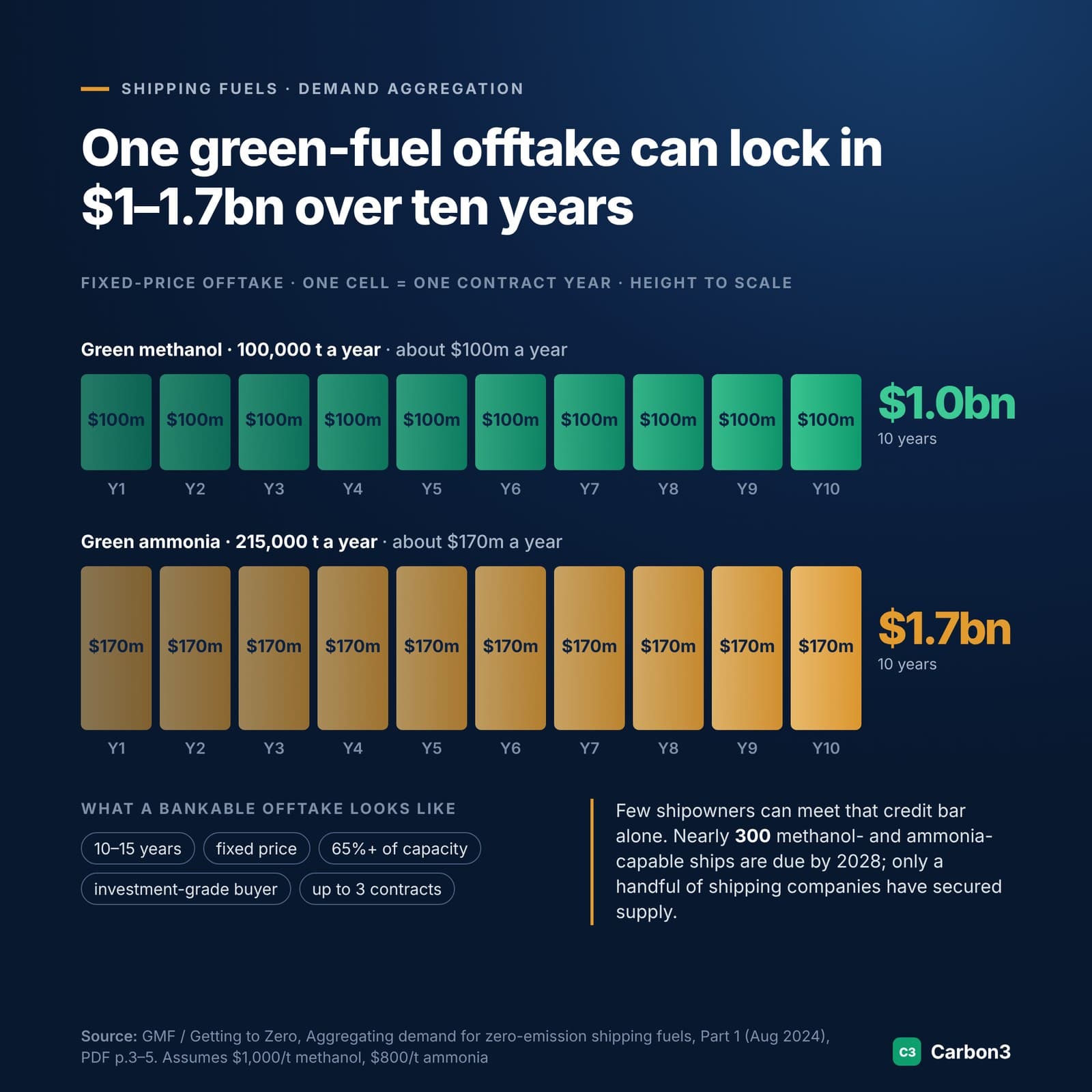
One green shipping fuel contract can commit a buyer to $1 billion or more
The Global Maritime Forum and the Getting to Zero Coalition price a 10-year green methanol or ammonia offtake at $1 billion to $1.7 billion, while nearly 300 capable ships are due by 2028.
Read the article
See the companies behind these figures in the Data Hub.
Look up your suppliers’ emissions and targets, free.