Under CBAM, who pays for the emissions embedded at the supplier?
COP31 opened without a formal agenda item on climate-related trade measures, and the EU CBAM stays on its own legal timetable. For importers of steel, aluminum, cement and fertilizers, the open question is who pays for the emissions made at the supplier.
By Carbon3 team3 min read
COP31 opened on 9 November without a formal agenda item on climate-related trade measures, after countries could not agree to add one. That leaves the EU Carbon Border Adjustment Mechanism (CBAM) where it was before the talks began: on its own legal timetable, set by EU regulation rather than by negotiation in the conference halls.
For companies that import steel, aluminum, cement or fertilizers into the EU, the diplomatic debate matters less than a practical question. Who pays for the emissions embedded in those goods at the supplier?
How the CBAM cost builds up
CBAM puts a price on the emissions released while making certain goods abroad, so that imports face a carbon cost comparable to the one EU producers carry under the EU Emissions Trading System (EU ETS). The cost arrives gradually.
Importers pay for 2.5% of embedded emissions in 2026. That share rises to 100% by 2034, in step with the end of free allocation under the EU ETS. A charge that looks small today becomes the full carbon cost of the material within eight years.
Why supplier data changes the bill
The amount an importer pays depends on how the embedded emissions are measured. Where no better data exists, default values apply. Verified actual emissions can replace those defaults.
That makes the supplier's own performance part of the importer's cost. A supplier that reduces its emissions per tonne of steel, aluminum, cement or fertilizer lowers the CBAM bill on every tonne shipped. The emissions reduction happens at the supplier, yet a large share of the financial benefit lands with the buyer.
A reason to co-finance
This creates a clear reason for importers to co-finance emissions reductions at their suppliers. Rather than paying a rising border charge year after year, an importer can help fund the work that brings the supplier's emissions per tonne down, and see that reduction reflected in verified figures.
This is the same logic Carbon3 applies across value chains. Buyers and suppliers co-finance the investment, the results are checked against a verification report, and each reduction is recorded so that it is claimed only once. Claim treatment depends on the applicable reporting framework.
CBAM adds a direct cost signal to that model. The phase-in from 2.5% to 100% gives importers time to act before the full charge applies, but only if the supplier work starts early enough for verified data to replace defaults.
The open question
The policy timetable is set. What remains open is how the cost of cleaner production is shared between the supplier that makes the material and the importer that pays at the border.
Is any importer already co-financing emissions reductions at its CBAM suppliers? Carbon3 would like to hear from those that are.
Dates, prices and the free-allocation phase-out are set out in plain words on the Carbon3 CBAM page. Shipping's side of the carbon market is covered on the EU ETS page.
Sources: CBAM.news, 11 November 2026; EU CBAM Regulation (EU) 2023/956.
Learn more
How insetting works in steel and cement
Originally published on LinkedIn, 18 November 2026.
Read more from the research team.
Policy
The EU carbon market is running out of allowances on a published schedule
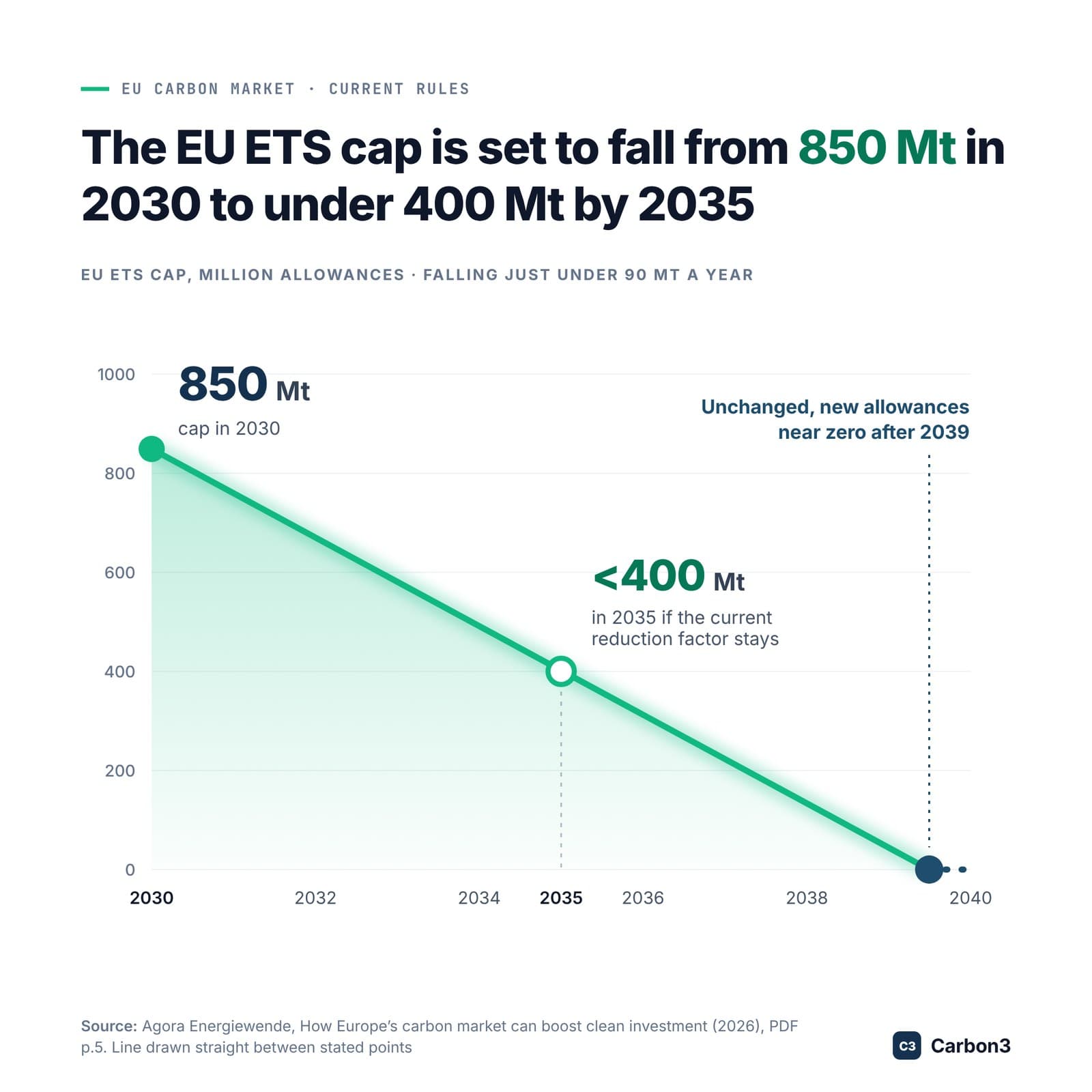
Agora Energiewende shows the EU ETS cap falling from 850 Mt in 2030 to just below 400 Mt in 2035, a cost that buyers of steel, cement and chemicals will feel through their suppliers.
Read the articlePolicy
Near-zero steel and cement will be built when buyers commit to the first tonnes
The COP31 Presidency's Antalya Green Industrialisation Compact sets out an investment gap of more than $500 billion for near-zero steel and cement.
Read the articlePolicy
EU importers can now deduct a supplier's home carbon price from their CBAM bill
Commission Implementing Regulation (EU) 2026/2498 lets importers deduct carbon prices already paid outside the EU, and admits international credits only if they are authorized and issued under Article 6.
Read the article
See the companies behind these figures in the Data Hub.
Look up your suppliers’ emissions and targets, free.