The EU carbon market is running out of allowances on a published schedule
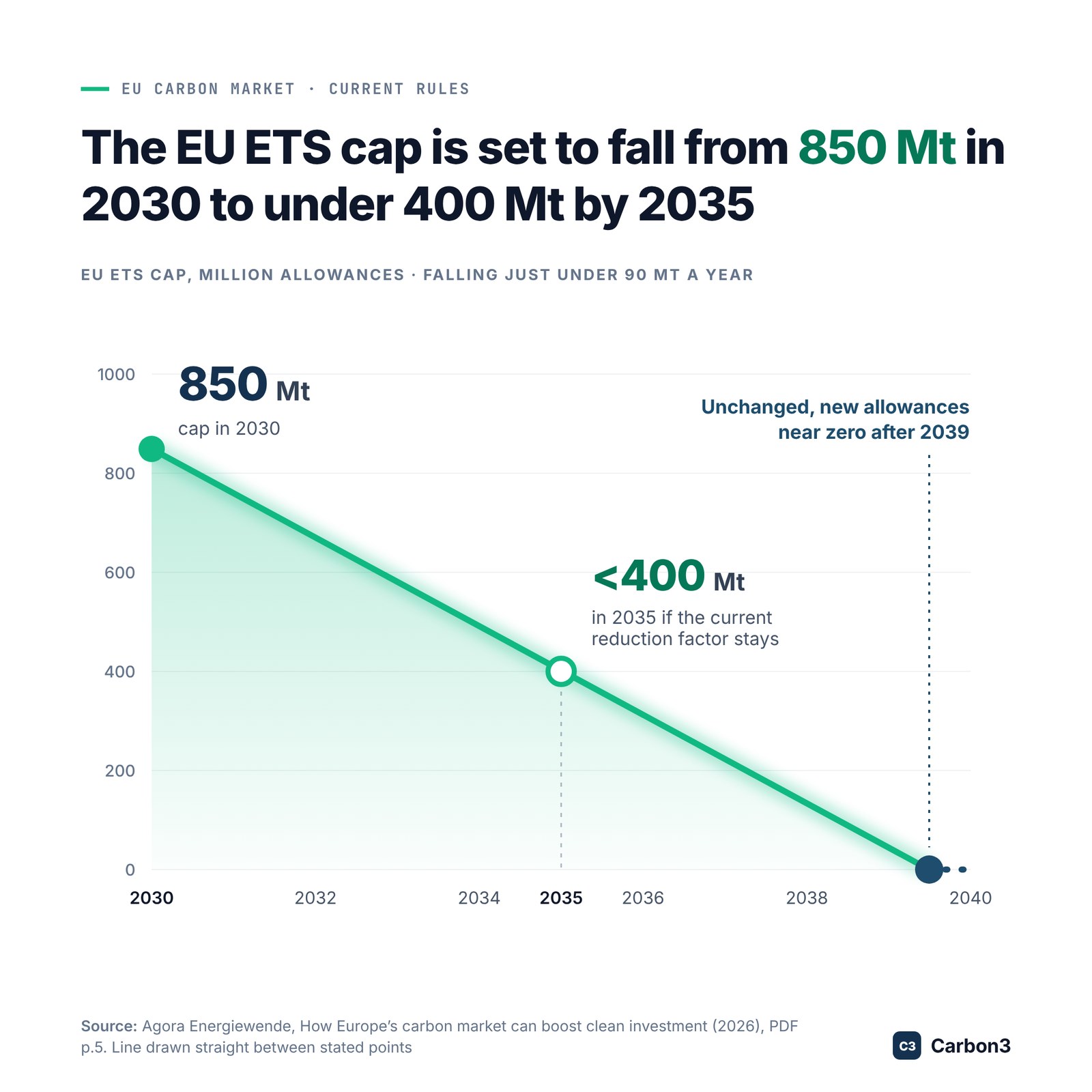
Agora Energiewende shows the EU ETS cap falling from 850 Mt in 2030 to just below 400 Mt in 2035, a cost that buyers of steel, cement and chemicals will feel through their suppliers.
By Carbon3 team2 min read
The EU Emissions Trading System, the bloc's main carbon market, does not tighten by surprise. Its cap on allowances falls on a schedule written into law, and that schedule now points to a much smaller market within a decade.
What the schedule says
In a 2026 analysis of how Europe's carbon market can boost clean investment, Agora Energiewende sets out where the current rules lead. Under those rules, the EU ETS cap falls to 850 Mt in 2030.
From 2028, the linear reduction factor, the share by which the cap shrinks each year, rises to 4.4%. As a result, the cap drops by just under 90 Mt a year and reaches just below 400 Mt in 2035. If nothing changes, Agora Energiewende notes that new allowance issuance would rapidly approach zero after 2039.
None of this depends on a forecast of prices or politics. It is the published path of the cap itself, and companies can plan against it today.
Why buyers of materials should care
The companies most exposed are not only those that hold allowances directly. Producers of steel, cement and chemicals sit inside the EU ETS, and the cost of a tightening cap flows through to the businesses that buy from them.
For those buyers, the effect shows up in two places. It appears in supplier costs, as producers pass on the price of a shrinking pool of allowances. It also appears in Scope 3 inventories, because the emissions of purchased materials are part of a buyer's own value-chain footprint.
A buyer that waits for allowances to run dry will face both pressures at once, with fewer lower-carbon suppliers to choose from.
Building a lower-carbon supply base now
Co-funding verified emissions reductions at suppliers is one way to act ahead of that curve. The support goes to projects in the buyer's own supply chain, such as a cleaner production line at a steel or cement supplier, so the reductions sit inside the buyer's Scope 3 emissions. This is insetting, not offsetting, and the difference is explained at carbon3.net/insets-vs-offsets.
The project developer issues credits on the Carbon3 registry once a verification report is on file. Each reduction then has a single owner and a single claim, which gives buyers, suppliers and auditors the same view of who holds what.
Done early, this builds a supply base that is already lower-carbon by the time the cap leaves little room for the old one.
Claim treatment depends on the applicable reporting framework.
Correction, 30 October 2026: An earlier version of this article said the reductions behind Carbon3 credits are independently verified. Credits are issued once a verification report is on file. Carbon3 asks for a verifier that is independent of the project, but the registry does not yet check who wrote the report.
Source: Agora Energiewende, How Europe's carbon market can boost clean investment (2026).
Learn more
How insetting works in steel and cement
Originally published on LinkedIn, 29 October 2026.
Read more from the research team.
Policy
CBAM is moving down the supply chain, and supplier emissions data now carries a price
The EU plans to extend its carbon border charge from basic metals to finished products in 2028, which makes verified supplier data a purchasing issue.
Read the articlePolicy
Under CBAM, who pays for the emissions embedded at the supplier?
COP31 opened without a formal agenda item on climate-related trade measures, and the EU CBAM stays on its own legal timetable.
Read the articleSector: Steel
Green steel looks expensive at the mill and cheap in the showroom
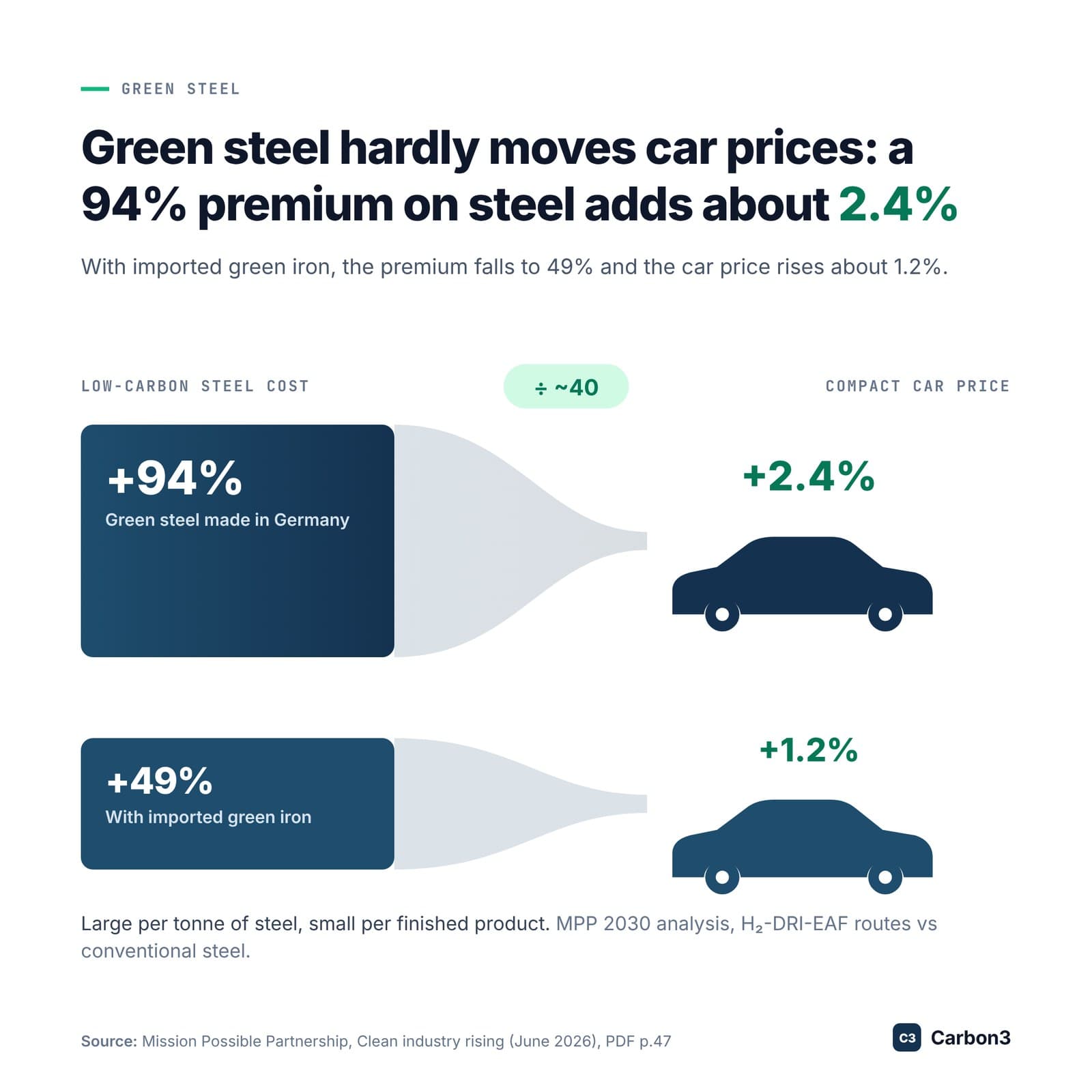
Mission Possible Partnership finds a 94% premium on hydrogen-based steel adds only about 2.4% to the cost of a compact car in 2030, which gives buyers a cheap way to act on purchased-goods emissions.
Read the article
See the companies behind these figures in the Data Hub.
Look up your suppliers’ emissions and targets, free.