CBAM is moving down the supply chain, and supplier emissions data now carries a price
The EU plans to extend its carbon border charge from basic metals to finished products in 2028, which makes verified supplier data a purchasing issue.
By Carbon3 team7 min read
The European Union's carbon border charge is heading for companies that never thought of themselves as metal importers. On 20 October 2026, negotiators for the European Parliament and EU member states held their first trilogue, the closed-door talks that settle the final text of a law, on extending the Carbon Border Adjustment Mechanism (CBAM) to finished steel and aluminum goods. According to press reports summarized by CBAM Guide, the meeting ended without an overall agreement, sent four technical issues back to working level, and set the next round for 30 November.
CBAM puts a carbon price on the emissions embedded in certain imports, at the level EU producers pay under the EU Emissions Trading System, the EU's carbon market. It has applied to imports of iron and steel, aluminum, cement, fertilizers, hydrogen and electricity since 1 January 2026. The European Commission set the price for goods imported in the third quarter of 2026 at €82.32 per certificate, up from €75.28 in the second quarter, and certificates go on sale in February 2027.
What the extension covers
The Commission's proposal of 17 December 2025 would add 180 steel- and aluminum-intensive downstream products from 1 January 2028. According to the Commission, 94% of them are industrial supply chain products with an average steel and aluminum content of 79%, such as base metal mountings, cylinders, industrial radiators and casting machines, while 6% are household goods such as washing machines.
Both the member states and the Parliament have proposed adding more products. The Council agreed its position on 12 June 2026, and the Parliament adopted its own on 15 September 2026 by 464 votes to 50, with 159 abstentions. S&P Global estimates that the products under discussion accounted for over $255 billion of EU imports in 2025, about 2.5 times the $103 billion in imports covered by CBAM's initial scope. Only 24% of that trade value sits in products that appear on all three lists, so the final scope is still open.
Why this becomes a supply chain question
The charge follows the metal, not the finished product. The Commission's own example is a car door made outside the EU, which would face CBAM only for the emissions embedded in the steel plates used to make it, not for cutting the plates into parts or assembling them. That means the number that matters sits with the steel or aluminum producer, often two or three tiers up the supply chain.
Importers can declare those emissions in one of two ways. They can use actual emissions data from the producing plant, provided it is verified by an independent verifier, or they can use default values set by the Commission. For goods already in scope, the default values carry a mark-up of 10% in 2026, 20% in 2027 and 30% in 2028, with a lower 1% mark-up for fertilizers. For the more complex downstream goods, the Commission has proposed default values without a mark-up, because it accepts that actual data will be administratively difficult to collect.
Even without a mark-up, a default value does not reflect a cleaner supplier. A manufacturer that buys lower-emission steel only pays for those lower emissions if the supplier's data exists and has been verified. The proposed anti-circumvention rules raise the bar further, because the Commission could require extra evidence for high-risk combinations of goods and origins.
The same supplier data already matters for a second reason. Purchased goods usually fall under Scope 3, which covers the emissions in a company's value chain outside its own operations. A buyer that collects verified, plant-level emissions data from its metal suppliers can use it both in its CBAM declarations and in its Scope 3 inventory.
Where insetting fits
Supplier data shows the emissions, but it does not reduce them. Insetting means financing emissions reductions in a company's own value chain, for example by co-financing a switch to renewable power at a steel supplier. When that investment works, the supplier's measured emissions fall, and its customers report the lower figure.
Inset credits are a separate instrument from CBAM certificates. They cannot be surrendered under CBAM and they do not replace the carbon price, which is still paid on the embedded emissions that remain. What insetting adds is a single, independently verified record of the reduction: credits are issued to the project developer after verification, Carbon3 records them in its registry, and they are allocated in proportion to each party's contribution so that each reduction is claimed only once.
Claim treatment depends on the applicable reporting framework. Because the same measured reduction can appear in a customs declaration and in a Scope 3 inventory, buyers should make sure both draw on the same verified evidence and describe the same tonne in a consistent way.
Where this still falls short
Nothing has changed for importers of finished goods yet, and the extension remains a proposal. CBAM is phased in between 2026 and 2034 as EU producers lose their free allowances under the EU Emissions Trading System, and the Commission's July 2026 proposal to revise that system would reintroduce 15% of the phased-out free allocation for CBAM sectors from 2028 and extend the phase-out to 2038, according to the International Carbon Action Partnership.
What comes next
The second trilogue on 30 November is the next date to watch, and the Council aims for an agreement before the end of 2026, according to the policy consultancy Publicea. Under every version of the list, manufacturers can check their bills of materials against the three product lists, ask non-EU metal suppliers for plant-level emissions data verified by an accredited verifier, and write those data requirements into supply contracts now.
The carbon cost of steel and aluminum is moving from the customs desk to the purchasing department, and buyers that know their suppliers' emissions, and help reduce them, will pay for what those suppliers actually emit rather than for a default.
Sources
- CBAM Guide, "First trilogue on the CBAM downstream extension: no deal, four open issues, next round reported for November 30," 23 October 2026 (first trilogue 20 October 2026; no overall agreement per Agence Europe; four technical issues; next round 30 November 2026)
- European Commission, Price of CBAM certificates (Q2 2026 €75.28; Q3 2026 €82.32, published 5 October 2026; certificates purchased on the central platform from February 2027)
- European Commission, "Questions and answers on the Carbon Border Adjustment Mechanism (CBAM)," 17 December 2025 (180 downstream products; 94% industrial supply chain products; average 79% steel and aluminum content; 6% household goods; car door example; verified actual data or default values; mark-ups of 10%, 20% and 30%, 1% for fertilizers; no mark-up proposed for complex downstream goods; extra evidence and country default values for high-risk cases; phase-in 2026 to 2034)
- European Parliament, Legislative Observatory, procedure 2025/0419(COD), summary of the 15 September 2026 decision (464 votes to 50, 159 abstentions; scope broadened; ex ante country default values for high-risk combinations)
- S&P Global, "EU institutions split on scope of CBAM expansion," 16 October 2026 (over $255 billion of 2025 EU imports; about 2.5 times the $103 billion initial scope; 24% common to all three proposals)
- Publicea, "CBAM in its definitive phase: what the downstream extension means for importers and manufacturers," updated 22 October 2026 (Council general approach 12 June 2026; Council aims for agreement before end of 2026; next trilogue 30 November)
- International Carbon Action Partnership, "EU Commission publishes EU ETS review proposal," 17 July 2026, updated 23 July 2026 (15% of phased-out free allocation reintroduced for CBAM sectors from 2028; phase-out extended to 2038)
- SBTi, Corporate Net-Zero Standard Manual V1.0 ("insetting, also referred to as supply chain interventions")
- Carbon3, insetting vs offsetting
More analysis at carbon3.net/insights.
The Carbon3 Newsletter
Weekly analysis of industrial decarbonization and insetting across Scope 1, 2 and 3, from the Carbon3 team.
Read more from the research team.
Policy
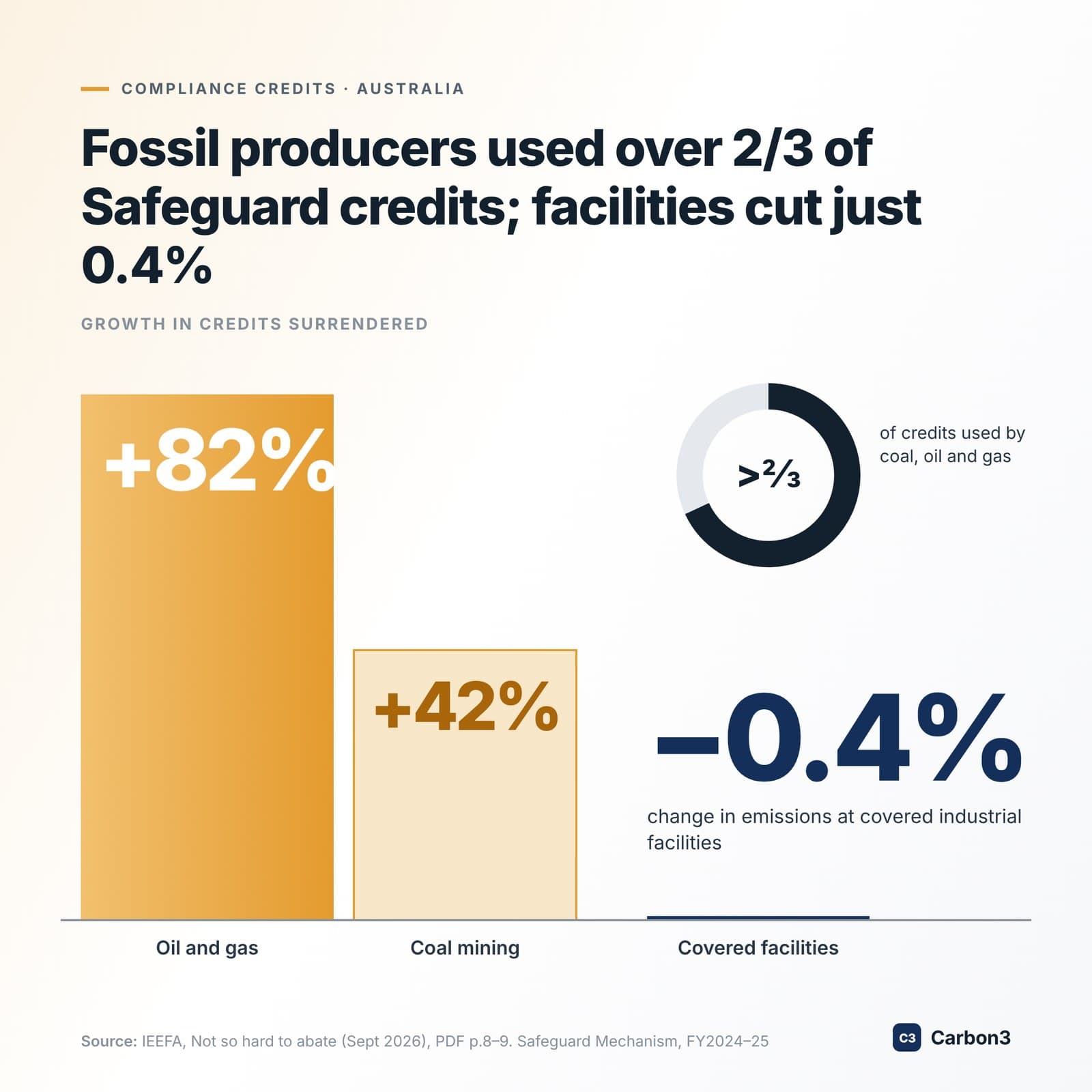
Under Australia's Safeguard Mechanism, credit use is growing faster than emissions reductions
IEEFA finds coal, oil and gas producers used more than two-thirds of the credits surrendered in FY2024-25, while covered facilities reduced emissions by only 0.4%.
Read the articlePolicy
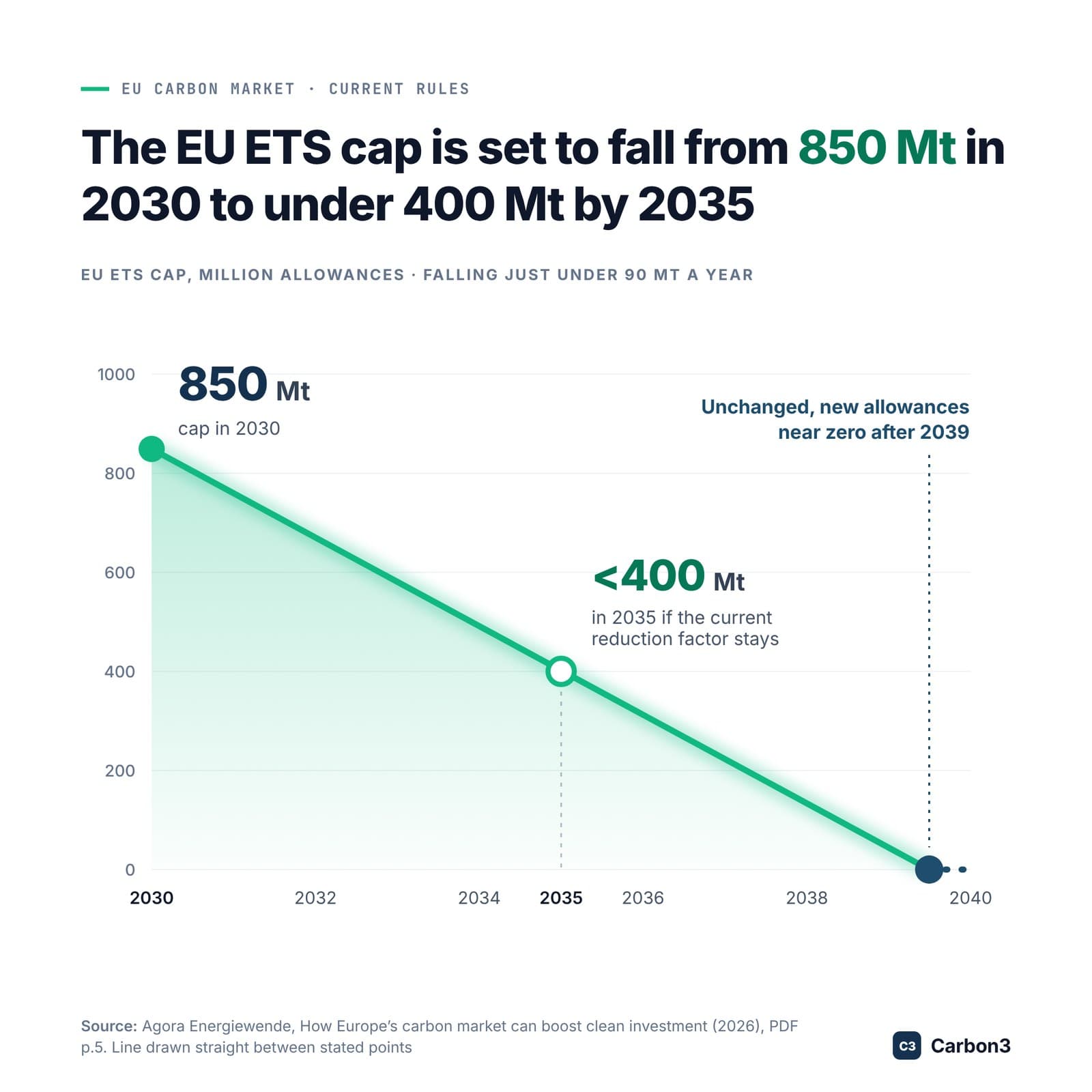
The EU carbon market is running out of allowances on a published schedule
Agora Energiewende shows the EU ETS cap falling from 850 Mt in 2030 to just below 400 Mt in 2035, a cost that buyers of steel, cement and chemicals will feel through their suppliers.
Read the articleClaims & reporting
Spend-based Scope 3 accounting cannot see a cleaner supplier, and that is about to change
The GHG Protocol is weighing limits on spend-based estimates, which moves verified supplier data into the purchasing decision.
Read the article
See the companies behind these figures in the Data Hub.
Look up your suppliers’ emissions and targets, free.