Spend-based Scope 3 accounting cannot see a cleaner supplier, and that is about to change
The GHG Protocol is weighing limits on spend-based estimates, which moves verified supplier data into the purchasing decision.
By Carbon3 team5 min read
Most companies still estimate the emissions of what they buy from what they spend, and the standard setter is now asking whether that should continue. In the plan it published on 29 July 2026 for a consolidated Corporate Standard, the GHG Protocol, the most widely used accounting standard for corporate emissions, lists "phasing out, limiting, or removing the spend-based method" among the Scope 3 changes it will consider. The same plan proposes a data quality hierarchy or scoring matrix, and more prescriptive rules for allocating supplier-specific emissions.
Scope 3 covers the emissions in a company's value chain outside its own operations, and for most buyers the largest share sits in purchased goods. The spend-based method multiplies money spent by an average emission factor for each product category. It is quick, but it is blind to the supplier. As Resource Solutions explains, these models assume all products in a category are alike, so more expensive products are assigned higher emissions, which makes it particularly difficult to show the result of a reduction that carries a price premium.
The data gap is still wide
That blind spot matters because most companies are not yet using better data. In Sphera's 2026 Scope 3 Report, a survey of 1,034 sustainability leaders, 45% of respondents said they lack full confidence in their Scope 3 data. Only 45.27% collect primary data from suppliers, and only 34% report purchased goods and services at all, even though Sphera calls it the largest Scope 3 category for most sectors. At the same time, 89% plan to expand their Scope 3 reporting.
Nothing is final yet. The GHG Protocol's timeline puts a consolidated draft standard out for public consultation in an estimated second quarter of 2027, with the revised standard estimated for the fourth quarter of 2028. Every item in the plan is framed as something to consider, so spend-based estimates may be limited rather than removed.
Procurement is where the data gets built
Some buyers have not waited. According to CDP, Bosch scaled its supplier data requests from 500 suppliers to over 4,500 in 2025, and its suppliers provided primary CO2 data for around 77% of its purchasing volume in 2024. Bosch uses that data in internal supplier scores, scorecards on CDP and SBTi performance, and bonus and malus programs that feed its purchasing decisions. Its target is to cut Scope 3 emissions by 30% by 2030 compared with 2018.
The lesson is that supplier data quality is now a purchasing question, not only a reporting one. A buyer that asks for plant-level or product-level emissions in tenders and contracts gets an inventory that moves when its suppliers improve. A buyer that relies on spend gets a number that rises when it pays more for cleaner goods.
Where insetting fits
Better data shows where the emissions are, but it does not reduce them. Insetting means financing emissions reductions in a company's own value chain, for example by co-financing a supplier's switch to renewable power or a cleaner fuel. Those reductions only appear in the buyer's Scope 3 inventory if the supplier's own emissions data exists and reflects them, which is why insetting and supplier-specific accounting go together.
Carbon3 provides the record that connects the two. The reduction is verified by an independent third party, credits are issued to the project developer after verification, Carbon3 records them in its registry, and they are allocated in proportion to each party's contribution so that each reduction is claimed only once. One inset credit equals one ton of CO2e of independently verified emissions reductions.
Claim treatment depends on the applicable reporting framework. Buyers should check that the supplier figure in their inventory and the inset credits they hold describe the same verified reduction, and that it is not counted twice.
What to watch
The next milestone is the GHG Protocol's consultation draft, estimated for the second quarter of 2027. Until then, buyers can rank their suppliers by spend and emissions, ask the largest ones for verified plant-level data, and write those requirements into contracts at award, when they have the most leverage.
Companies that build supplier data now will see their own decarbonization efforts in their numbers, while those that wait will keep reporting averages.
Sources
- GHG Protocol, Corporate Standard Version 3.0 Standard Development Plan, version 2.0, 29 July 2026 (spend-based method; data quality hierarchy/scoring matrix; allocation of supplier-specific emissions; consultation draft estimated Q2 2027; revised standard estimated Q4 2028)
- Resource Solutions, "Scope 3 GHG Accounting for Upstream Clean Electricity Use," 2023 (spend-based method assigns higher emissions to more expensive products; hard to show price-premium reductions)
- Sphera, The 2026 Scope 3 Report (1,034 respondents; 45% lack full confidence; 45.27% collect primary supplier data; 34% report purchased goods and services; 89% plan to expand)
- CDP, "Bosch: Scaling Primary Supplier Data to Power Strategic Decision-Making" (500 to over 4,500 suppliers in 2025; around 77% of purchasing volume in 2024; bonus/malus; 30% by 2030 vs 2018)
- Carbon3, insetting vs offsetting
If this was useful, subscribe to get our weekly analysis of industrial decarbonization and insetting across Scope 1, 2 and 3, from shipping fuels to steel and supplier data. It is free and lands in your inbox once a week.
More analysis at carbon3.net/insights.
The Carbon3 Newsletter
Weekly analysis of industrial decarbonization and insetting across Scope 1, 2 and 3, from the Carbon3 team.
Read more from the research team.
Claims & reporting
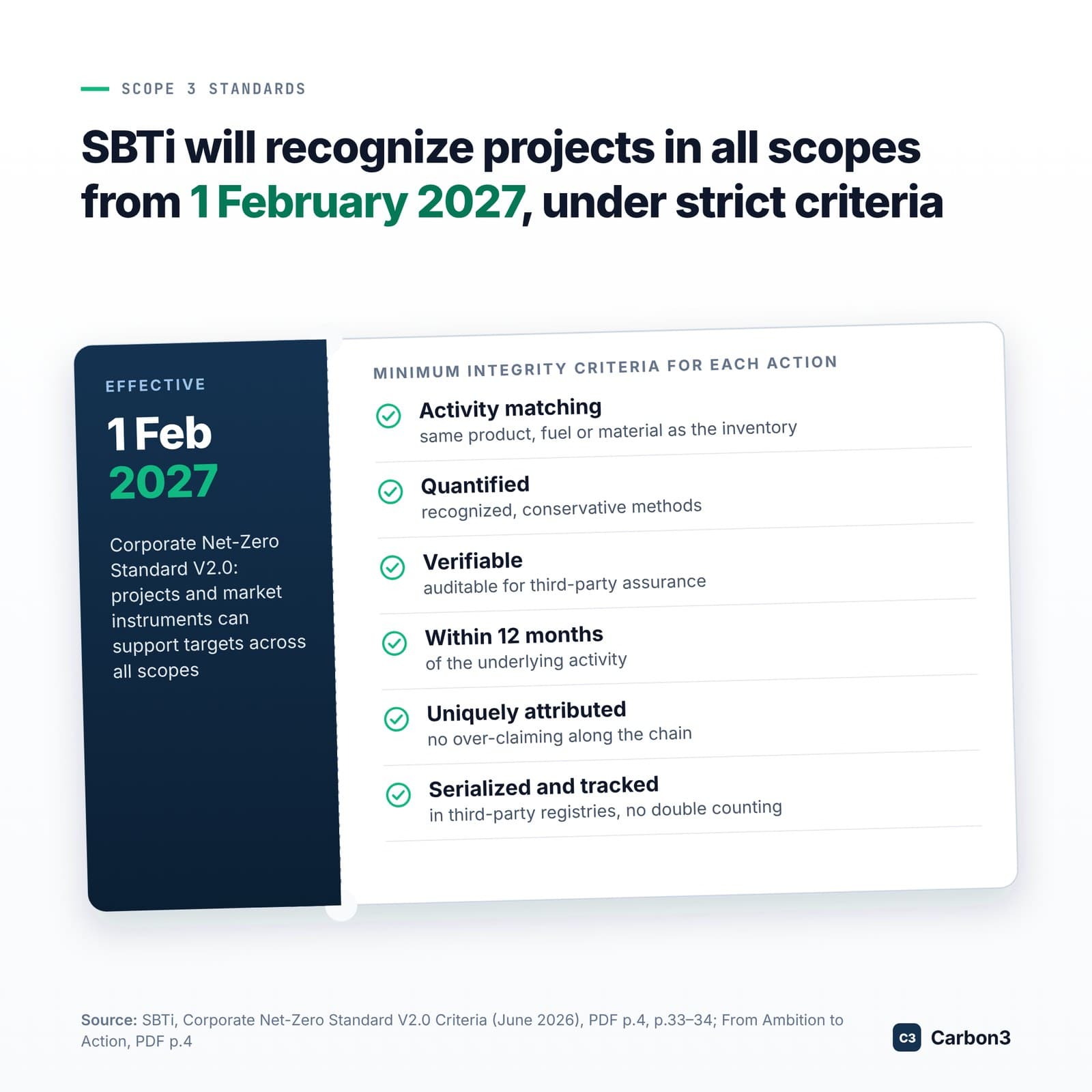
The SBTi has set the rules for using value-chain projects toward targets
The Corporate Net-Zero Standard V2.0 opens for validations on 1 February 2027, becomes mandatory for new targets on 1 February 2028, and lets projects support targets across all scopes, provided each action is verifiable, timely, uniquely attributed and serialized.
Read the articleClaims & reporting
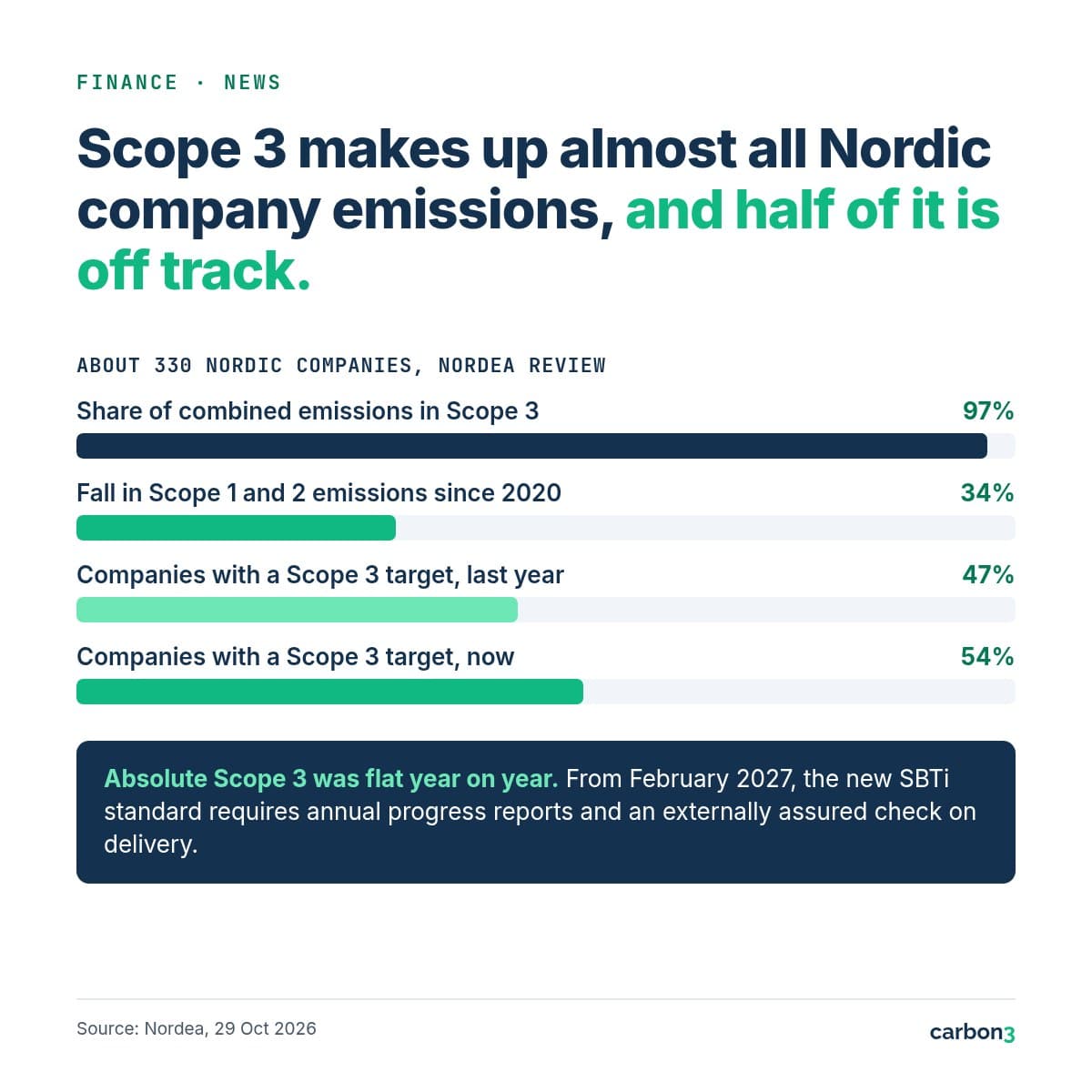
Scope 3 makes up almost all Nordic company emissions, and half of it is off track
Nordea's review of about 330 Nordic companies finds value-chain emissions are 97% of the total and flat year on year, while Scope 1 and 2 are down 34% since 2020.
Read the articlePolicy
CBAM is moving down the supply chain, and supplier emissions data now carries a price
The EU plans to extend its carbon border charge from basic metals to finished products in 2028, which makes verified supplier data a purchasing issue.
Read the article
See the companies behind these figures in the Data Hub.
Look up your suppliers’ emissions and targets, free.