Scope 3 makes up almost all Nordic company emissions, and half of it is off track
Nordea's review of about 330 Nordic companies finds value-chain emissions are 97% of the total and flat year on year, while Scope 1 and 2 are down 34% since 2020.
By Carbon3 team2 min read
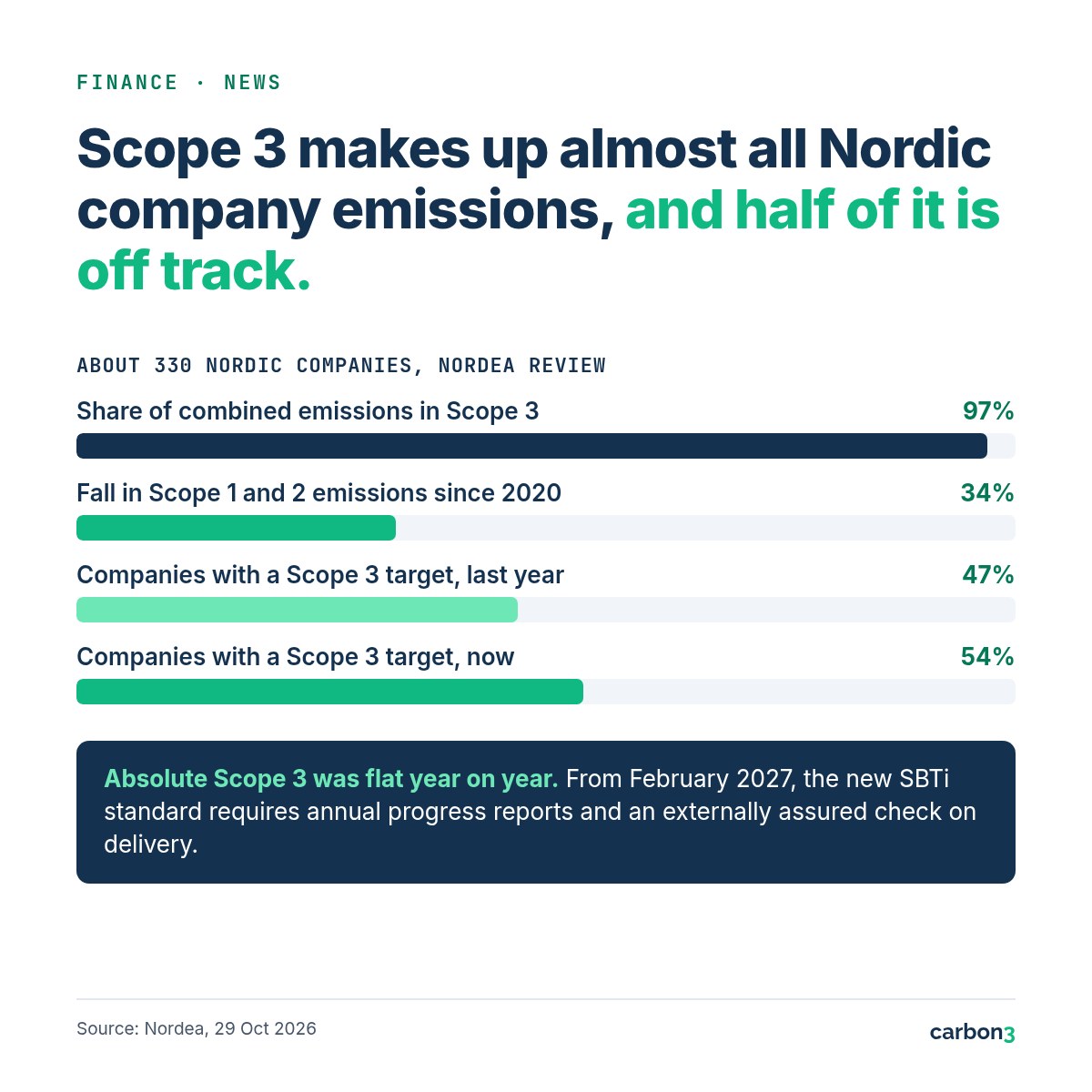
Nordea's annual review of climate targets and progress across about 330 Nordic companies points to a persistent gap between ambition and delivery. The gap sits almost entirely in one place: Scope 3, the emissions in a company's value chain.
Where the emissions sit
Scope 3 emissions account for 97% of the combined emissions of the companies Nordea covers. Absolute Scope 3 was flat year on year, and the bank assesses that half of it is not on track with targets.
The direct picture looks better. Scope 1 and 2 emissions, from a company's own operations and the energy it buys, fell 3% in 2025 and are down 34% since 2020. Target setting is also spreading: 63% of the companies now have a Scope 1 and 2 target, up from 55%, and 54% have a Scope 3 target, up from 47%.
Why the gap now matters more
The reporting rules are about to tighten. From February 2027, version 2.0 of the corporate standard from the Science Based Targets initiative (SBTi) enters into force. Under it, progress has to be reported every year, and at the end of each five-year cycle an assessment of delivery is required and must be externally assured.
That changes the nature of the Scope 3 problem. A target that sits on paper is no longer enough. A company will need to show, to an auditor, what has actually changed in its value chain.
Turning value-chain progress into evidence
For most companies, Scope 3 reductions happen at suppliers, carriers and fuel producers, outside their own walls. The hard part is proving which reductions belong to which buyer, without the same tonne being claimed twice.
Financing verified emissions reductions inside a company's own value chain is insetting, not offsetting, and the difference is explained at carbon3.net/insets-vs-offsets. The project developer issues credits on the Carbon3 registry once a verification report is on file, so each reduction has a single owner and a single claim that an auditor can trace.
Claim treatment depends on the applicable reporting framework.
If almost all the emissions sit in Scope 3, the open question is how companies will show progress that holds up to an auditor.
Correction, 30 October 2026: An earlier version of this article said the reductions behind Carbon3 credits are independently verified. Credits are issued once a verification report is on file. Carbon3 asks for a verifier that is independent of the project, but the registry does not yet check who wrote the report.
Source: Nordea, "Crossing 1.5°C: Assessing Nordic climate targets and delivery" (29 October 2026).
Learn more
How a buyer reports inset credits
Originally published on LinkedIn, 29 October 2026.
Read more from the research team.
Claims & reporting
Spend-based Scope 3 accounting cannot see a cleaner supplier, and that is about to change
The GHG Protocol is weighing limits on spend-based estimates, which moves verified supplier data into the purchasing decision.
Read the articleClaims & reporting
A proof of sustainability settles compliance but does not carry a Scope 3 claim
The EU's Union Database gives every renewable fuel batch a common record.
Read the articleClaims & reporting
Half of the companies checked are reducing emissions at the pace their climate targets promise
Carbon3 compared about 7,200 companies on the SBTi registry three ways: how many have climate targets, how fast those targets promise to cut and whether reported emissions are falling that fast.
Read the article

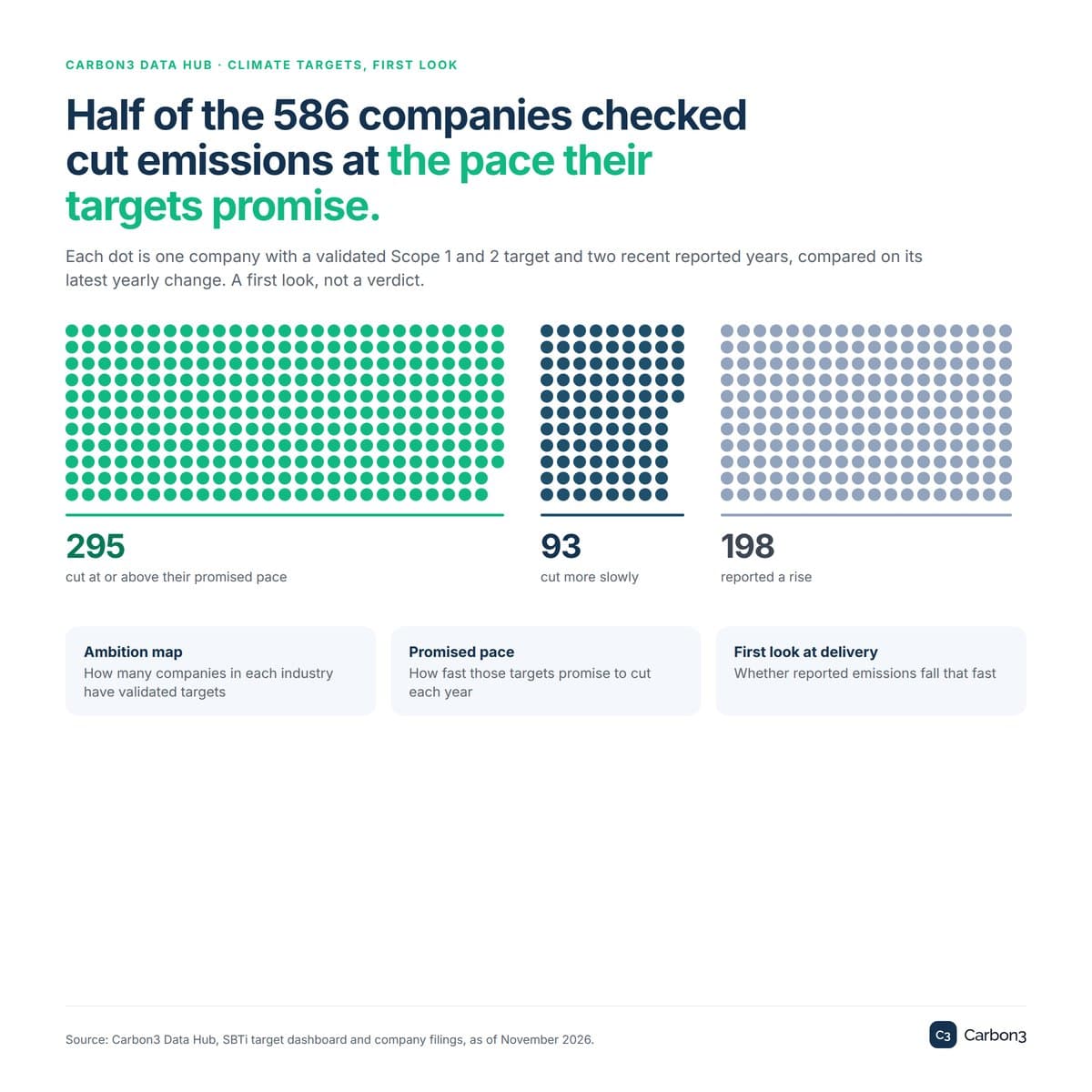
See the companies behind these figures in the Data Hub.
Look up your suppliers’ emissions and targets, free.