A proof of sustainability settles compliance but does not carry a Scope 3 claim
The EU's Union Database gives every renewable fuel batch a common record. That record settles compliance, but it is not enough on its own for airlines making voluntary Scope 3 claims, and the rules that would close the gap are still being written.
By Carbon3 team4 min read

The EU's Union Database works like an identity card for every batch of renewable liquid and gaseous fuel headed for the EU market. It holds one common record covering certification data, proofs of sustainability, transactions and, for renewable gas, the link to guarantee-of-origin registries. In effect, it puts data from different certification schemes into one format, although the record stops at the EU market and is not global.
What the record holds
A proof of sustainability is a declaration by a fuel supplier or trader, based on a certificate from an audited certification scheme, that a specific quantity of fuel meets the EU's sustainability and greenhouse gas savings criteria. The EU rules on certification list what travels with it: the scheme's name, the proof's number, the greenhouse gas data, the raw material, its country of origin and whether public support was paid.
The gas link is written into law. Under the Renewable Energy Directive, guarantees of origin for a renewable gas consignment move into the Union Database when the consignment is registered there, cannot be traded outside it, and are cancelled when the gas leaves the EU grid. The directive set a deadline of November 2024 for the database, but in March 2026 the European Biogas Association reported that it was still in pilot testing for biomethane.
Same record, different assurance
A shared record is only as useful as the rules that produced it. The European Commission has recognized 18 voluntary and national certification schemes. Each runs its own audits against the EU criteria, and several add criteria of their own, such as soil, water or social protections. This suggests that two batches with the same identity card can rest on different audit practices, and so on different levels of assurance.
The Commission is revising its 2022 certification rules, Implementing Regulation (EU) 2022/996, to further develop the standards on reliability, transparency, independent auditing and the supervision of certification bodies. The official draft has not yet been opened for public feedback, and adoption is planned for the first quarter of 2027. Industry groups commenting on a draft text describe six-monthly audits, mandatory rotation of certification bodies every three years and stricter on-site audits for waste suppliers. In their papers, they warn of extra administrative burden and say key terms in the draft are used inconsistently, which they argue creates legal uncertainty.
Compliance treats every proof the same
The Renewable Energy Directive sets the baseline for compliance. When a supplier's evidence comes from a scheme the Commission has recognized, an EU country may not ask for further evidence on the points the recognition covers. In practice, that means a proof of sustainability from any recognized scheme counts the same toward EU targets.
Voluntary claims ask for more
Voluntary claims work differently. A company counting renewable fuel toward its Scope 3 target, the emissions in its value chain, has to show more than the fuel's sustainability. It also has to show who holds the environmental benefit, how that benefit was allocated and when it was retired, meaning used up so that nobody claims it again. A proof of sustainability records the fuel's origin and greenhouse gas data, but it does not, by itself, settle those questions. As airlines and their corporate customers pursue Scope 3 targets, they are likely to ask for more detail on reporting, allocation and retirement.
The standard setters point the same way. The Science Based Targets initiative (SBTi), which validates corporate climate targets, published version 2.0 of its Corporate Net-Zero Standard in June 2026. It requires certificates used toward targets to be issued, transferred and retired through transparent, secure tracking systems that prevent double counting. The GHG Protocol, the main standard for corporate emissions accounting, has proposed a separate market-based statement for reporting certificates and environmental attributes, with a draft consolidated standard due for public consultation in the second quarter of 2027.
Where compliance and voluntary claims meet
Book-and-claim registries, which let the benefit of fuel be sold apart from the physical fuel, already try to separate the two kinds of claim. On the CADO SAF Registry, launched by the International Air Transport Association (IATA) in 2025, a supplier surrenders the proof of sustainability when registering a batch. Redemption, which cannot be reversed, is the step where the airline's Scope 1 claim and its customers' Scope 3 claims are assigned.
The rules on fuel used to meet a mandate are still unsettled. The Sustainable Aviation Buyers Alliance says reductions from fuel used to meet a mandate such as ReFuelEU Aviation should not be sold for voluntary claims. The Roundtable on Sustainable Biomaterials has consulted on a draft that would replace its strict ban on registering such fuel with a framework that allows it under defined conditions.
The gap the next layer has to close
The proof of sustainability is likely to remain the compliance baseline. On its own, though, it does not show that a Scope 3 claim is valid. What is missing is clear rules on who claims which attribute and how each claim is recorded and retired, and that is where the next layer of infrastructure is needed.
The same principle runs through insetting, which means financing emissions reductions in a company's own value chain. Inset credits are issued to the project developer after independent verification, and Carbon3 records them in its registry, so every allocation and retirement can be traced and each tonne is claimed only once.
Claim treatment depends on the applicable reporting framework.
Sources
- European Commission, Union Database for liquid and gaseous renewable and recycled carbon fuels, accessed 29 October 2026.
- Directive (EU) 2018/2001, consolidated text of 16 July 2024, Articles 30(9) and 31a, EUR-Lex, accessed 29 October 2026.
- Commission Implementing Regulation (EU) 2022/996, Article 2 and Annex I, EUR-Lex, accessed 29 October 2026.
- European Commission, Have your say, Revision of the Implementing Regulation on sustainability certification, Ares(2024)5309493, accessed 29 October 2026.
- European Commission, Voluntary schemes, accessed 29 October 2026.
- European Biogas Association, Your short guide to the Union Database, March 2026, accessed 29 October 2026.
- Eurogas, Revision of EU Sustainability Certification Rules, 18 August 2026, and EBA, Eurogas and others, Joint Paper on Recast Implementing Regulation (EU) 2022/996, 6 October 2026, accessed 29 October 2026.
- SBTi, Corporate Net-Zero Standard V2.0 release, 11 June 2026, and Chapter 4, criterion CNZS-C28, accessed 29 October 2026.
- GHG Protocol, AMI feedback summary announcement, 23 September 2026, accessed 29 October 2026.
- IATA, SAF Registry goes live, 3 April 2025, and CADO, CORSIA Eligible Fuel Claims on the CADO SAF Registry, 1 September 2026, accessed 29 October 2026.
- SABA, Sustainability Framework for Sustainable Aviation Fuel, V3, March 2025, accessed 29 October 2026.
- RSB, Book and Claim Manual Version 5 consultation and changes between v4.2 and v5, July 2026, accessed 29 October 2026.
The Carbon3 Newsletter
Weekly analysis of industrial decarbonization and insetting across Scope 1 to 3, from the Carbon3 team.
Read more from the research team.
Claims & reporting
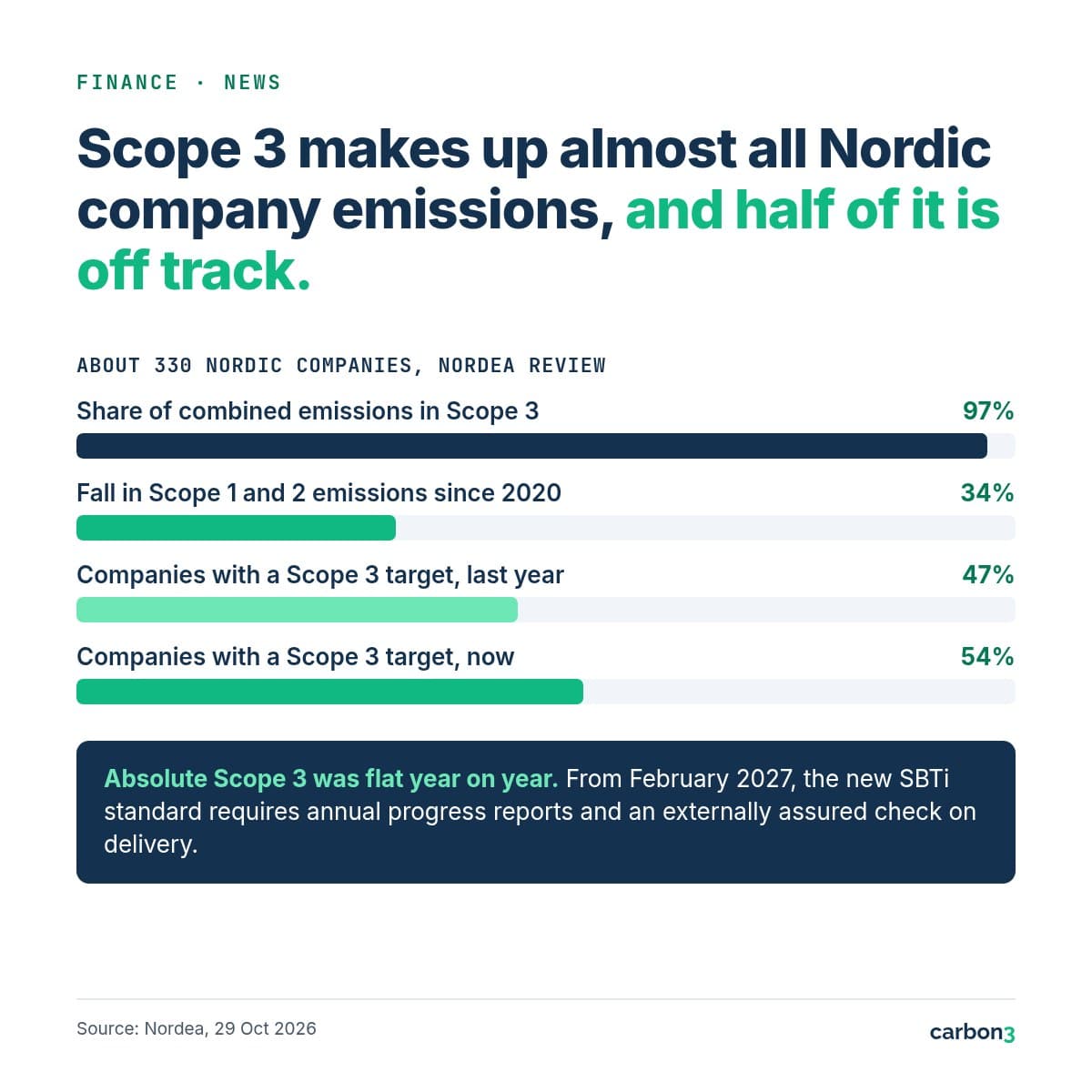
Scope 3 makes up almost all Nordic company emissions, and half of it is off track
Nordea's review of about 330 Nordic companies finds value-chain emissions are 97% of the total and flat year on year, while Scope 1 and 2 are down 34% since 2020.
Read the articleClaims & reporting
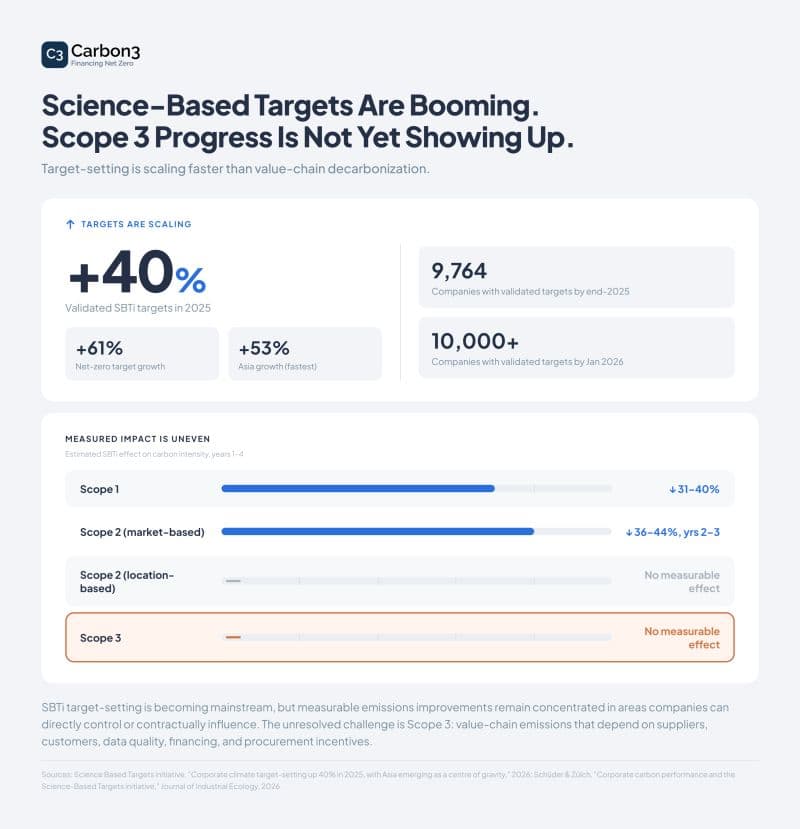
Science-based targets are scaling, but impact is still concentrated where companies have control
The next frontier is Scope 3: turning value-chain ambition into financed, verified and shareable outcomes.
Read the articleSector: Aviation
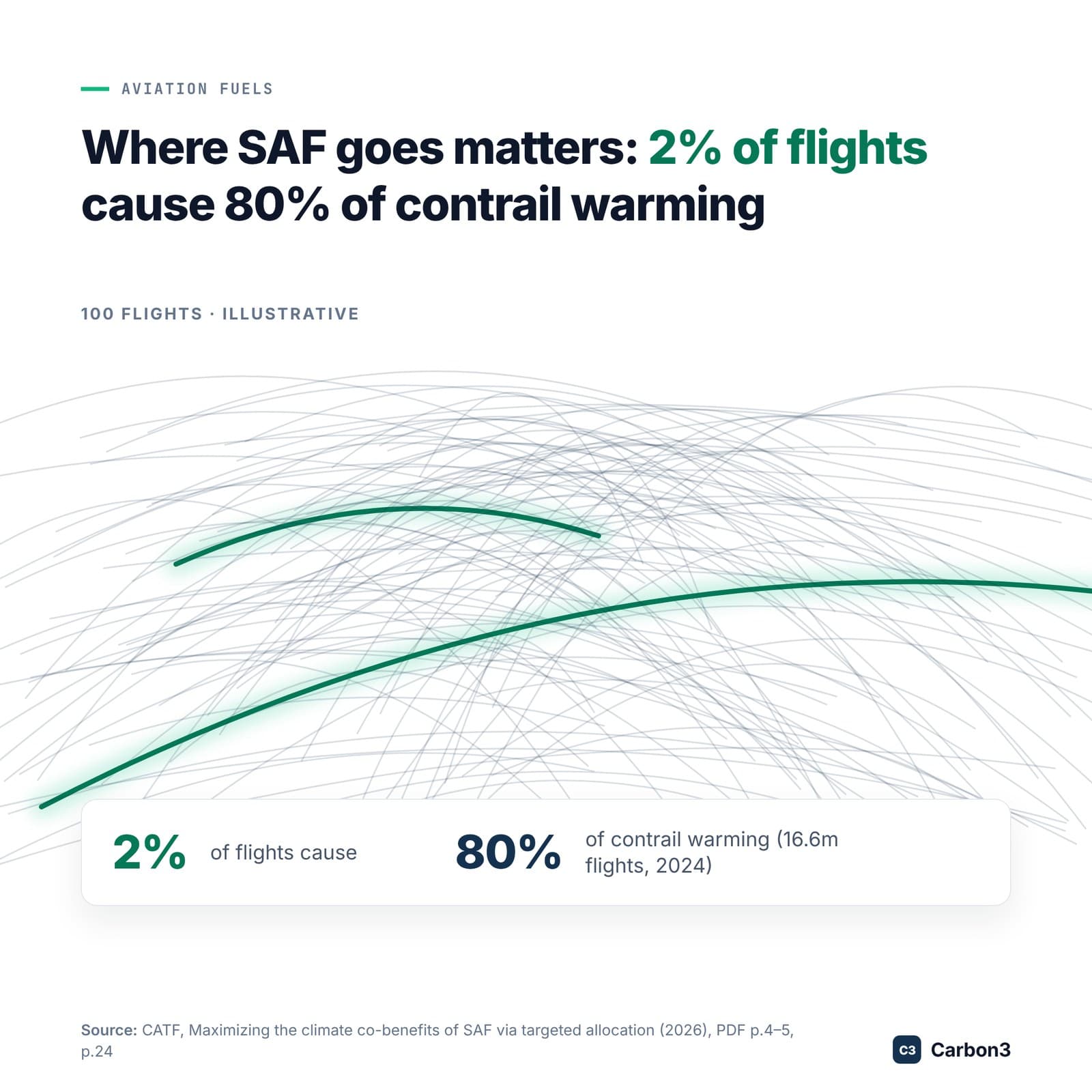
Not every liter of sustainable aviation fuel does the same climate work
Clean Air Task Force finds about 2% of flights cause 80% of contrail-related warming, which makes where scarce SAF is burned, and how it is traced, matter for Scope 3 buyers.
Read the article
See the companies behind these figures in the Data Hub.
Look up your suppliers’ emissions and targets, free.