The SBTi has set the rules for using value-chain projects toward targets
The Corporate Net-Zero Standard V2.0 opens for validations on 1 February 2027, becomes mandatory for new targets on 1 February 2028, and lets projects support targets across all scopes, provided each action is verifiable, timely, uniquely attributed and serialized.
By Carbon3 team2 min read
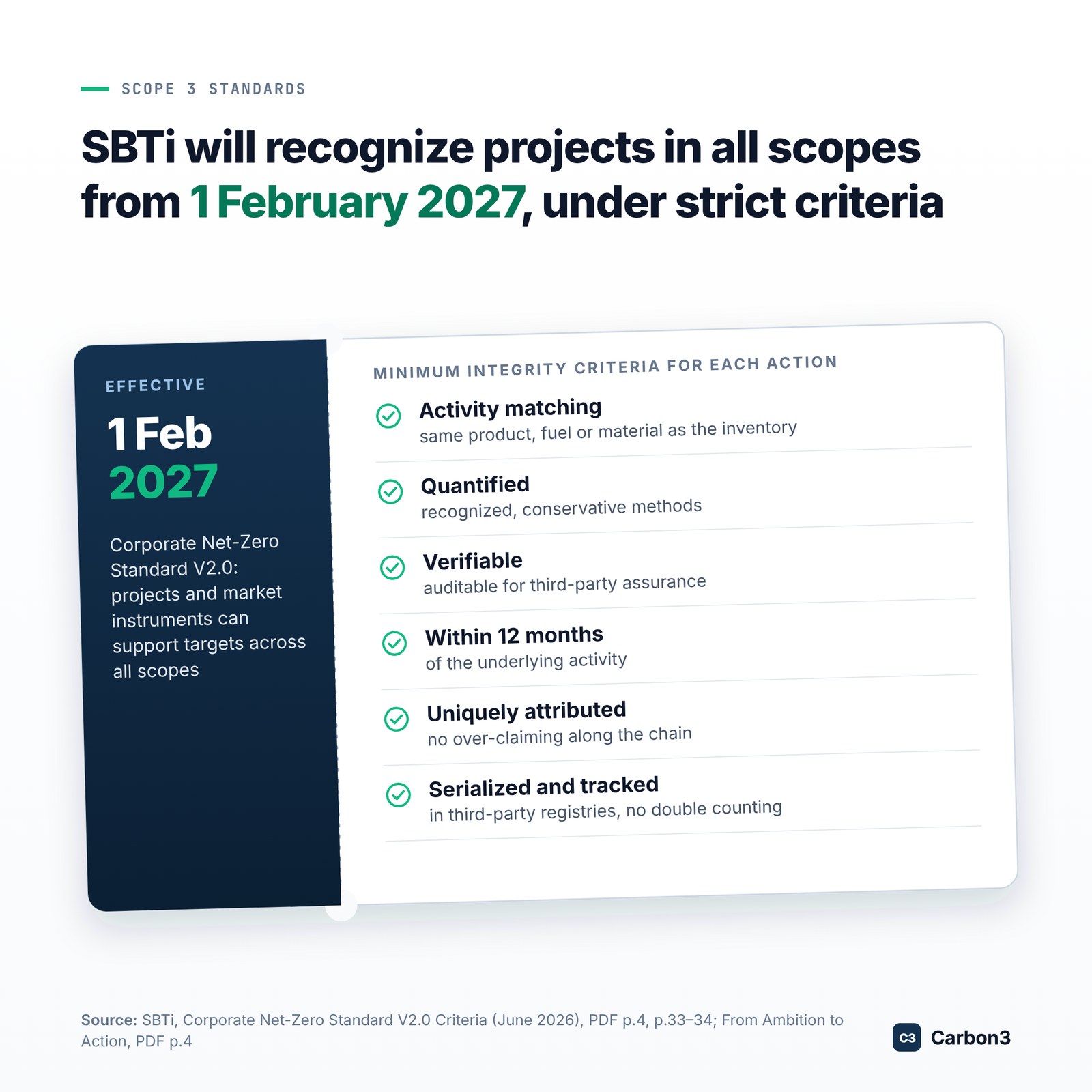
The SBTi has set the rules for using value-chain projects toward targets, and those rules read like a specification for good records.
What V2.0 changes
The Science Based Targets initiative released its Corporate Net-Zero Standard V2.0 in June 2026. Validations under it open on 1 February 2027, and it becomes mandatory for new target submissions from 1 February 2028. Under the new standard, projects and market instruments can support target implementation across all scopes, subject to safeguards.
Those safeguards are specific. Each action must match the underlying activity, be conservatively quantified and verifiable, and fall within 12 months of the activity. It must be uniquely attributed, and it must avoid double counting through unique identification such as serialization.
The standard also draws clear lines on what does not count. Reductions estimated ex ante are excluded, and so are credits sold to a third party.
Why this is a records problem
For buyers and advisors, most of these criteria are not about the project itself but about how it is documented. Matching an action to its activity, proving it happened within the time window, and showing that nobody else claims the same reduction all depend on a reliable record that follows the reduction from the supplier to the company that reports it.
Spreadsheets and bilateral contracts struggle with that. A reduction recorded in two places, or described differently by a supplier and a customer, is exactly the kind of ambiguity the safeguards are designed to rule out.
How inset credits fit
Inset credits are serialized, single-claim records of verified reductions inside the value chain. The project developer issues credits on the Carbon3 registry once a verification report is on file, so each one carries a unique identifier and a clear chain of custody from issuance to retirement.
That structure lines up with the safeguards in V2.0. Serialization supports unique identification, verification supports conservative quantification, and a single claim per credit supports unique attribution. Because the reductions sit inside the reporting company's own value chain, inset credits are also a different instrument from offsets bought from projects outside it.
Companies preparing for validations from February 2027 have time to put these records in place, but the window between now and then is short for anyone who wants value-chain projects to count.
Claim treatment depends on the applicable reporting framework.
Correction, 30 October 2026: An earlier version of this article said Carbon3 credits carry serial numbers. They do not yet. Each batch of credits has its own record ID on the Carbon3 registry, and every transfer, split and retirement is recorded against it. Source: Carbon3 registry.
Correction, 30 October 2026: An earlier version of this article said the reductions behind Carbon3 credits are independently verified. Credits are issued once a verification report is on file. Carbon3 asks for a verifier that is independent of the project, but the registry does not yet check who wrote the report.
Source: SBTi, Corporate Net-Zero Standard V2.0 Criteria (June 2026).
Learn more
How a buyer reports inset credits
Originally published on LinkedIn, 26 October 2026.
Read more from the research team.
Claims & reporting
SBTi's new net-zero standard spells out what a market instrument must prove
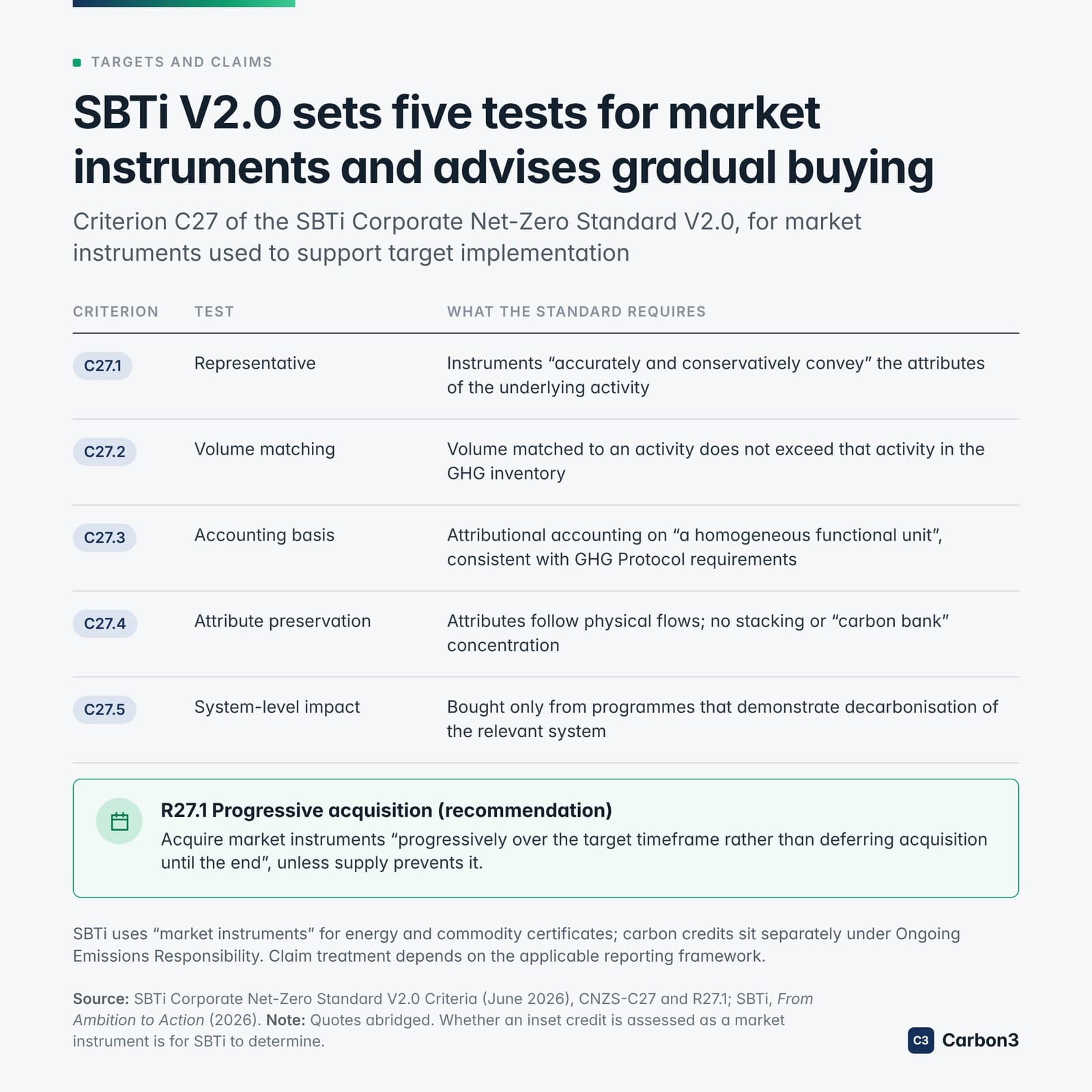
Criterion C27 of the Corporate Net-Zero Standard V2.0 sets five tests for market instruments, and recommendation R27.1 advises buying progressively over the target timeframe.
Read the articleClaims & reporting
Spend-based Scope 3 accounting cannot see a cleaner supplier, and that is about to change
The GHG Protocol is weighing limits on spend-based estimates, which moves verified supplier data into the purchasing decision.
Read the articleClaims & reporting
Scope 3 rules are being rewritten between 2026 and 2028
Revised ESRS apply from financial year 2027, and SBTi's Net-Zero Standard V2.0 becomes mandatory in February 2028.
Read the article
See the companies behind these figures in the Data Hub.
Look up your suppliers’ emissions and targets, free.