Scope 3 rules are being rewritten between 2026 and 2028
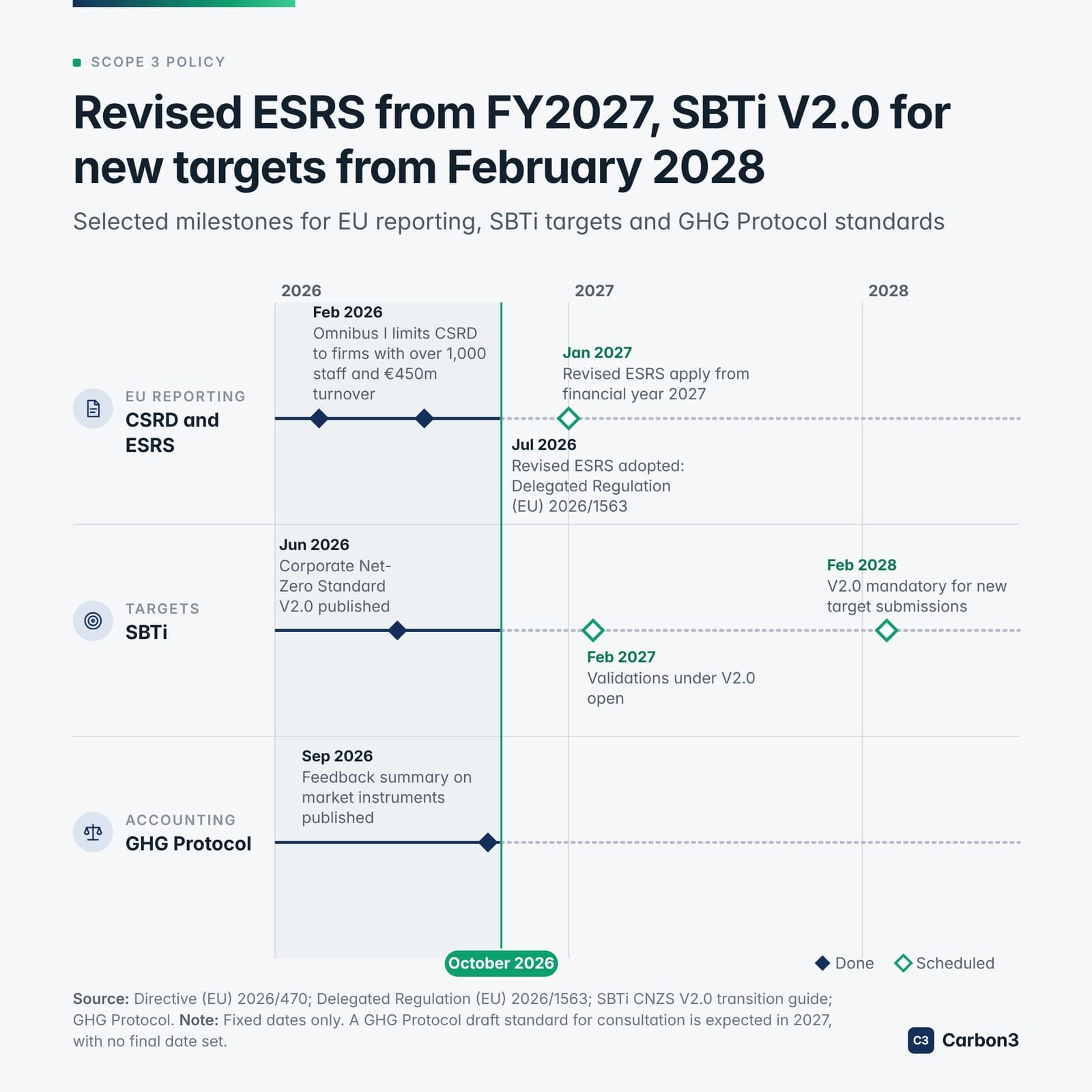
Revised ESRS apply from financial year 2027, and SBTi's Net-Zero Standard V2.0 becomes mandatory in February 2028. Supplier data work needs to start now.
By Carbon3 team2 min read
The rules that govern how companies report and target Scope 3 emissions are being revised over the next two years. Two dates stand out.
The two dates
- Revised ESRS from financial year 2027. The revised European Sustainability Reporting Standards apply from financial year 2027. For companies in scope, that means the reporting they prepare for 2027 will follow the revised standards, including how value-chain emissions are reported.
- SBTi Net-Zero Standard V2.0 mandatory from February 2028. The Science Based Targets initiative's Corporate Net-Zero Standard version 2.0 becomes mandatory in February 2028. Companies setting or renewing targets will need to meet its requirements, which place more weight on Scope 3.
Why the timing matters now
Both dates can look distant. They are not, once the work behind them is counted. Reporting for financial year 2027 depends on data gathered during 2027, and on systems and supplier relationships set up before that. Targets submitted under the new SBTi standard need a baseline and an understanding of where reductions will come from.
For Scope 3, that preparation runs through suppliers. The data has to come from them, and the reductions have to happen at their sites.
What changes in practice
The direction across both frameworks is toward more rigour on value-chain emissions: better data, clearer boundaries, and a stronger link between targets and actual reductions. Estimates built purely from spend data will be harder to rely on. Companies will need to show not only what their Scope 3 is, but what they are doing about it.
A window to prepare
The period between 2026 and 2028 is a window. Companies that use it to build supplier data, agree reduction projects and set up clear records will be ready when the rules apply. Those that wait will be doing the same work under deadline.
Co-funding verified reductions at suppliers is one practical step. When the reduction is recorded as an inset credit, buyer and supplier hold a shared record of what was achieved and who holds it. Insetting is not offsetting.
Claim treatment depends on the applicable reporting framework, and that is exactly what is changing between now and 2028.
Originally published on LinkedIn, 9 October 2026.
The Carbon3 Newsletter
Weekly analysis of industrial decarbonization and insetting across Scope 1 to 3, from the Carbon3 team.
Read more from the research team.
Claims & reporting
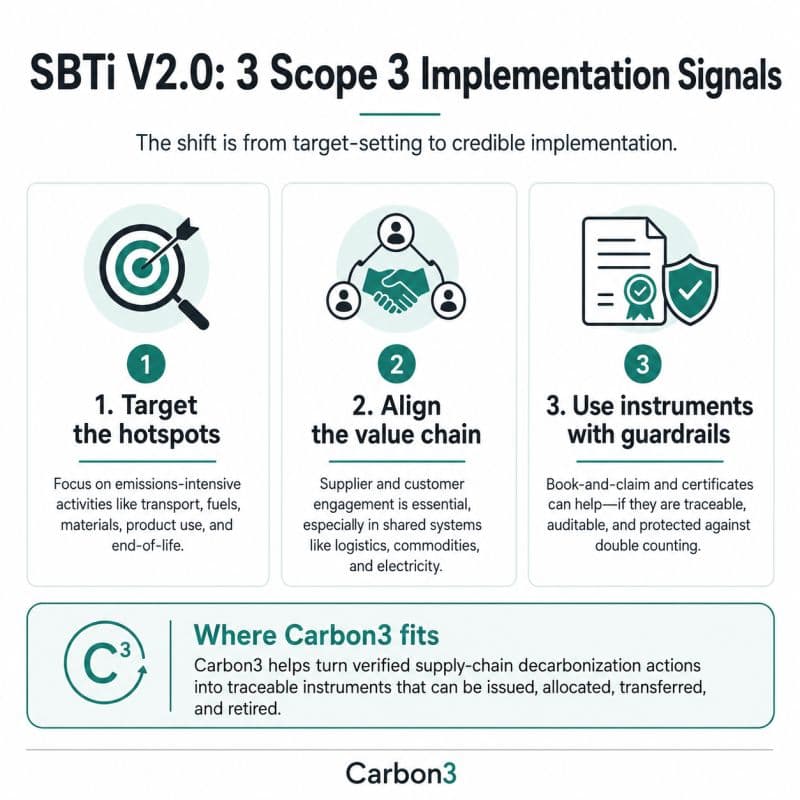
What SBTi's Net-Zero Standard V2.0 changes for Scope 3 implementation
Activity-specific action, supplier alignment, shared systems and high-integrity instruments under clear guardrails.
Read the articleClaims & reporting
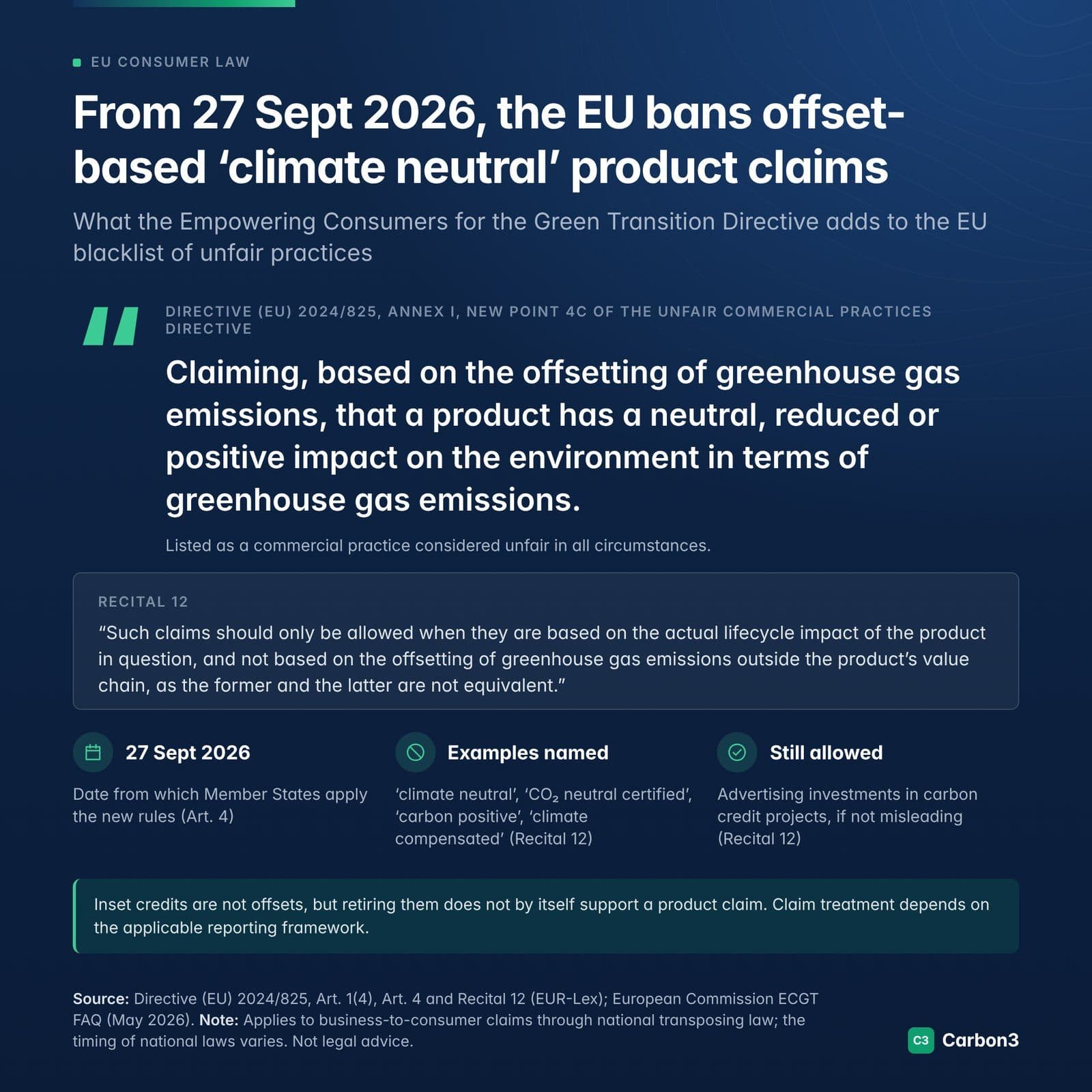
'Climate neutral' labels backed by offsets are now on the EU blacklist
Directive (EU) 2024/825 bans offset-based neutrality claims on products from 27 September 2026, shifting attention to reductions inside the value chain.
Read the articlePolicy
Two Scope 3 rulebooks now have fixed dates, and supplier programs take time to set up
Revised ESRS apply from financial year 2027 and SBTi's Net-Zero Standard V2.0 from February 2028.
Read the article
See the companies behind these figures in the Data Hub.
Look up your suppliers’ emissions and targets, free.