'Climate neutral' labels backed by offsets are now on the EU blacklist
Directive (EU) 2024/825 bans offset-based neutrality claims on products from 27 September 2026, shifting attention to reductions inside the value chain.
By Carbon3 team1 min read
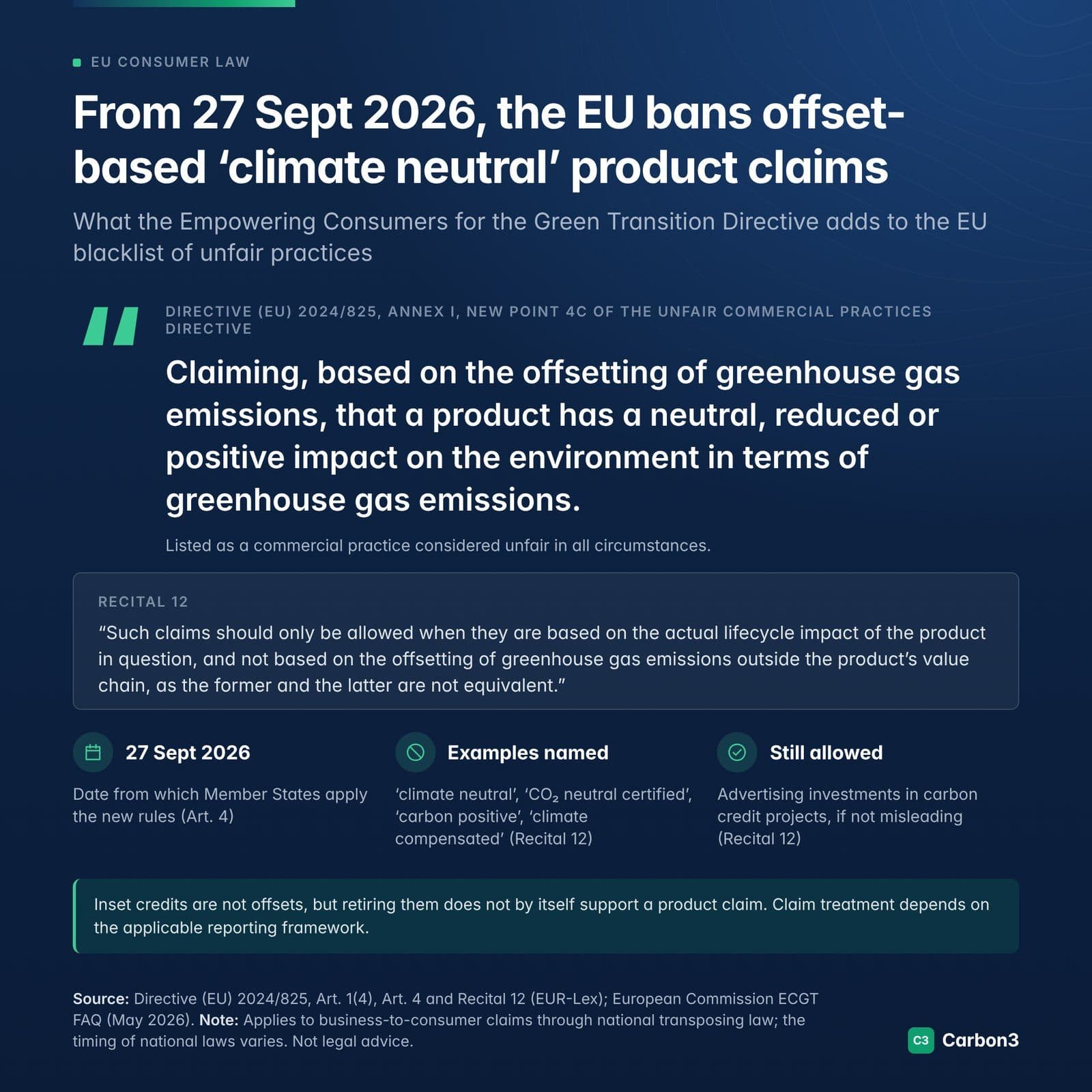
'Climate neutral' on a product label, backed by offsets, is now on the EU blacklist.
What changed
Directive (EU) 2024/825, part of the EU's rules on empowering consumers for the green transition, amends the Unfair Commercial Practices Directive. It adds point 4c to the list of commercial practices that are considered unfair in all circumstances: claiming, based on the offsetting of greenhouse gas emissions, that a product has a neutral, reduced or positive impact on the environment in terms of greenhouse gas emissions.
Member States apply the new rules from 27 September 2026. Being on the blacklist means no case-by-case assessment of whether a consumer was misled: the practice itself is prohibited.
The reasoning
Recital 12 of the directive sets out the logic. Claims of this kind should rest on the product's actual lifecycle impact, not on offsetting emissions outside the product's value chain. The concern is that an offset purchased somewhere else does not change the footprint of the product the consumer is buying.
Why the focus shifts to the value chain
The directive puts attention on reductions inside the value chain, the emissions that actually make up a product's footprint: raw materials, suppliers, manufacturing and transport.
Insetting works in that space. It funds verified reductions inside a company's own value chain, and it is not offsetting. But Carbon3 is careful on the limits. Retiring inset credits does not by itself support a product claim. A product-level claim is a separate matter with its own requirements, and claim treatment depends on the applicable reporting framework.
What companies should take from it
For brands with 'climate neutral' or similar labels backed by offsets, the immediate task is reviewing what is on pack and in marketing. For the longer term, the direction is clear: the credible route is reducing the emissions that sit in the product's own lifecycle, with data that shows it.
Not legal advice; national transposing laws vary.
Originally published on LinkedIn, 13 October 2026.
The Carbon3 Newsletter
Weekly analysis of industrial decarbonization and insetting across Scope 1 to 3, from the Carbon3 team.
Read more from the research team.
Claims & reporting
Scope 3 rules are being rewritten between 2026 and 2028
Revised ESRS apply from financial year 2027, and SBTi's Net-Zero Standard V2.0 becomes mandatory in February 2028.
Read the articleClaims & reporting
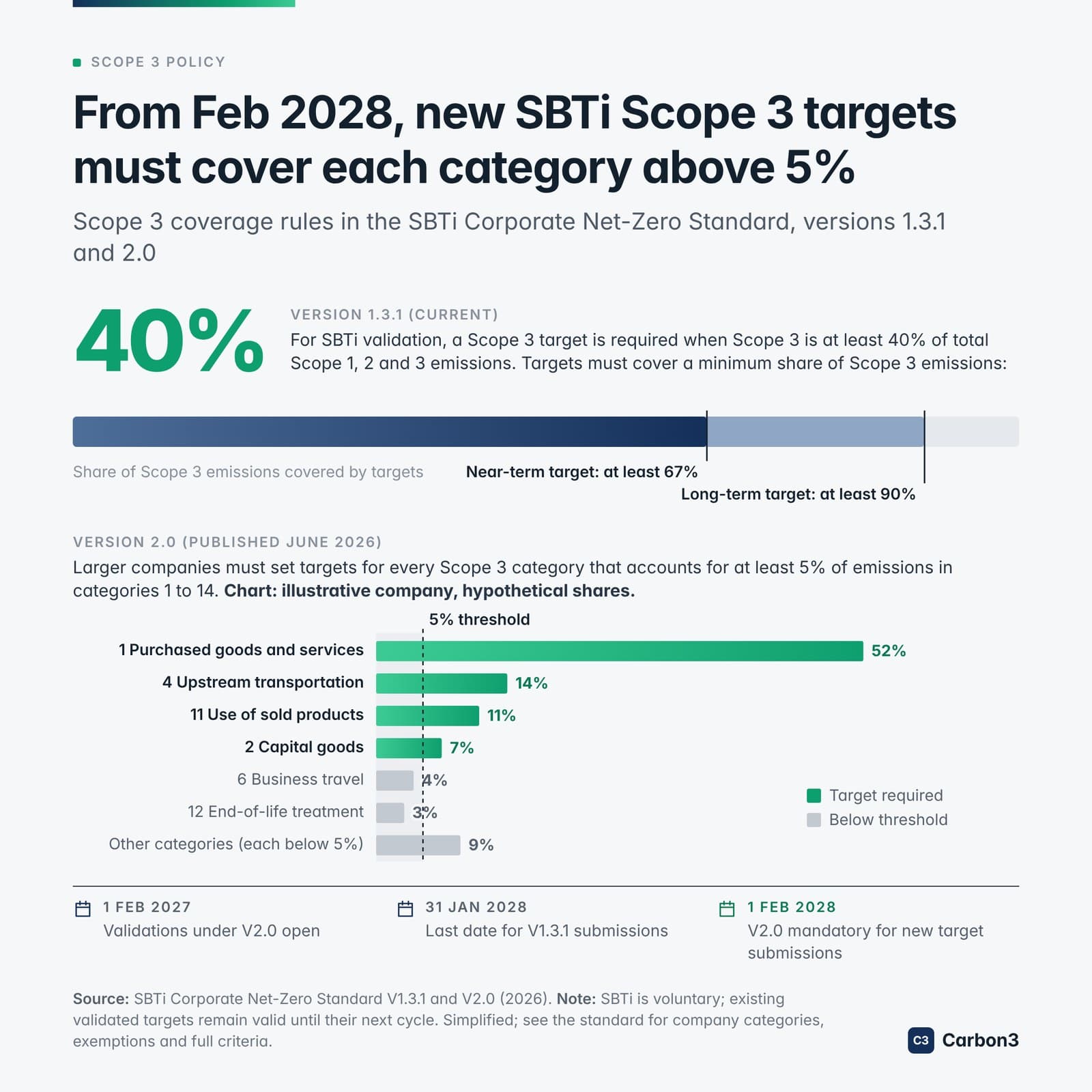
From February 2028, new SBTi Scope 3 targets must cover each category above 5%
SBTi's Corporate Net-Zero Standard V2.0 replaces a single Scope 3 coverage threshold with targets for each category above 5% of emissions, for new submissions from 1 February 2028.
Read the articleMarket structure
Carbon markets 2026: flat on the surface, splitting underneath
Where the voluntary carbon market and corporate supply-chain climate action are heading, based on registry data, new standards and disclosed deals.
Read the article
See the companies behind these figures in the Data Hub.
Look up your suppliers’ emissions and targets, free.