Two Scope 3 rulebooks now have fixed dates, and supplier programs take time to set up
Revised ESRS apply from financial year 2027 and SBTi's Net-Zero Standard V2.0 from February 2028. Read backwards, the timeline leaves little room for supplier programs.
By Carbon3 team2 min read
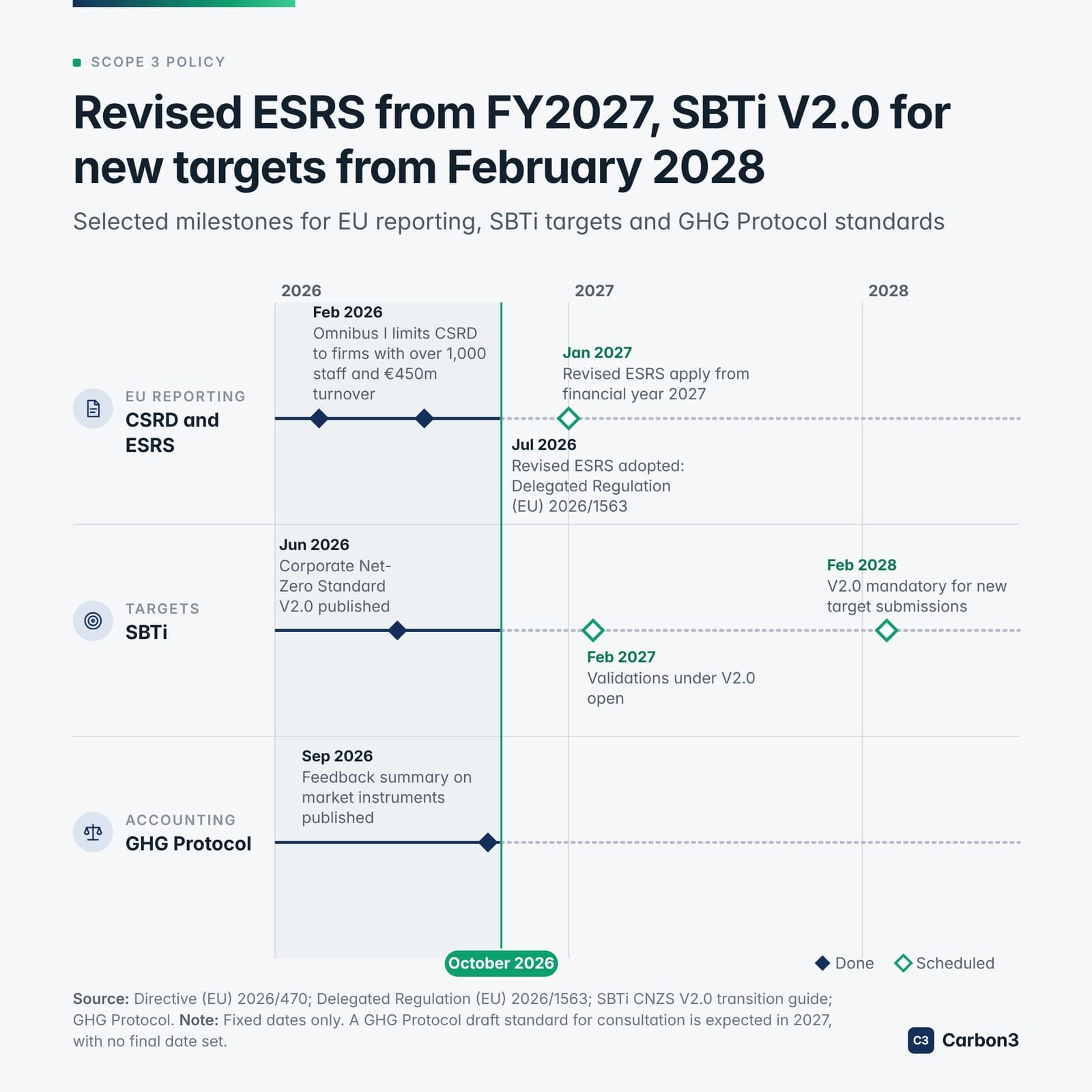
Two of the rulebooks that shape corporate Scope 3 work now have fixed dates. Revised European Sustainability Reporting Standards (ESRS) apply from financial year 2027, and version 2.0 of SBTi's Corporate Net-Zero Standard applies to new target submissions from February 2028. A third, the GHG Protocol's work on actions and market instruments, is still moving, with a draft for consultation expected in 2027. Set side by side, the milestones show how little room is left for supplier programs, which take time to set up.
EU reporting: CSRD and ESRS
In February 2026, the Omnibus I package (Directive (EU) 2026/470) narrowed the Corporate Sustainability Reporting Directive to companies with more than 1,000 employees and €450m in turnover. In July 2026, the revised ESRS were adopted as Delegated Regulation (EU) 2026/1563. They apply from financial year 2027.
For companies still in scope, that means the reporting they prepare for 2027 follows the revised standards, including how value-chain emissions are disclosed. The data for that year starts accumulating in January 2027.
Targets: SBTi Corporate Net-Zero Standard V2.0
SBTi published version 2.0 of its Corporate Net-Zero Standard in June 2026. Validations under V2.0 are scheduled to open in February 2027, and from February 2028 V2.0 becomes mandatory for new target submissions. Existing validated targets remain valid until their next cycle.
The practical effect for Scope 3 is that a company preparing a new or renewed target in 2027 will be working to a standard that looks harder at individual Scope 3 categories, and therefore at the suppliers behind them.
Accounting: GHG Protocol
The GHG Protocol is the accounting layer underneath both. In September 2026 it published a feedback summary from its actions and market instruments workstream, and a draft standard for consultation is expected in 2027. No final date has been set, so this is the one strand of the timeline without a fixed endpoint.
Why the dates matter for supplier programs
None of these milestones can be met by a reporting team alone. Measuring and reducing value-chain emissions depends on suppliers: identifying which ones drive each category, agreeing how reductions are measured, funding changes at their sites, farms or vessels, and recording the result so it is counted once. That work involves contracts, data agreements and verification, and it takes time to put in place.
Read backwards from February 2028, a company that wants verified supplier reductions in place for a new target, and reportable under the revised ESRS, needs those programs running through 2027. October 2026 sits roughly halfway between the adoption of the revised ESRS and their first reporting year.
Where insetting fits
Insetting is one way companies act on reductions inside their own value chains: a company co-funds a lower-emission practice at a supplier, and the verified reduction is recorded so it is issued, transferred and retired once. Carbon3 works on that record-keeping, so teams planning supplier programs can track how each verified reduction is measured and reported. Claim treatment depends on the applicable reporting framework.
Sources: Directive (EU) 2026/470; Delegated Regulation (EU) 2026/1563; SBTi Corporate Net-Zero Standard V2.0 transition guide; GHG Protocol.
Originally published on LinkedIn, 17 October 2026.
The Carbon3 Newsletter
Weekly analysis of industrial decarbonization and insetting across Scope 1 to 3, from the Carbon3 team.
Read more from the research team.
Policy
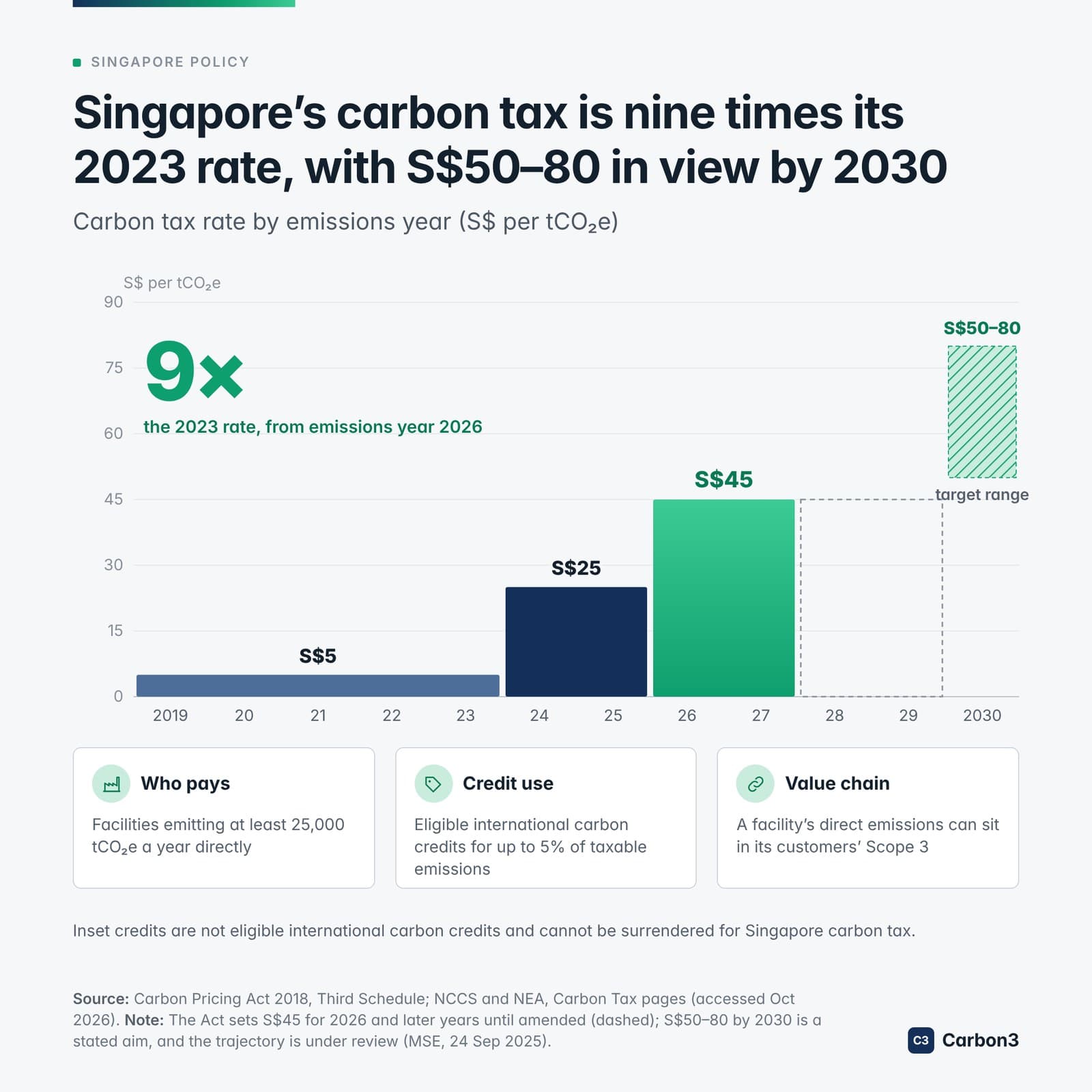
Singapore's carbon tax rose from S$5 to S$45 per tonne in three years
A large emitter's direct emissions can sit in its customers' Scope 3, which gives buyers and suppliers a shared reason to co-fund verified emissions reductions.
Read the articlePolicy
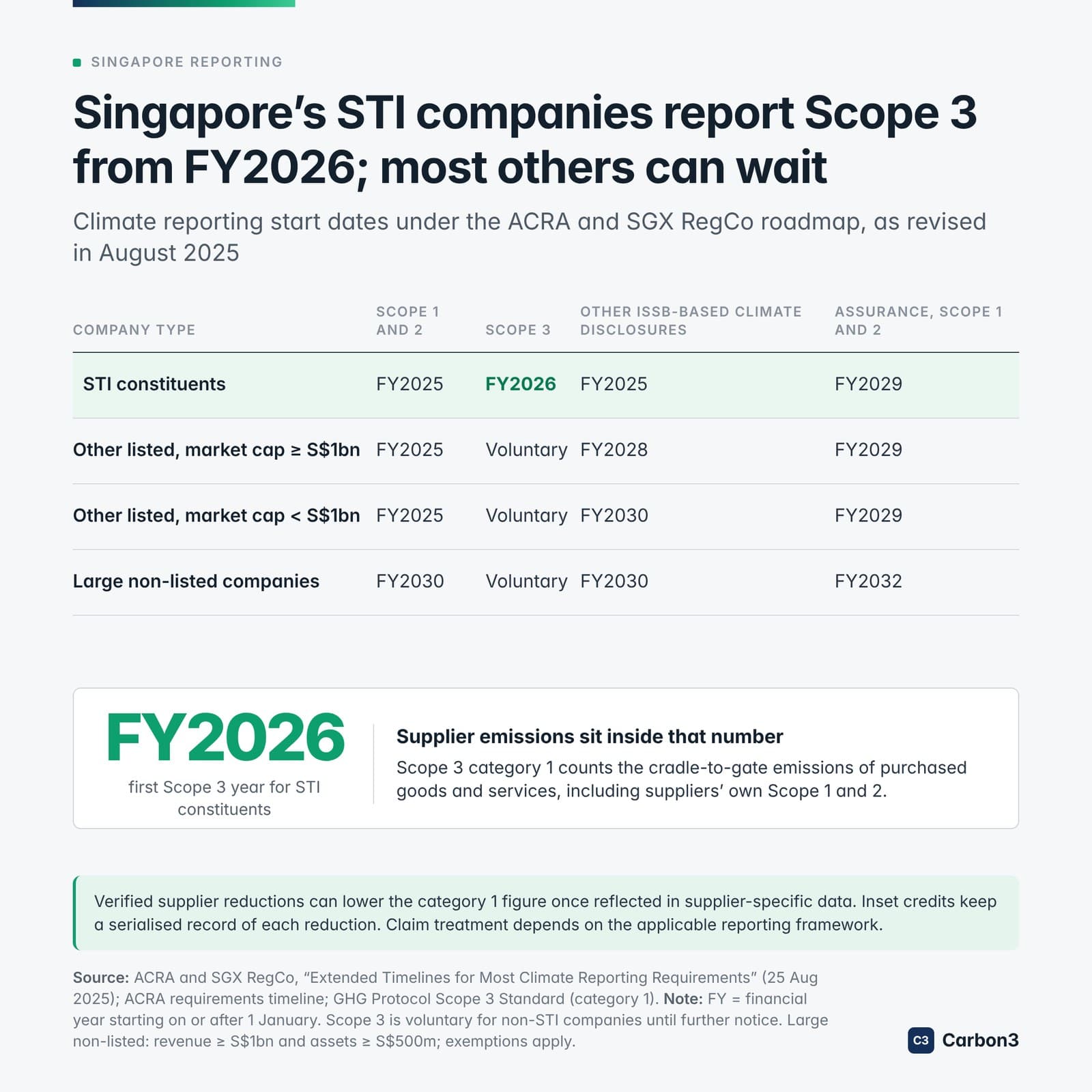
For Singapore's largest listed companies, FY2026 is the first Scope 3 year
Under the ACRA and SGX RegCo roadmap revised in August 2025, STI constituents report Scope 3 from FY2026, while other companies can wait.
Read the articleClaims & reporting
Scope 3 rules are being rewritten between 2026 and 2028
Revised ESRS apply from financial year 2027, and SBTi's Net-Zero Standard V2.0 becomes mandatory in February 2028.
Read the article
See the companies behind these figures in the Data Hub.
Look up your suppliers’ emissions and targets, free.