Singapore's carbon tax rose from S$5 to S$45 per tonne in three years
A large emitter's direct emissions can sit in its customers' Scope 3, which gives buyers and suppliers a shared reason to co-fund verified emissions reductions.
By Carbon3 team2 min read
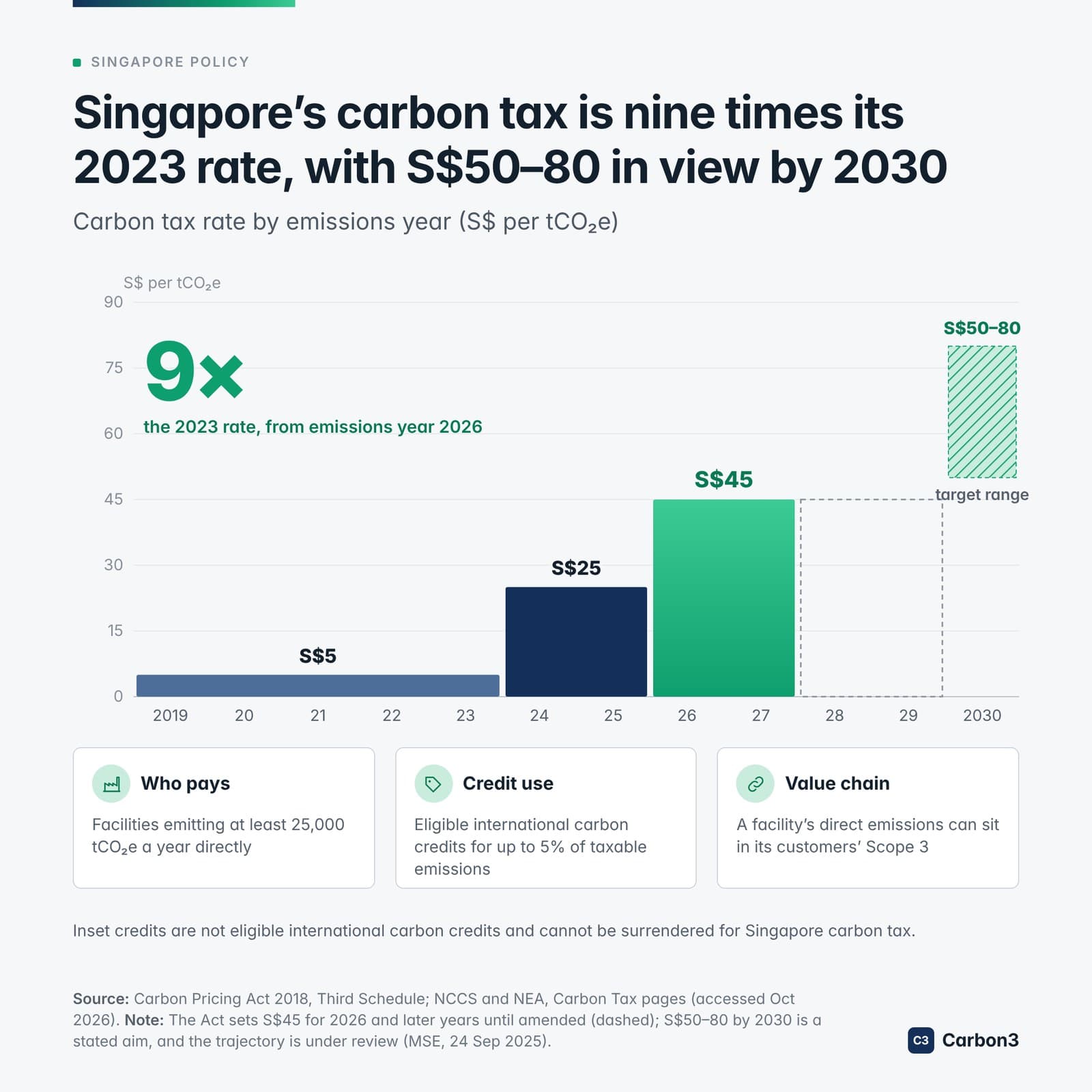
Singapore's carbon tax rose from S$5 to S$45 per tonne in three years.
How the tax works
Singapore's carbon tax applies to facilities that emit at least 25,000 tCO2e of direct emissions a year. The rate was S$5 per tonne from 2019 to 2023. It rose to S$25 for 2024 and 2025, and to S$45 from emissions year 2026. The stated aim is S$50 to S$80 per tonne by 2030, and the Government says it keeps the trajectory under review.
Taxable facilities can use eligible international carbon credits to cover up to 5% of their taxable emissions.
Whose costs, whose emissions
A carbon tax is levied on the facility that emits. But a large emitter's direct emissions rarely stay in one inventory. A refinery, power plant or chemicals facility sells its output to customers, and for those customers the emissions embedded in what they buy sit in Scope 3.
That gives buyer and supplier overlapping interests. The supplier faces a rising tax on its direct emissions. The buyer has a Scope 3 inventory, and often a target, that includes the same tonnes.
Co-funding the emissions reductions
Buyers and suppliers that co-fund verified emissions reductions can record them once, as inset credits. The inset credit records the verified reduction inside the value chain and which party holds it, so the same tonnes are not counted twice by two parties telling separate stories.
Carbon3 is clear on one boundary: inset credits are not eligible international credits for the Singapore carbon tax. They do not reduce the tax bill by being surrendered. Any tax effect comes from the underlying reduction in the facility's direct emissions, not from the credit. Insetting is not offsetting.
Claim treatment depends on the applicable reporting framework.
Why the trajectory matters
The step from S$5 to S$45 changes the economics of abatement at taxed facilities, and a stated range of S$50 to S$80 by 2030 signals that the direction is upward. For customers of those facilities, a rising carbon price upstream is also a reason to look at which reductions they could help fund, and record, in their own value chain.
Originally published on LinkedIn, 14 October 2026.
The Carbon3 Newsletter
Weekly analysis of industrial decarbonization and insetting across Scope 1 to 3, from the Carbon3 team.
Read more from the research team.
Policy
CBAM in 2026: the bill accrues before certificates go on sale
No CBAM certificates can be bought in 2026, but 2026 imports are already priced.
Read the articlePolicy
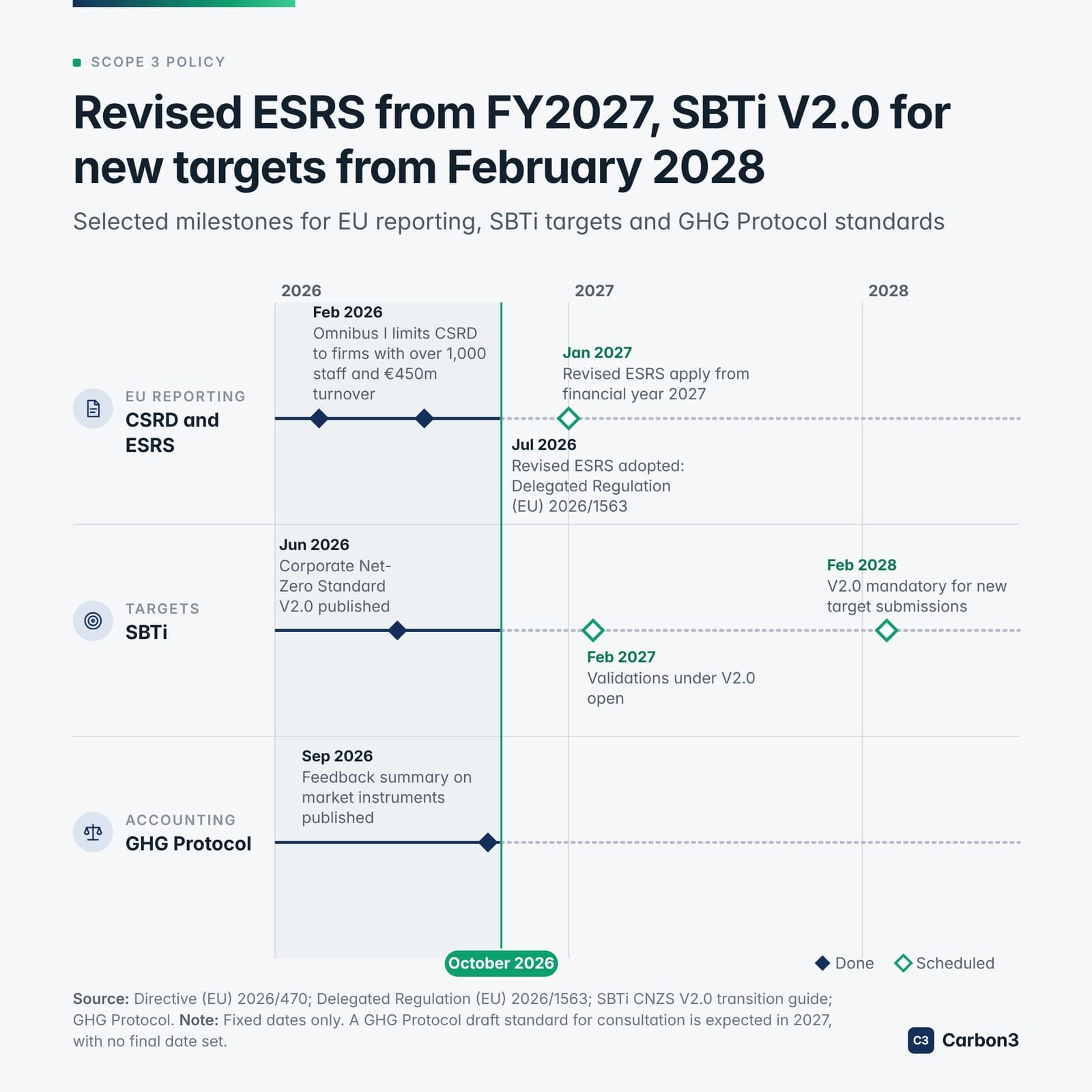
Two Scope 3 rulebooks now have fixed dates, and supplier programs take time to set up
Revised ESRS apply from financial year 2027 and SBTi's Net-Zero Standard V2.0 from February 2028.
Read the articlePolicy
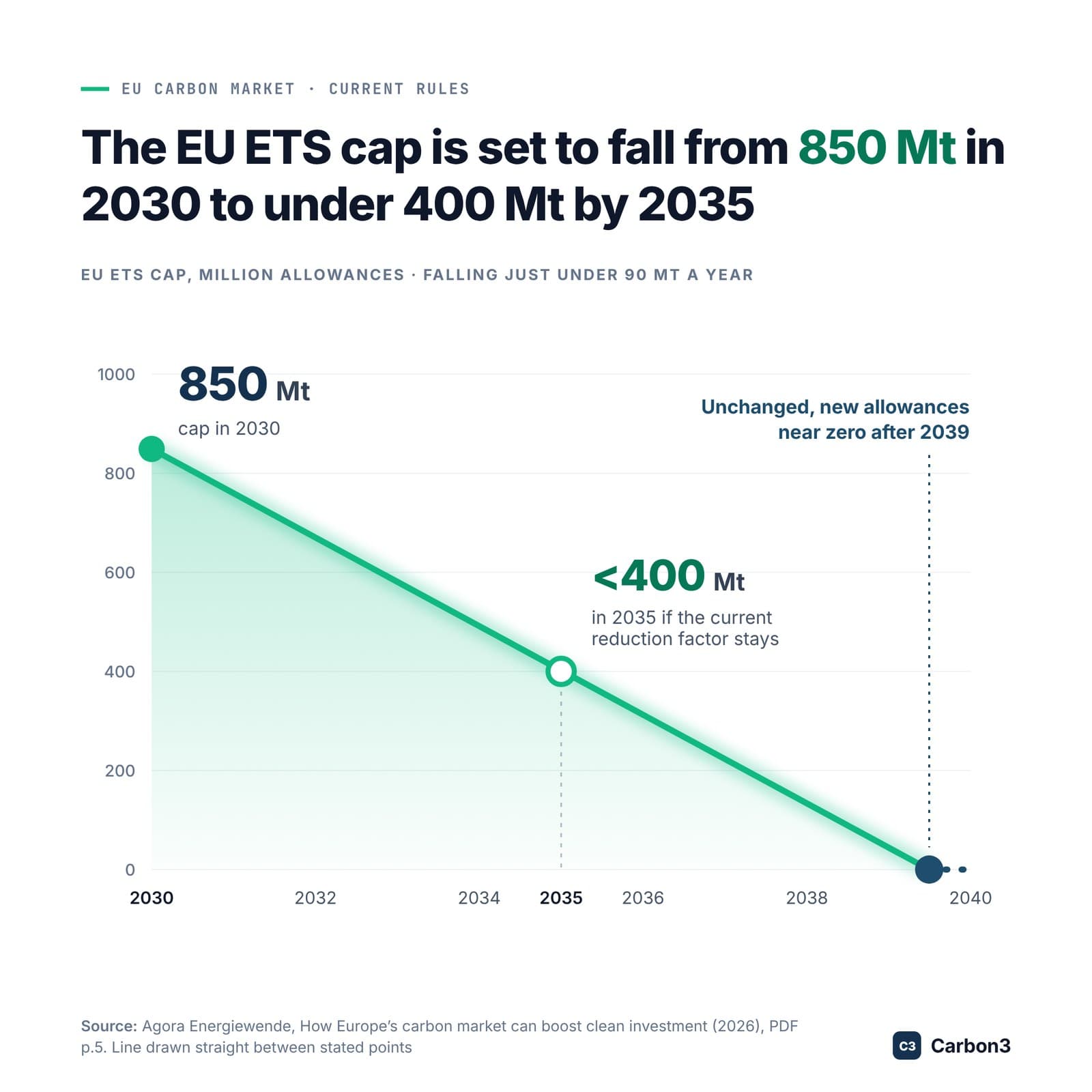
The EU carbon market is running out of allowances on a published schedule
Agora Energiewende shows the EU ETS cap falling from 850 Mt in 2030 to just below 400 Mt in 2035, a cost that buyers of steel, cement and chemicals will feel through their suppliers.
Read the article
See the companies behind these figures in the Data Hub.
Look up your suppliers’ emissions and targets, free.