CBAM in 2026: the bill accrues before certificates go on sale
No CBAM certificates can be bought in 2026, but 2026 imports are already priced. Verified supplier data is the main lever on the bill.
By Carbon3 team2 min read
The EU's Carbon Border Adjustment Mechanism has entered its definitive period, and the timing of payments is easy to misread. No CBAM certificates can be bought in 2026. The cost of 2026 imports is accruing anyway.
How the timeline works
- Pricing: imports in 2026 are priced at the quarterly average EU carbon price.
- Sales: certificate sales open in February 2027.
- Surrender: certificates covering 2026 obligations must be surrendered by 30 September 2027.
- Holding requirement: importers must hold certificates covering 50% of their 2027 imports.
So a company importing steel, aluminum, cement, fertilizers or other covered goods this year is building up a liability now, priced as it goes, that it will settle in 2027, while at the same time having to hold certificates against its 2027 imports.
Default values are set high
The size of that bill depends heavily on data. Where an importer cannot provide verified emissions data from its supplier, it uses default values. Those defaults are set high on purpose, so that relying on them is more expensive than reporting actual emissions.
That makes verified supplier data the main lever an importer has on its CBAM cost. A producer with lower actual emissions than the default, and the verified data to show it, can reduce what its EU customers pay.
Why this is a supply-chain issue
CBAM is formally an importer's obligation, but the inputs to the bill sit with suppliers outside the EU. The importer needs the producer's installation-level emissions data, verified to the required standard. Getting that data means working with suppliers, often several tiers into a chain that has not been asked for it before.
The same data serves another purpose. The embedded emissions in imported goods are part of the importer's Scope 3 inventory. Better supplier data improves the CBAM figure and the Scope 3 figure together.
What to do now
For importers, 2026 is the year to secure verified data from suppliers before the first surrender comes due. For suppliers, it is an opportunity: verified, lower emissions now carry a direct financial value for their EU customers.
Where buyers co-fund reductions at their suppliers, the verified results can be recorded as inset credits inside the value chain. Inset credits are not CBAM certificates and do not reduce a CBAM obligation by themselves; the CBAM effect comes from the producer's verified actual emissions.
Originally published on LinkedIn, 4 October 2026.
The Carbon3 Newsletter
Weekly analysis of industrial decarbonization and insetting across Scope 1 to 3, from the Carbon3 team.
Read more from the research team.
Policy
87 carbon pricing schemes, and 'Scope 3' appears once
The World Bank's State and Trends of Carbon Pricing 2026 counts 87 schemes.
Read the articlePolicy
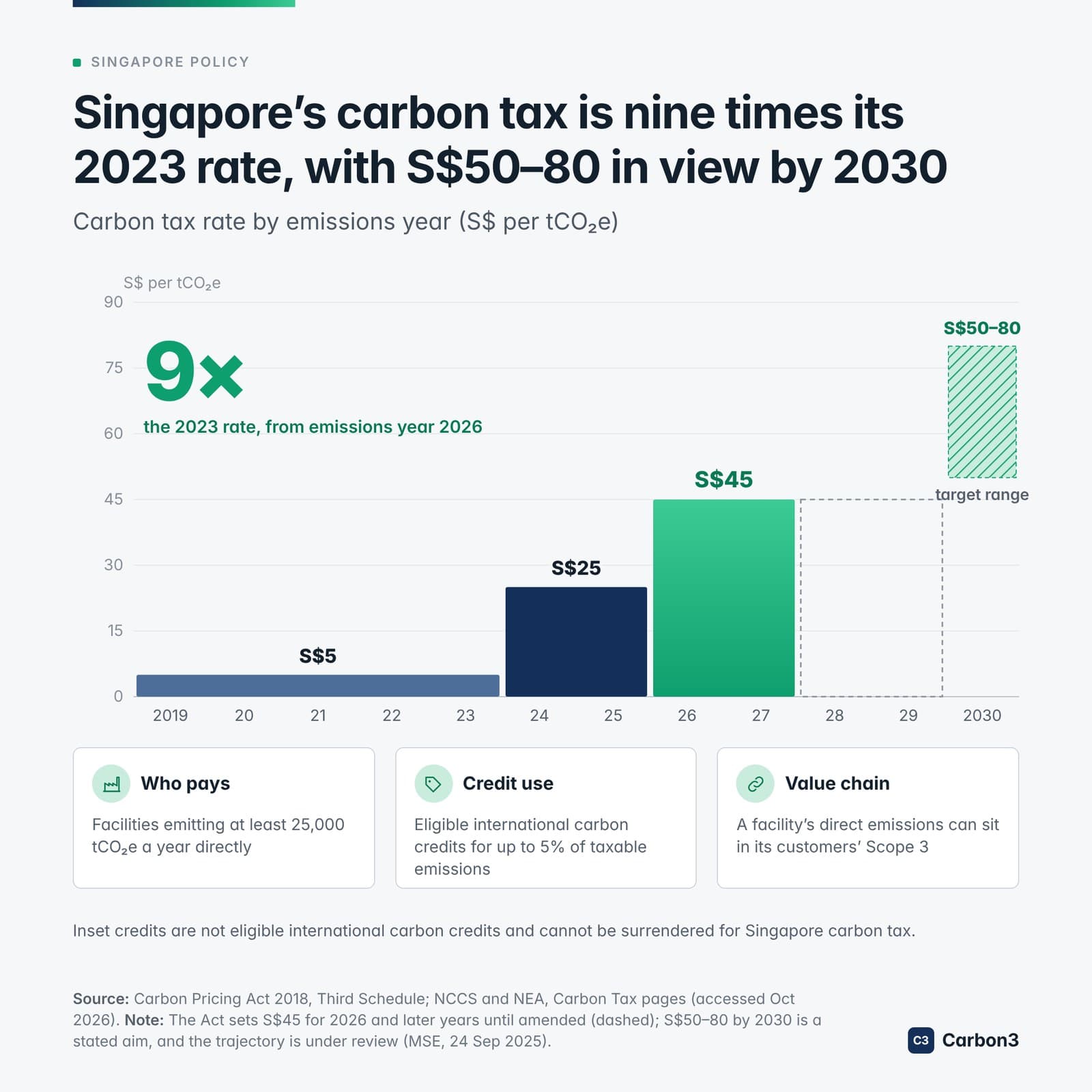
Singapore's carbon tax rose from S$5 to S$45 per tonne in three years
A large emitter's direct emissions can sit in its customers' Scope 3, which gives buyers and suppliers a shared reason to co-fund verified emissions reductions.
Read the articleClaims & reporting
Scope 3 rules are being rewritten between 2026 and 2028
Revised ESRS apply from financial year 2027, and SBTi's Net-Zero Standard V2.0 becomes mandatory in February 2028.
Read the article
See the companies behind these figures in the Data Hub.
Look up your suppliers’ emissions and targets, free.