SBTi's new net-zero standard spells out what a market instrument must prove
Criterion C27 of the Corporate Net-Zero Standard V2.0 sets five tests for market instruments, and recommendation R27.1 advises buying progressively over the target timeframe.
By Carbon3 team2 min read
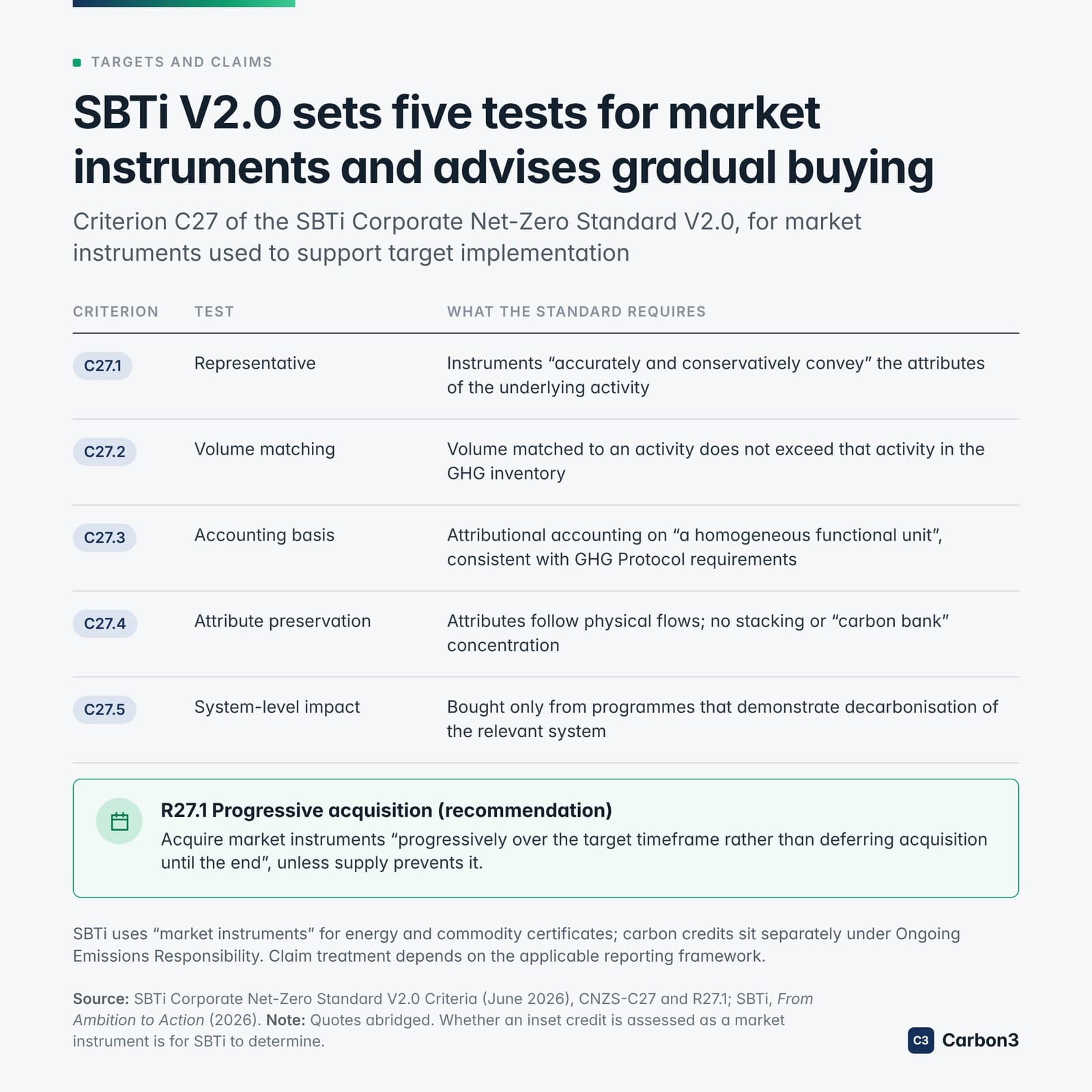
SBTi's Corporate Net-Zero Standard V2.0 sets out, in one criterion, what a market instrument must prove before it can support target implementation. Criterion C27 lists five tests. A recommendation alongside it, R27.1, addresses timing: buy progressively, not at the end.
The five tests in C27
C27.1, Representative. Instruments must "accurately and conservatively convey" the attributes of the underlying activity.
C27.2, Volume matching. The volume matched to an activity must not exceed that activity in the company's GHG inventory.
C27.3, Accounting basis. Instruments rest on attributional accounting on "a homogeneous functional unit", consistent with GHG Protocol requirements.
C27.4, Attribute preservation. Attributes follow physical flows, with no stacking and no "carbon bank" concentration.
C27.5, System-level impact. Instruments are bought only from programs that demonstrate decarbonization of the relevant system.
Taken together, the tests describe an instrument that is tied to a real activity, sized to the inventory it supports, counted on a consistent basis, and drawn from a program that is changing the system it sits in.
R27.1: buy progressively
Recommendation R27.1 adds a timing expectation. Companies should acquire market instruments "progressively over the target timeframe rather than deferring acquisition until the end", unless supply prevents it. It is a recommendation rather than a requirement, but it points away from a single large purchase in a target year.
What "market instruments" means here
The term has a specific meaning in the standard. SBTi uses "market instruments" for energy and commodity certificates. Carbon credits are handled separately, under Ongoing Emissions Responsibility, rather than as part of target implementation.
How inset credits are assessed under C27 is for SBTi to determine. Inset credits record verified reductions inside a company's own value chain; whether a given credit qualifies as a market instrument, and on what terms, is not something a registry can decide for the standard.
Why the tests matter for the record
What the tests do make clear is the kind of evidence a company is likely to need: data on the underlying activity, a match to inventory volumes, and a record of where each attribute went. Carbon3 works on the record-keeping side, keeping one serialized record of each verified reduction so it can be issued, transferred and retired once. Claim treatment depends on the applicable reporting framework.
Sources: SBTi Corporate Net-Zero Standard V2.0 Criteria (June 2026), CNZS-C27 and R27.1; SBTi, From Ambition to Action (2026). Quotes abridged. Simplified; not legal or accounting advice.
Originally published on LinkedIn, 19 October 2026.
The Carbon3 Newsletter
Weekly analysis of industrial decarbonization and insetting across Scope 1 to 3, from the Carbon3 team.
Read more from the research team.
Claims & reporting
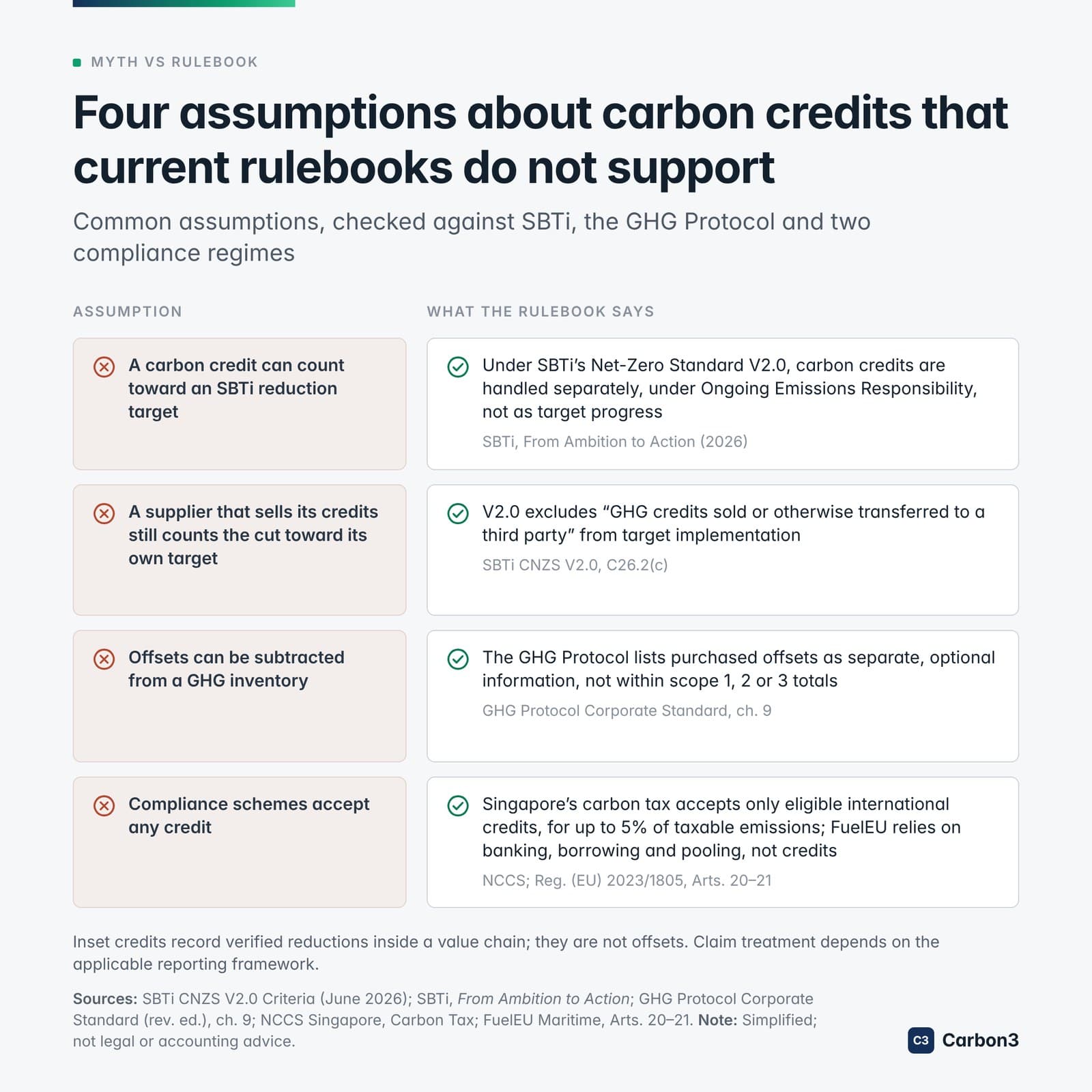
Four common assumptions about carbon credits, checked against the rulebooks
SBTi V2.0, the GHG Protocol, Singapore's carbon tax and FuelEU Maritime each keep credits apart from targets, inventories or compliance in their own way.
Read the articleClaims & reporting
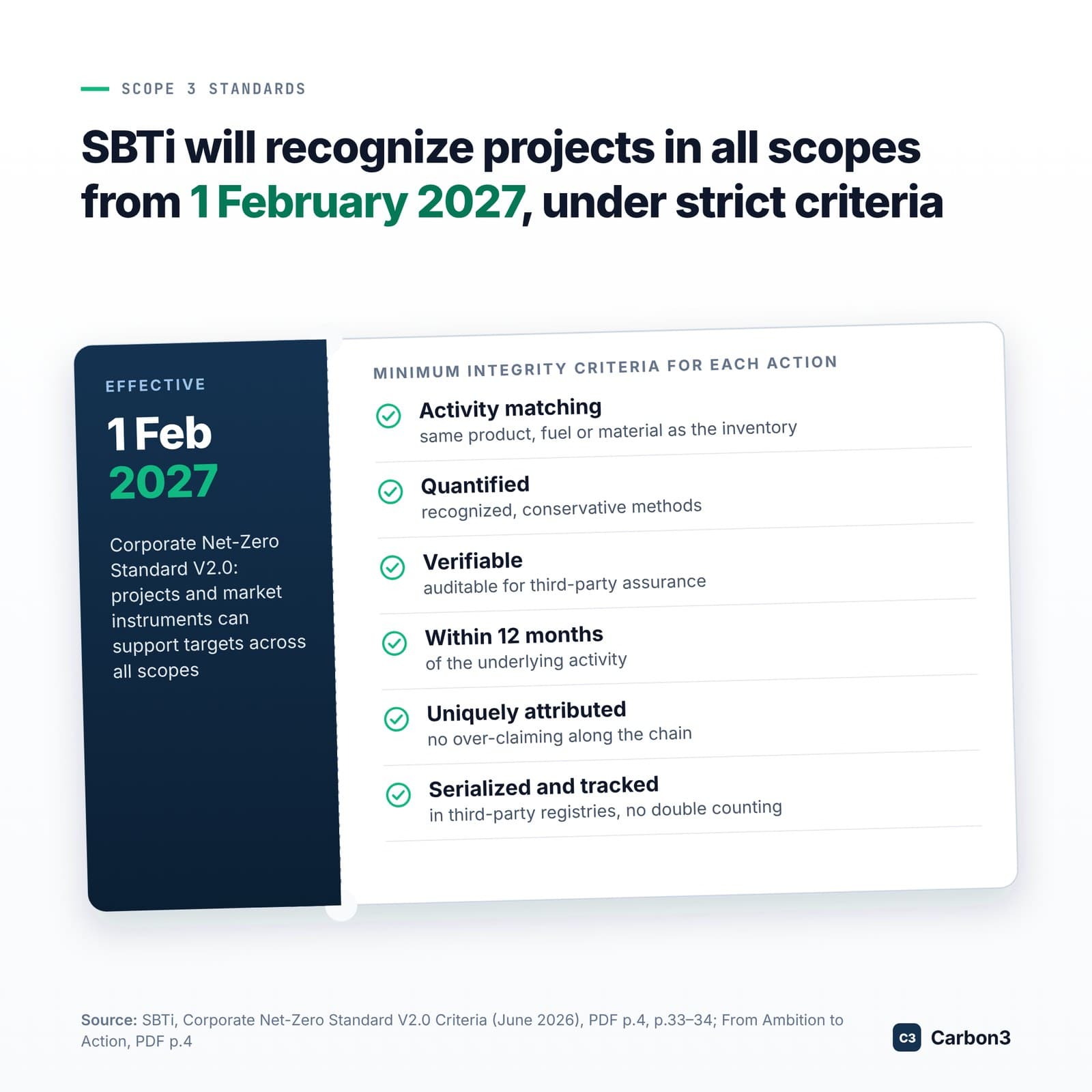
The SBTi has set the rules for using value-chain projects toward targets
The Corporate Net-Zero Standard V2.0 opens for validations on 1 February 2027, becomes mandatory for new targets on 1 February 2028, and lets projects support targets across all scopes, provided each action is verifiable, timely, uniquely attributed and serialized.
Read the articleClaims & reporting
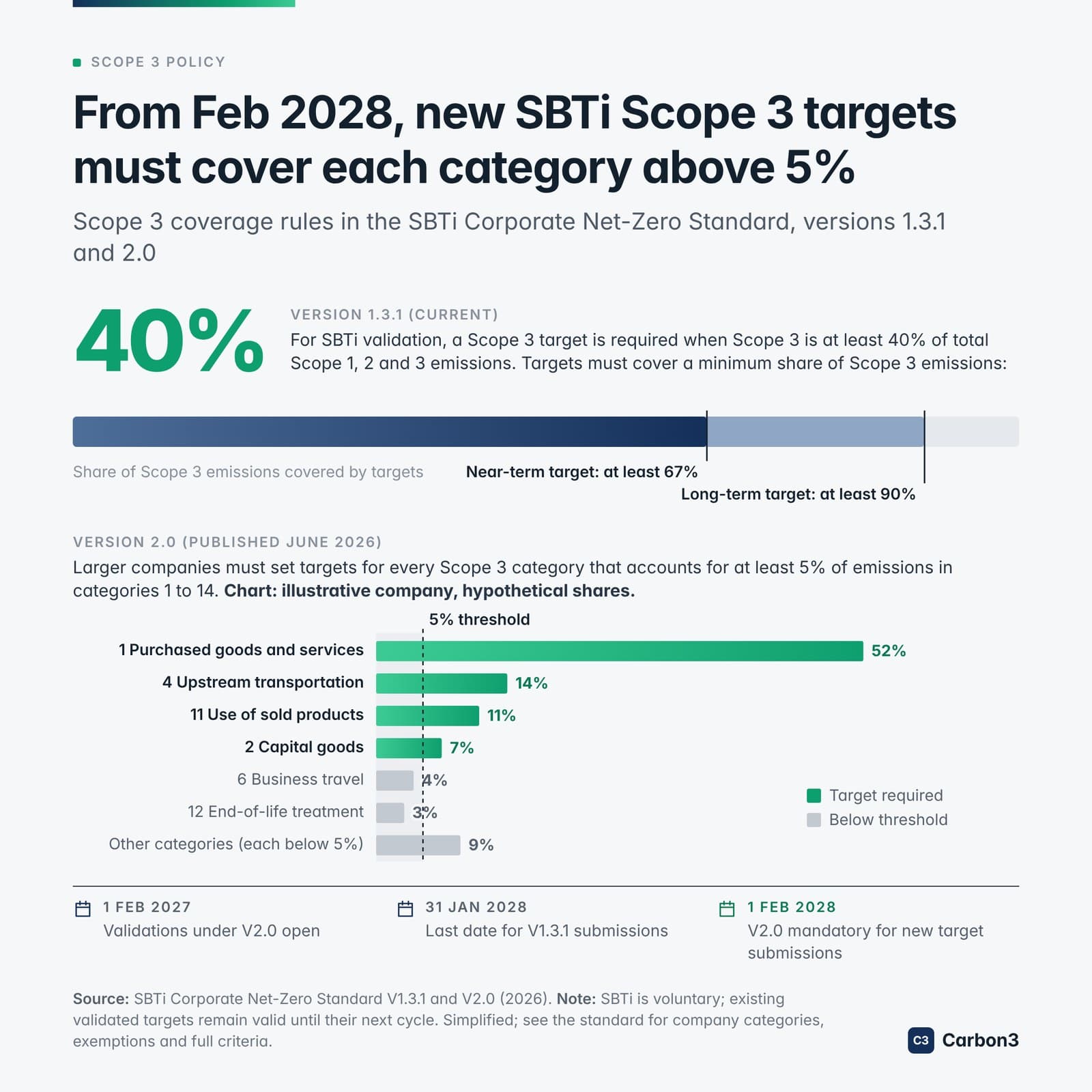
From February 2028, new SBTi Scope 3 targets must cover each category above 5%
SBTi's Corporate Net-Zero Standard V2.0 replaces a single Scope 3 coverage threshold with targets for each category above 5% of emissions, for new submissions from 1 February 2028.
Read the article
See the companies behind these figures in the Data Hub.
Look up your suppliers’ emissions and targets, free.