Four common assumptions about carbon credits, checked against the rulebooks
SBTi V2.0, the GHG Protocol, Singapore's carbon tax and FuelEU Maritime each keep credits apart from targets, inventories or compliance in their own way.
By Carbon3 team2 min read
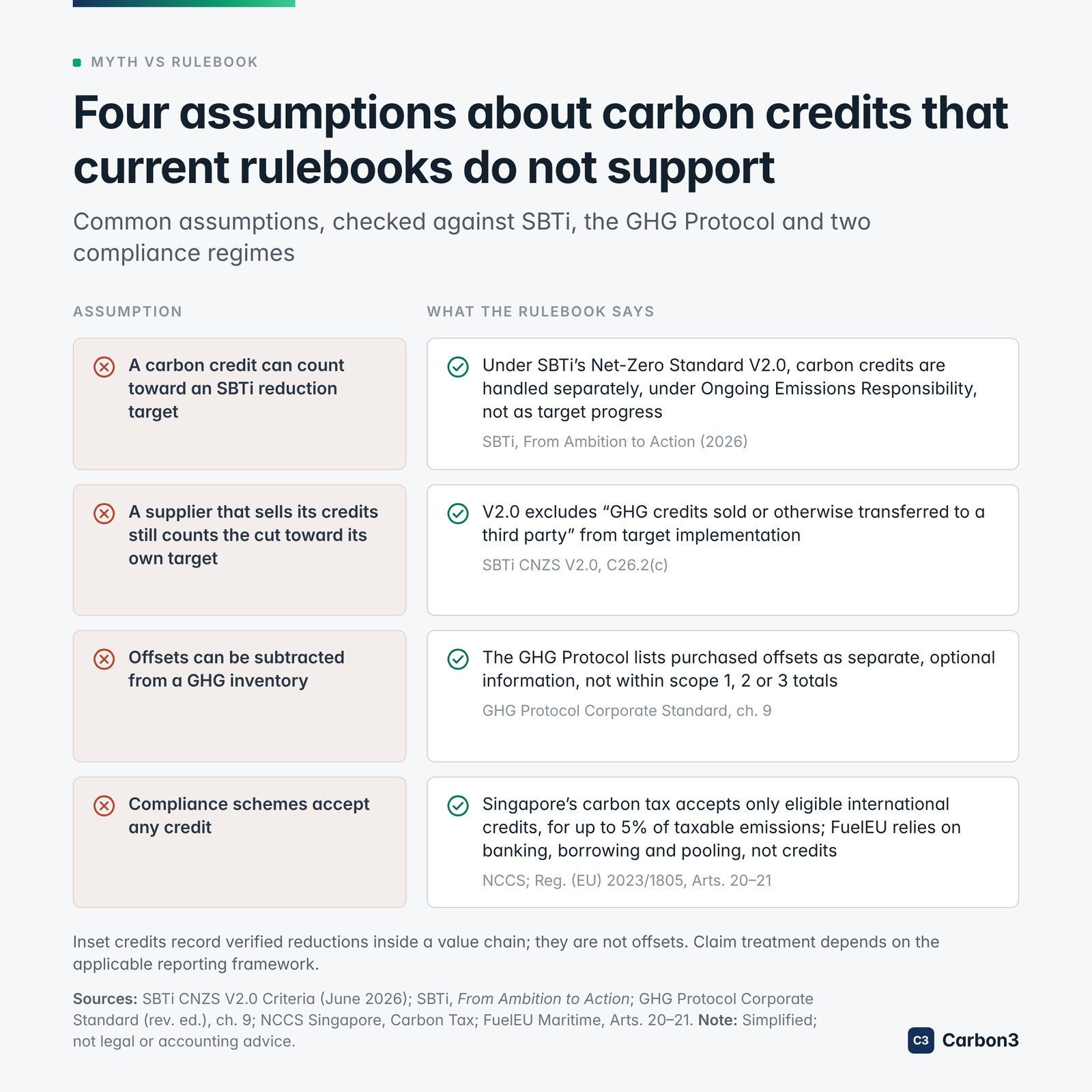
Four common assumptions about carbon credits do not hold up when they are checked against the rulebooks that companies actually report under. Each one concerns where a credit sits: in a target, in an inventory, or in a compliance scheme. The answers come from SBTi's Corporate Net-Zero Standard V2.0, the GHG Protocol Corporate Standard, Singapore's carbon tax and FuelEU Maritime.
1. "A carbon credit can count toward an SBTi reduction target"
Under SBTi's Corporate Net-Zero Standard V2.0, carbon credits are handled separately, under Ongoing Emissions Responsibility, not as progress toward a reduction target. SBTi sets this out in its 2026 publication From Ambition to Action. A company can still buy and retire credits, but that activity is reported in its own place rather than netted against the target.
2. "A supplier that sells its credits still counts the emissions reduction toward its own target"
V2.0 excludes "GHG credits sold or otherwise transferred to a third party" from target implementation (criterion C26.2(c)). If a supplier sells the credit for a reduction, it cannot also count that reduction as progress on its own target. The rule closes off one route to the same tonne being claimed twice.
3. "Offsets can be subtracted from a GHG inventory"
The GHG Protocol Corporate Standard lists purchased offsets as separate, optional information, not within the Scope 1, 2 or 3 totals (chapter 9). An inventory reports the emissions a company has; offsets do not reduce that figure.
4. "Compliance schemes accept any credit"
Compliance regimes set their own terms. Singapore's carbon tax accepts only eligible international carbon credits, for up to 5% of a company's taxable emissions, according to Singapore's National Climate Change Secretariat (NCCS). FuelEU Maritime does not use credits at all for compliance; it relies on banking, borrowing and pooling between ships (Regulation (EU) 2023/1805, Articles 20 and 21).
What the four answers have in common
Each rulebook draws a line between the emissions a company reports and the instruments it buys. Credits are not banned, but they are kept apart from targets and inventory totals, and compliance schemes accept only what their own rules allow.
That distinction matters for insetting. Inset credits record verified reductions inside a company's own value chain, such as a supplier switching fuel or farm practice with the company's support. They are not offsets. Carbon3 works on the record-keeping that lets each verified reduction be issued, transferred and retired once, so the record shows who funded the reduction and where it was claimed. Claim treatment depends on the applicable reporting framework.
Sources: SBTi Corporate Net-Zero Standard V2.0 Criteria (June 2026); SBTi, From Ambition to Action; GHG Protocol Corporate Standard (revised edition), chapter 9; NCCS Singapore, Carbon Tax; FuelEU Maritime, Articles 20 and 21. Simplified; not legal or accounting advice.
Learn more
How insetting works in shipping
Originally published on LinkedIn, 18 October 2026.
Read more from the research team.
Claims & reporting
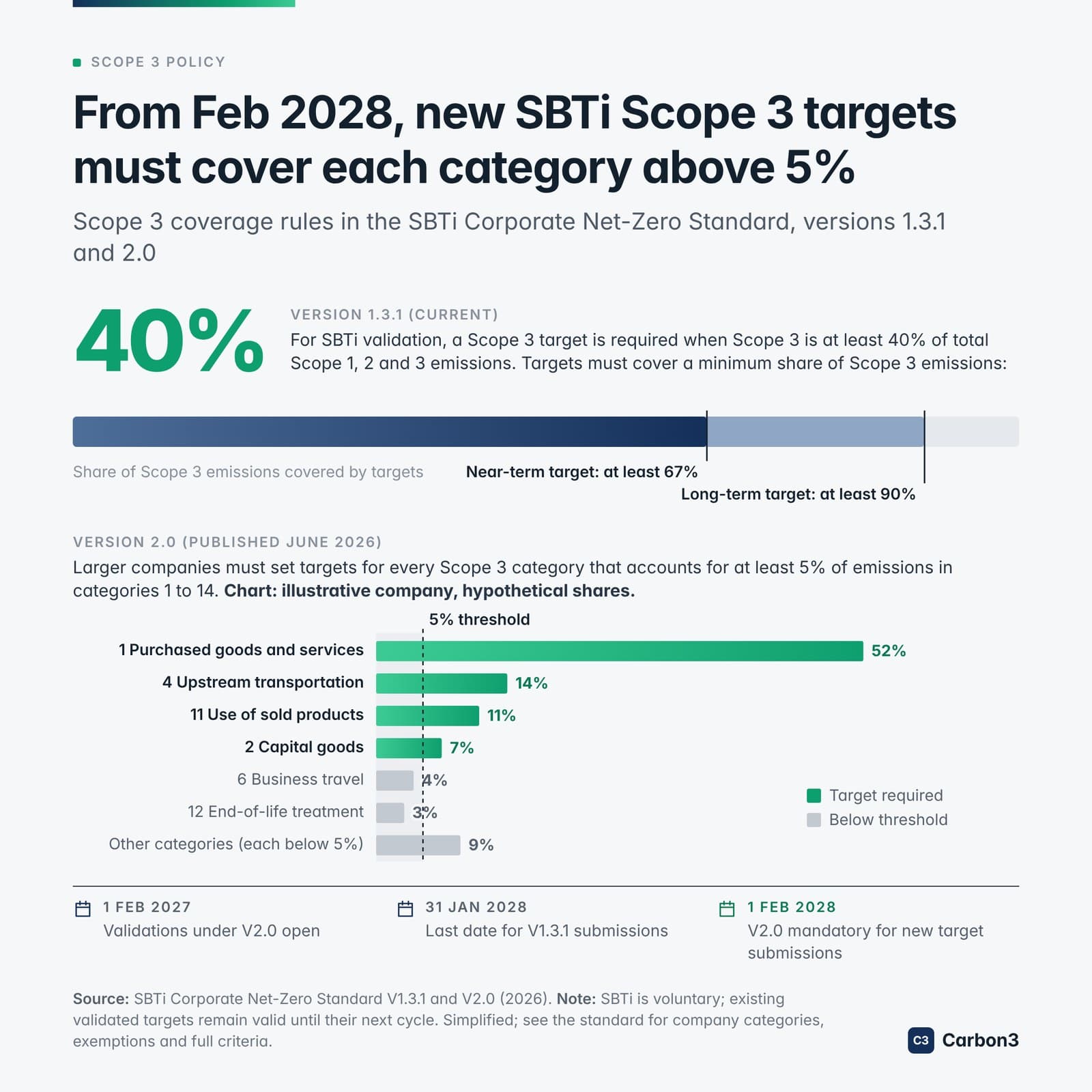
From February 2028, new SBTi Scope 3 targets must cover each category above 5%
SBTi's Corporate Net-Zero Standard V2.0 replaces a single Scope 3 coverage threshold with targets for each category above 5% of emissions, for new submissions from 1 February 2028.
Read the articleClaims & reporting
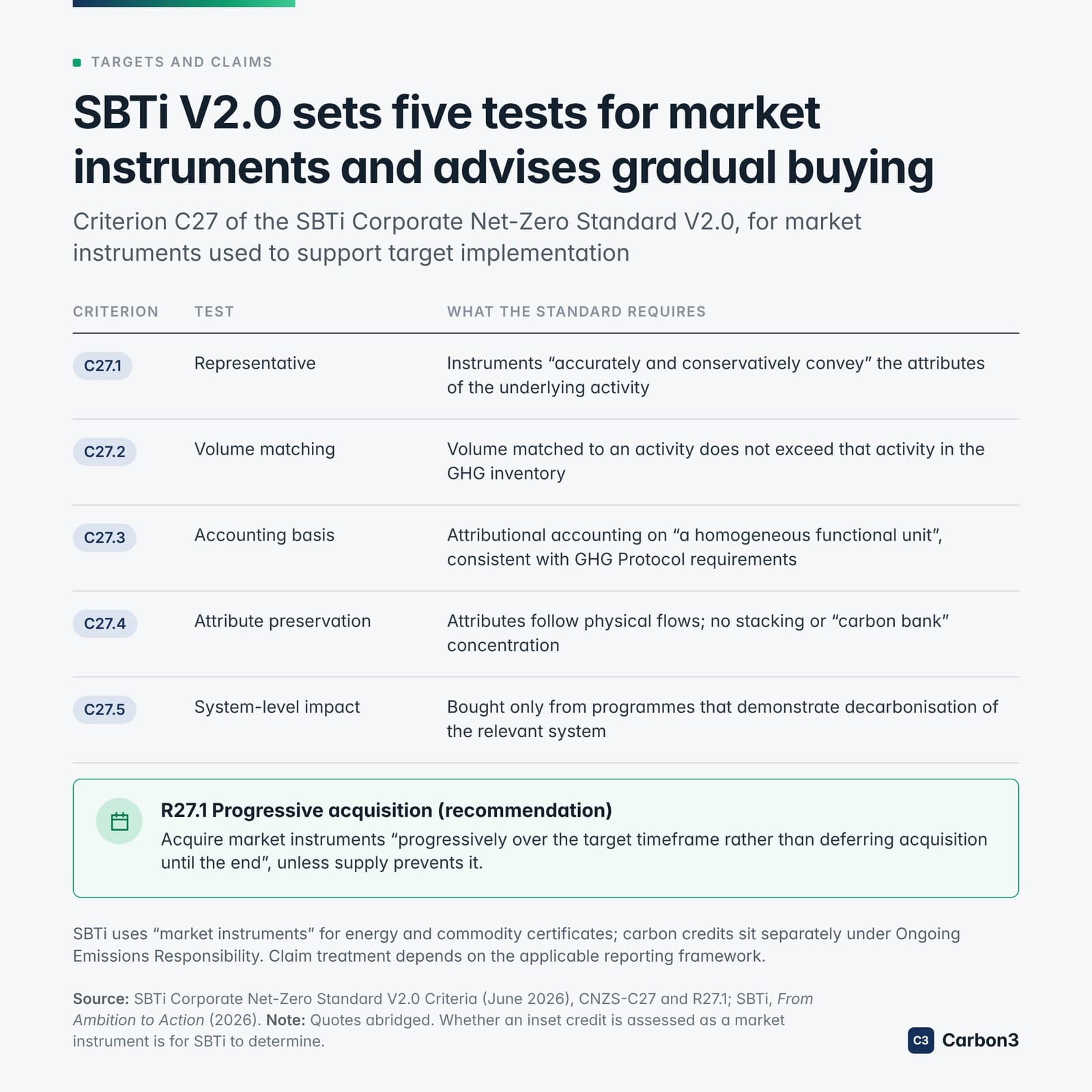
SBTi's new net-zero standard spells out what a market instrument must prove
Criterion C27 of the Corporate Net-Zero Standard V2.0 sets five tests for market instruments, and recommendation R27.1 advises buying progressively over the target timeframe.
Read the articleClaims & reporting
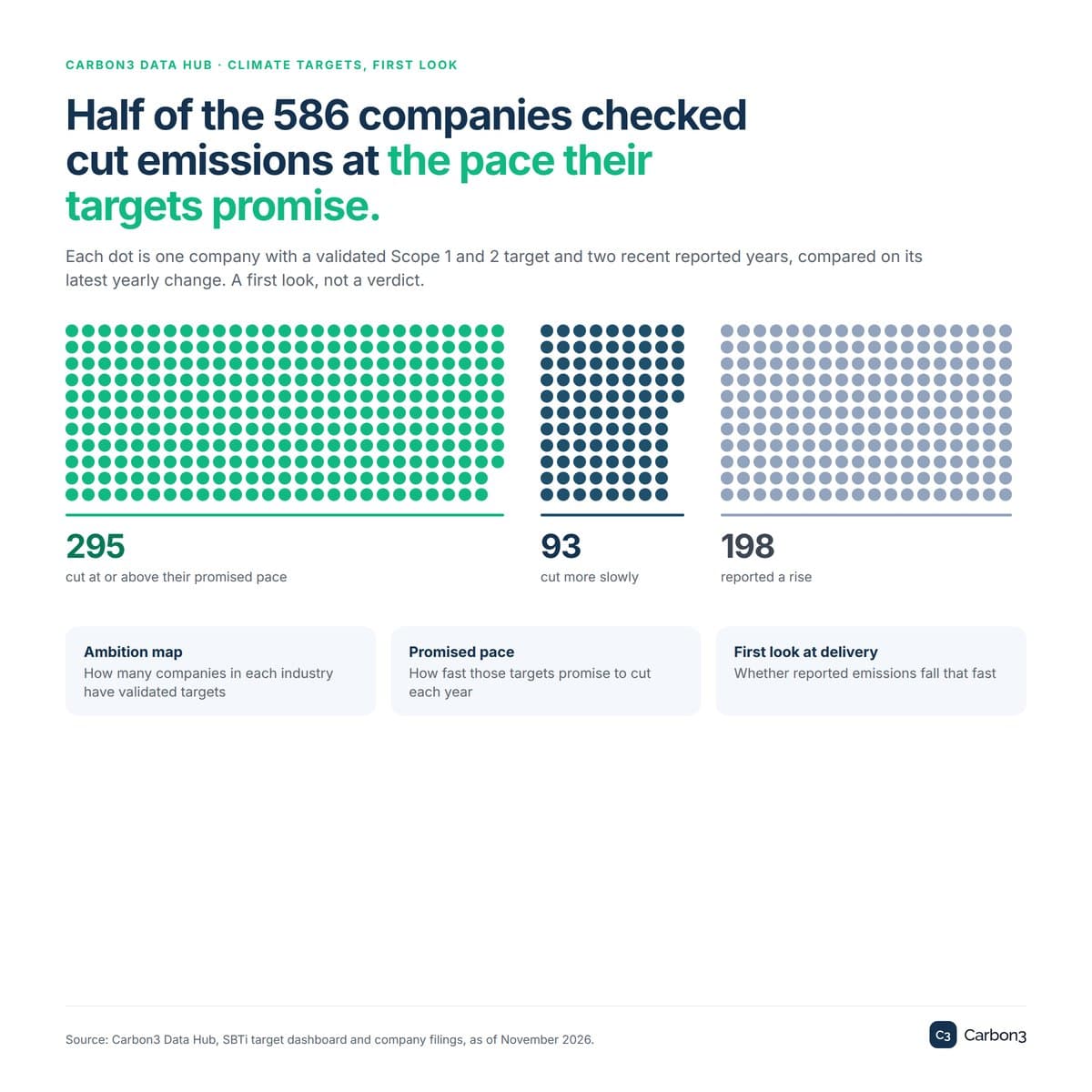
Half of the companies checked are reducing emissions at the pace their climate targets promise
Carbon3 compared about 7,200 companies on the SBTi registry three ways: how many have climate targets, how fast those targets promise to cut and whether reported emissions are falling that fast.
Read the article
See the companies behind these figures in the Data Hub.
Look up your suppliers’ emissions and targets, free.