Climate Week NYC and the 70% that sits in the supply chain
As Climate Week NYC opens, the number that matters for most companies is where their emissions sit: around 70% in the supply chain.
By Carbon3 team2 min read
Climate Week NYC brings a week of commitments, panels and announcements. For most companies, though, the figure that decides whether those commitments turn into results is a simple one: around 70% of emissions sit in the supply chain.
Where the emissions are
For a typical company, the emissions it controls directly, from its own sites and vehicles, are the smaller part of the picture. The larger part sits with suppliers: the materials, components, transport and services the company buys. Those are Scope 3 emissions, and they are produced by other businesses.
That matters for how climate plans are built. A company can reduce its own operational emissions to near zero and still leave most of its footprint untouched. The headline commitments made in weeks like this one depend, in the end, on what happens in supplier factories, farms and fleets.
Why the supply chain is hard
Supply-chain emissions are hard to move for familiar reasons. The company that sets the target is not the company that has to change its process. The supplier that would make the change often faces the cost without a clear reason to carry it alone. And the data connecting the two is frequently an estimate rather than a measurement.
None of this is new. What changes is how seriously companies treat it: whether supply-chain emissions stay a line in a report, or become a working program with suppliers.
From commitments to co-funded reductions
Carbon3's view is that supply-chain decarbonization moves when the cost of change is shared and the result is recorded clearly. When a company co-funds a verified reduction at a supplier, the reduction happens inside its own value chain, on emissions it already reports. Recording that reduction as an inset credit gives both parties a single record of what was achieved and who holds it.
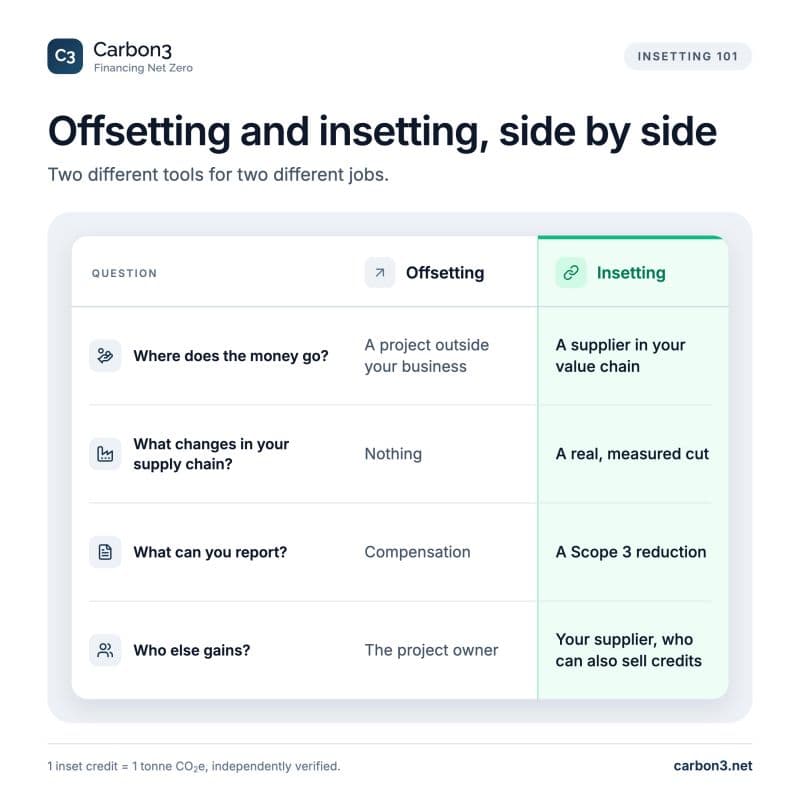
Insetting is not offsetting. The money goes to the suppliers whose emissions make up the company's footprint, not to projects outside it.
The question for the week
The useful question to bring to Climate Week NYC is not only what a company has pledged, but how it plans to reach the 70% that sits outside its own walls. That is where most of the work, and most of the reductions, will be.
Originally published on LinkedIn, 20 September 2026.
The Carbon3 Newsletter
Weekly analysis of industrial decarbonization and insetting across Scope 1 to 3, from the Carbon3 team.
Read more from the research team.
Field notes
DP World's Insetify: inset credits at commercial scale
Offering credits at no cost to customers is a deliberate market-building strategy.
Read the articleField notes
Insetting turns a sustainability expense into a supplier relationship
BASF and Boortmalt on barley emissions, Royal Canin and Soil Capital on 300,000 hectares of farmland, and ZEMBA on pooled buying power for low-emission shipping.
Read the articleSector: Aviation
Boeing's 40,000 tonne removal deal and aviation's next phase
Supply-chain emissions are where most of aviation's footprint sits.
Read the article

See the companies behind these figures in the Data Hub.
Look up your suppliers’ emissions and targets, free.