DP World's Insetify: inset credits at commercial scale
Offering credits at no cost to customers is a deliberate market-building strategy. Create the buyer habit first; price discovery follows.
By Carbon3 team1 min read

The DP World Insetify program is among the most instructive early-market examples of inset credits operating at commercial scale. It provides concrete proof that the operational and accounting infrastructure for shipping inset credits can be built and deployed.
DP World's decision to offer credits at no cost to customers is a deliberate market-building strategy, seeding demand for inset credits among cargo owners before a paid market exists. This mirrors the classic two-sided marketplace cold start: create the buyer habit first, price discovery follows.
"We believe carbon insetting is a pragmatic approach to managing residual emissions within a longer-term, holistic plan. We encourage organizations to explore carbon insets as part of intentional progress toward decarbonization." , John Trenchard, VP Sustainable International Supply Chains, DP World Europe
At Carbon3 we are very excited seeing insetting take off, as we continue building a global insetting infrastructure and marketplace.
Learn more: dpworld.com
Originally published on LinkedIn, 9 April 2026.
The Carbon3 Newsletter
Weekly analysis of industrial decarbonization and insetting across Scope 1 to 3, from the Carbon3 team.
Read more from the research team.
Field notes
Banks are financing supplier upgrades to reduce Scope 3 emissions
DBS's data center retrofit initiative links supplier efficiency to sustainability-linked loans.
Read the articleField notes
Climate Week NYC and the 70% that sits in the supply chain
As Climate Week NYC opens, the number that matters for most companies is where their emissions sit: around 70% in the supply chain.
Read the articleSector: Maritime
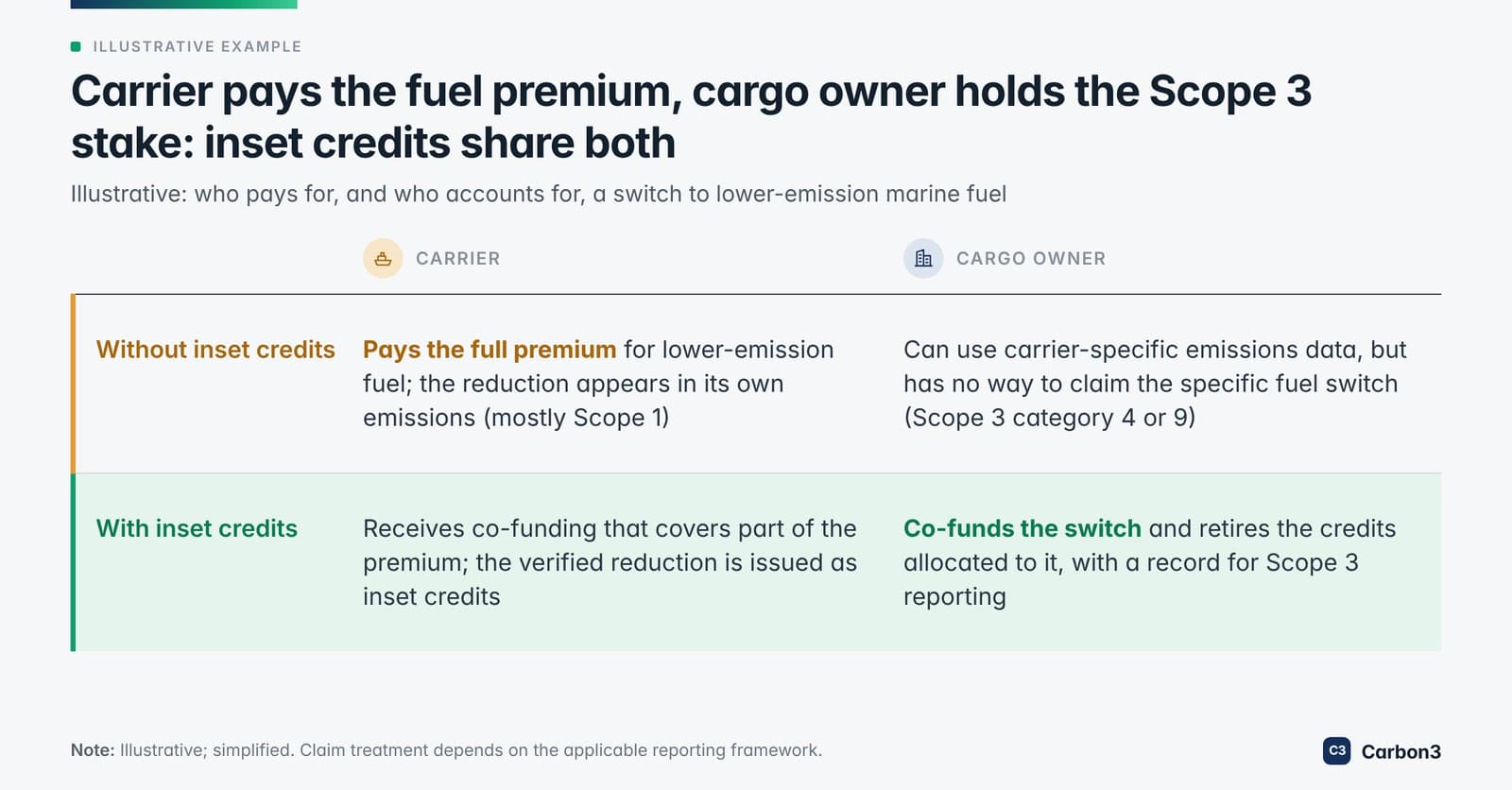
In shipping, the party paying for cleaner fuel is not the party holding the emissions
The carrier pays the fuel premium; the cargo owner reports the emissions in Scope 3.
Read the article
See the companies behind these figures in the Data Hub.
Look up your suppliers’ emissions and targets, free.