Suppliers, buyers and advisors rarely work from the same record of a reduction
Carbon3 has four participant types: project developers, supply-chain partners, credit buyers and ESG consultants. Each uses the registry and market differently, but all work from one serialized record.
By Carbon3 team2 min read
Suppliers, buyers and advisors rarely work from the same record of a reduction. A supplier keeps its own project files, a buyer keeps its own purchase and retirement records, and a consultant pieces the two together for a report. Carbon3 is built so that all of them work from one record instead.
Four participant types
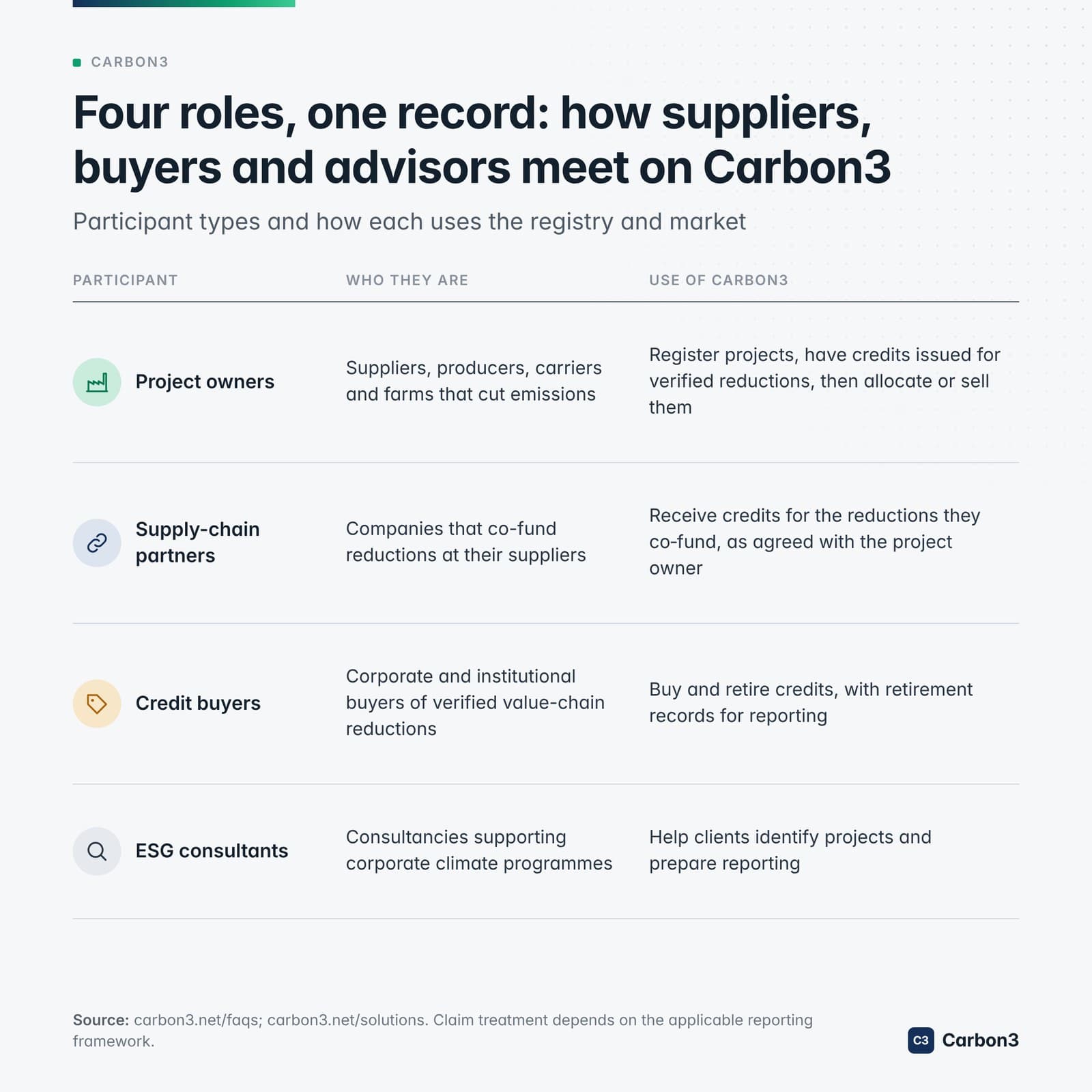
The Carbon3 platform has four participant types. Each uses the registry and market differently.
- Project developers. Suppliers, producers, carriers and farms that reduce emissions. They register projects, have credits issued for verified reductions, then allocate or sell them.
- Supply-chain partners. Companies that co-fund reductions at their suppliers. They receive credits for the reductions they co-fund, as agreed with the project developer.
- Credit buyers. Corporate and institutional buyers of verified value-chain reductions. They buy and retire credits, and receive retirement records for their reporting.
- ESG consultants. Consultancies supporting corporate climate programs. They help clients identify projects and prepare reporting.
One serialized record, from issuance to retirement
What the four have in common is the record. All of them work from the same serialized record of verified reductions, from issuance through to retirement.
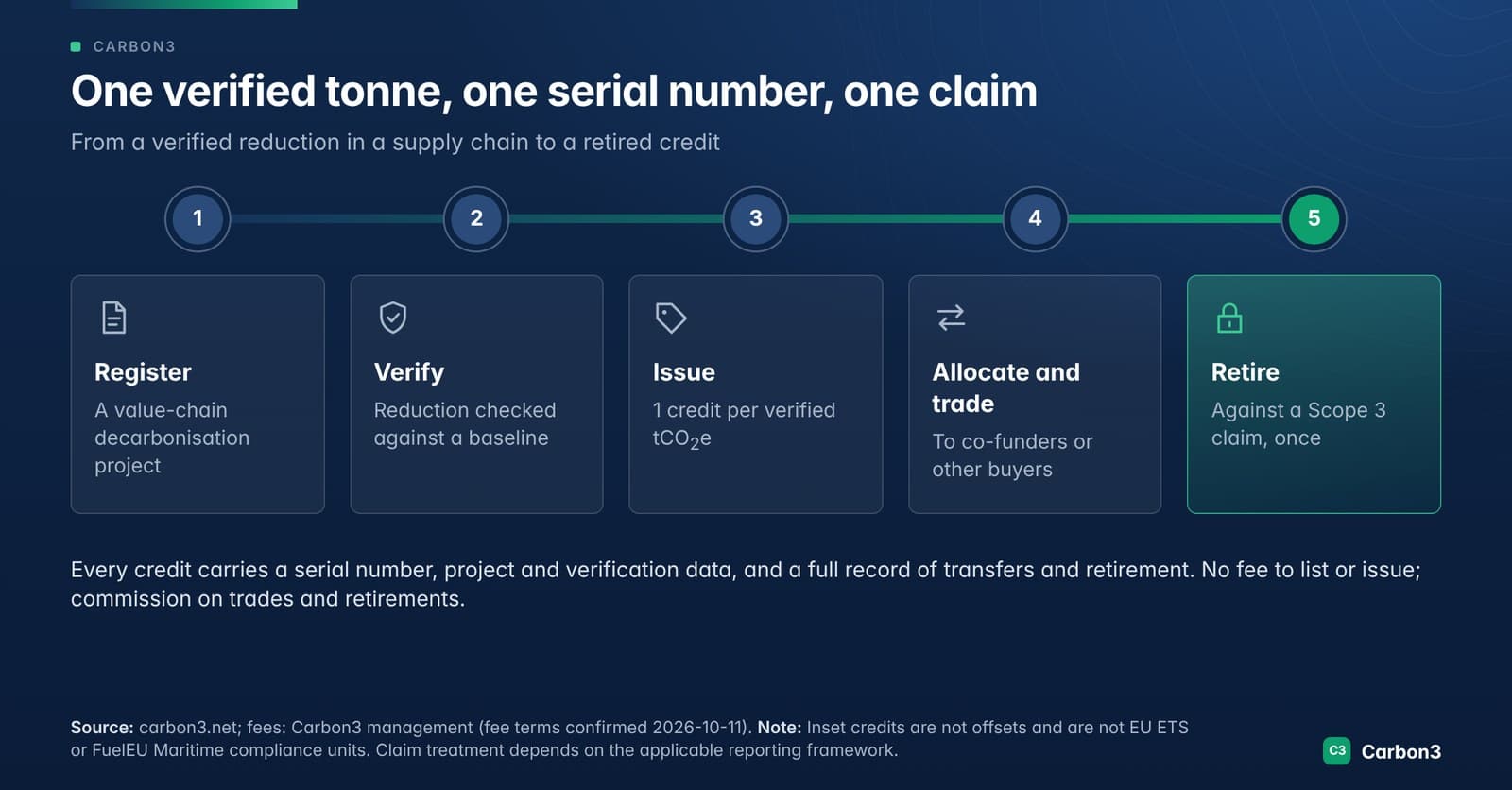
The project developer issues the credits, and Carbon3 records them on its registry, each with its own serial number. When credits are allocated to co-funders, sold to a buyer or retired, that step is recorded against the same serial numbers. A buyer can see where a credit came from, a supplier can see where its credits went, and a consultant preparing a report can point to one trail rather than reconciling separate spreadsheets.
That shared record is what keeps a reduction from being counted twice. Once a credit is retired, the record shows it as retired, and it cannot be retired again by anyone else. Claim treatment depends on the applicable reporting framework.
Why a shared record matters for insetting
Insetting means supporting emissions reductions inside a company's own value chain, such as a supplier switching to lower-emission energy or a carrier using cleaner fuel. Unlike offsetting with projects outside the value chain, insetting usually involves several parties around the same reduction: the supplier that makes the change, the customers that help pay for it, and the advisors that help account for it.
Each party has its own reason to care about the result. The supplier wants recognition for the change it made. The co-funders want evidence that their money produced the reduction they were promised. The consultant needs data that will hold up in a client's report. When each party keeps a separate version, those reasons pull the records apart. When all of them work from one record, the same reduction reads the same way for everyone.
A simple fee structure
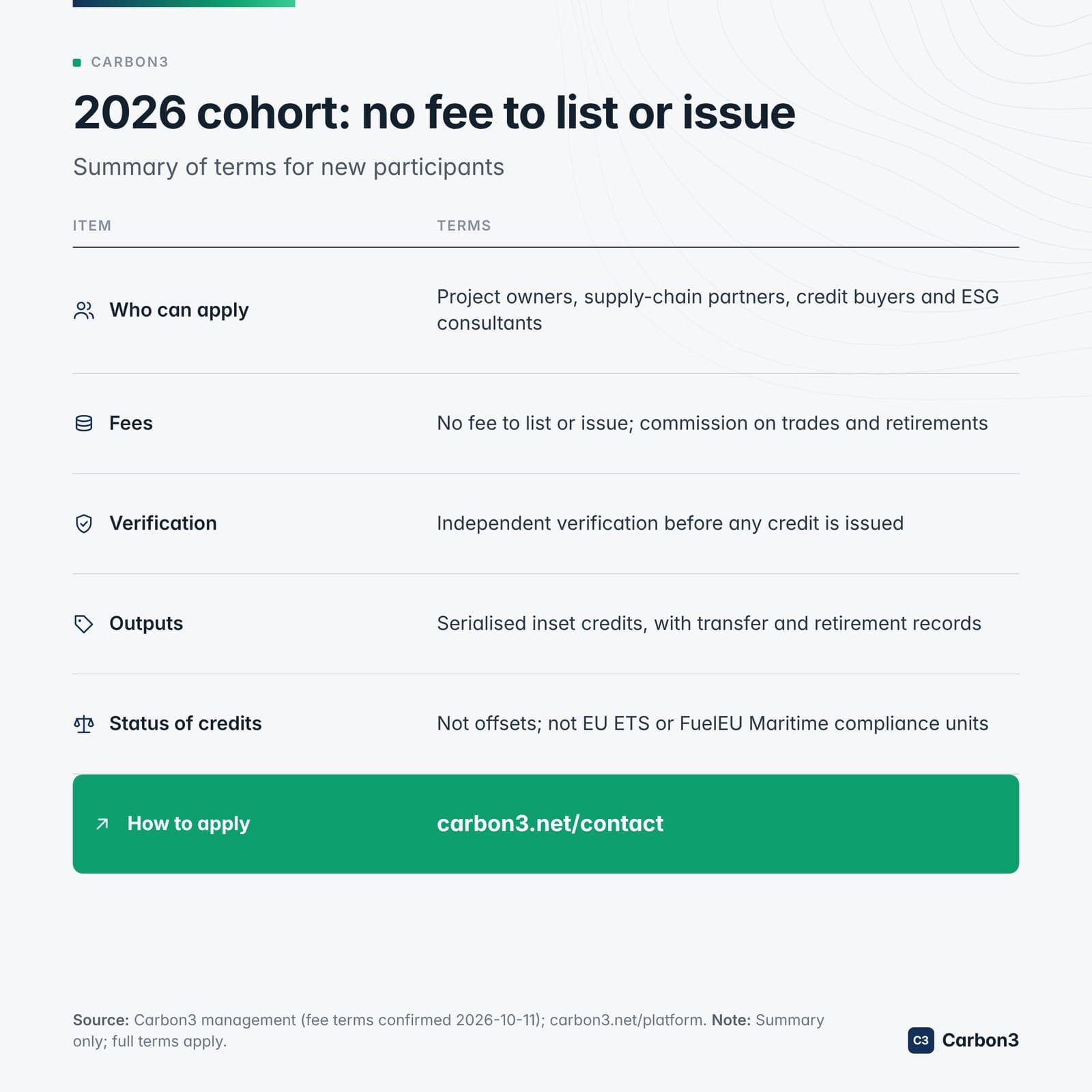
Carbon3's fees are simple. There is no fee to list a project or to issue credits. A commission applies on trades and retirements, so the cost arises when credits change hands or are retired.
For project developers, that means registering a project and having its credits issued carries no upfront platform cost. For buyers and co-funders, the fee is tied to the transactions they actually make.
Source: Carbon3 (carbon3.net FAQs and solutions pages).
Originally published on LinkedIn, 19 October 2026.
The Carbon3 Newsletter
Weekly analysis of industrial decarbonization and insetting across Scope 1 to 3, from the Carbon3 team.
Read more from the research team.
Product
We built a global insetting market and simulated it end to end
Supply-chain decarbonization is a financing problem.
Read the articleProduct
One verified tonne, one serial number, one claim
The five stages a reduction passes through on Carbon3, from supplier project to retired credit, and the record each stage leaves so the same tonne is never claimed twice.
Read the articleProduct
Applications are open for the Carbon3 2026 cohort, with no fee to list or issue
The 2026 cohort is open to project developers, supply-chain partners, credit buyers and ESG consultants.
Read the article
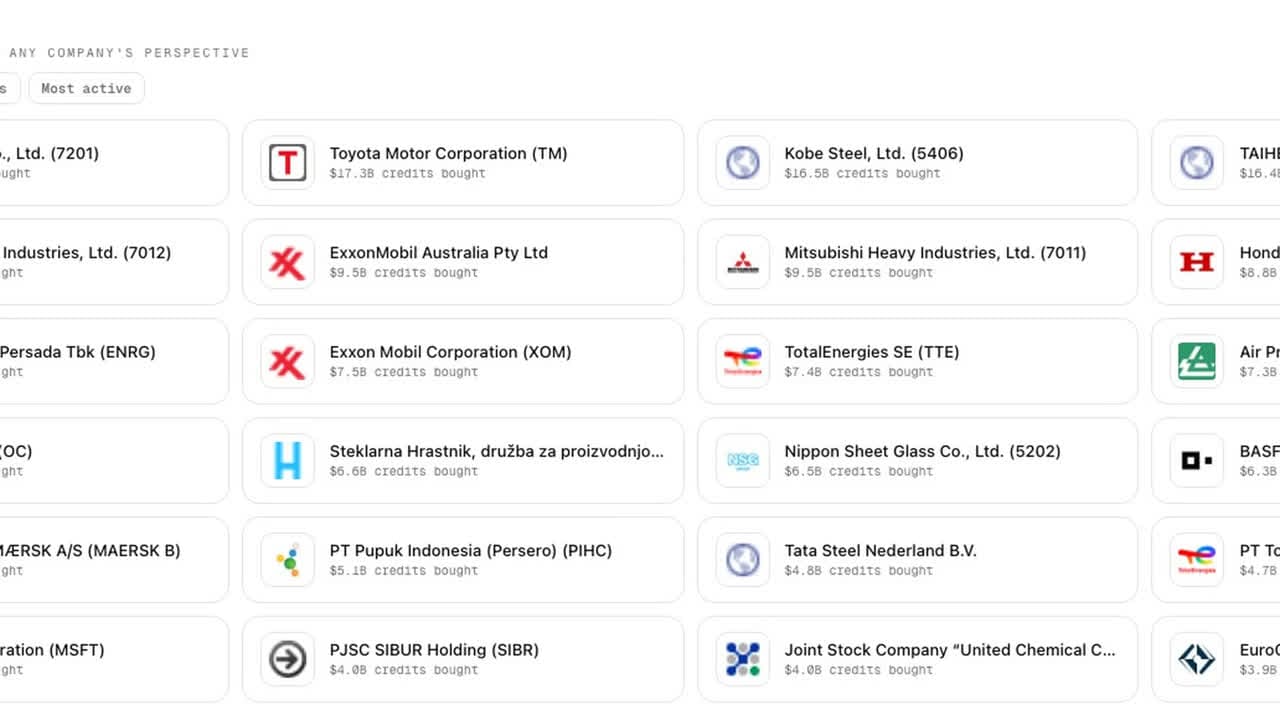
See the companies behind these figures in the Data Hub.
Look up your suppliers’ emissions and targets, free.